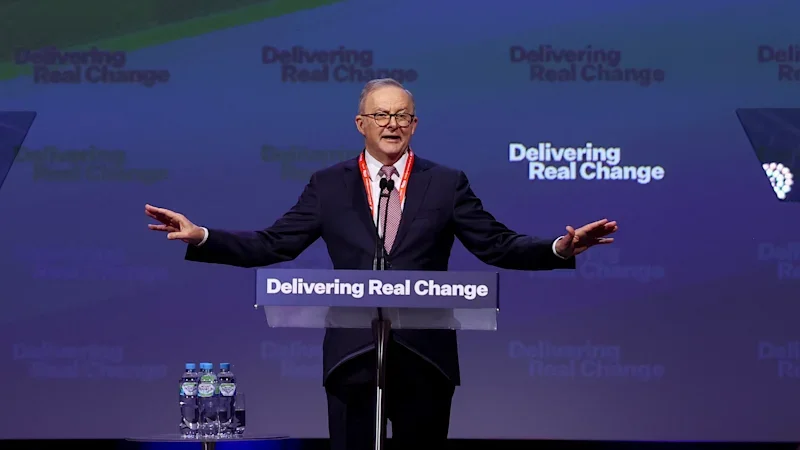
Anthony Albanese arrived in Adelaide to celebrate Labor’s dominance. He left having demonstrated something almost as valuable: command of the party itself.
The only significant challenge to the carefully choreographed unity of Labor’s 50th national conference never made it to the stage.
As former cabinet minister-turned-rebel backbencher Ed Husic attempted to force a debate over Israel and Palestine, factional leaders moved quickly to prevent the resolution reaching the floor. A Maritime Union official expected to second the motion withdrew, while delegates supportive of it were urged not to back it.
It was a familiar display of factional discipline, deployed in service of a modern ALP objective: eliminate the disagreement before it becomes tomorrow’s headline.
For the prime minister, it represented another demonstration of the authority he has accumulated since his emphatic election victory last year. But Husic’s intervention clearly got under his skin.
Albanese worked the media daily during the event but avoided a formal press conference, instead relying on two carefully crafted speeches.
On the final day, he appeared unannounced in the media room and complained in front of about 30 journalists that the press pack would make the conference “all about Ed”.
“I think I know the Labor Party better than whoever you’ve been speaking to, and I don’t even know who they are,” he snapped, determined to frame Husic as a loner without any institutional backing. “Four hundred delegates, and he couldn’t find a seconder.”
Under Albanese, Labor has entered its second term with a stability that once seemed impossible for a party renowned for internal conflict. Having watched previous leaders consumed by internal warfare, the prime minister has no desire to repeat those mistakes. This week that strategy worked.
The ideological battles, factional warfare and messy amendments that once defined Labor gatherings were largely absent. Potentially explosive debates were negotiated away before delegates entered the hall. Ministers spoke with one voice. The platform passed with minimal drama.
Outside the Adelaide Convention Centre, protesters raised concerns from AUKUS and Palestine to gambling harm and nuclear proliferation. Fringe events featured complaints about the lack of deeper debate on issues including the US alliance and an Australian republic.
Albanese’s discipline has not been manufactured; it has been earned. But dominant leaders can also become insulated leaders.
The handling of Husic’s intervention exposed a tension at the heart of Albanese’s Labor: whether unity is strengthening the party’s argument with voters, or simply avoiding arguments within the party itself.
That question matters as Labor confronts the rise of One Nation and a broader global wave of populism.
Husic suggested his actions were about more than the Middle East. It was about the challenge confronting major political parties in an era when voters increasingly feel disconnected from institutions.
“We have a competitor that a lot of people talk about now that is energised,” Husic told reporters. “It’s attracted a lot of members. They feel their party listens to them, and they’re attracted by the idea that this is a party that will stand up for what they think is right for the country.”
His broader warning was aimed squarely at Labor’s political future.
“I think the big test for us as one of the big parties is to be able to show that we’re willing to take stands on issues and to also bring people along with us and not jam the lines of the day into people’s ears, but convince people.”
Husic’s argument raised the bigger question of how a governing party can maintain discipline without losing the ability to listen, debate and persuade.
It is a question Labor has been grappling with as it confronts One Nation. Throughout the conference, Pauline Hanson and her party were repeatedly invoked as the next great political challenge.
Albanese argued in his opening address that the Coalition and One Nation were increasingly aligned.
“Beyond One Nation’s personality clashes, policy confusion, conspiracy theories and candidate chaos,” he told delegates, “and regardless of who leads the Liberals to the next election, in every way that matters, the Liberals, Nationals and One Nation are already a coalition.”
Former treasurer Wayne Swan framed the contest in Labor’s traditional language of struggle.
“Together with our mighty trade union movement we fought Fraser. We fought Howard. We fought Abbott. And now we watch the conservative mantle pass to One Nation, and a new battle awaits us,” he said.
But experienced union leaders warned on the sidelines that populist movements do not emerge in a vacuum. They prosper when voters believe established political institutions no longer represent their concerns or address their economic circumstances.
Several wise heads privately observed that the conference spent far more time discussing the political challenge posed by Hanson than the economic frustrations that help fuel it. It was the striking omission of Adelaide.
For three days, Labor debated fairness, redistribution, workplace protections and expanding government services. Far less attention was given to the harder question underneath those ambitions as to how Australia creates the wealth required to sustain them.
The most significant economic warning from a Labor figure this week came not from the conference floor, but outside it.
Former ACTU secretary Bill Kelty, one of the architects of the Hawke-Keating economic reforms, delivered a stark assessment of Australia’s economic condition.
He said the OECD’s finding that Australia had suffered one of the biggest falls in real wages since 2021 was “hard to comprehend” and a “sad reflection in this nation”. Kelty warned Australia’s productivity had fallen, investment was too low and per capita growth was “non-existent”.
It echoed concerns from economists about Australia’s longer-term trajectory. But inside the conference hall, productivity remained an uncomfortable subject.
The economic debate passed without serious contest. There was little argument about how to encourage private investment, lift productivity or restore the growth rates that historically allowed governments to improve living standards.
That tension sits at the centre of Labor’s current political project, with history having repeatedly shown governments cannot indefinitely redistribute prosperity that is no longer being created.
Swan warned Labor against what he called “antiseptic centrism” and “incrementalism”, arguing voters wanted conviction over caution. Albanese this week proudly boasted his government occupies the “radical centre”.
“Our first task is not to talk. It is to listen,” Swan says. “Right now, people are pessimistic. They are carrying an unprecedented cost of living, and they despair at the behaviour of their leaders across the Western world.
“We will only earn their support if they believe we are genuine local champions who understand what their community actually wants.”
Labor figures privately say they understand the danger. Their repeated focus on One Nation throughout the conference showed that. But the harder question is whether the party has the courage and ability to address the conditions that allow such movements to grow.
Albanese has succeeded where many Labor leaders before him struggled. He has united factions, disciplined the caucus and turned a once-chaotic conference into a demonstration of political strength.
“In my view this is the most purposeful and united national conference I have attended since I joined the Labor Party,” he told delegates in his closing speech.
But conferences are easier to control than economies, and Labor’s challenge after Adelaide is not simply defeating One Nation at the ballot box. It is convincing voters that the mainstream political system can still deliver the future they want.
Go deeper on Labor’s national conference
- How day one of the conference played out in Adelaide:Follow our reporters on the ground
- What the PM said:Albanese’s speech on cost of living and One Nation’s rise
- $1000 to see Tony Burke rock out?Labor’s sideline fundraiser for lobbyists
- Gambling donations revealed:How Labor collected more than $4m in five years
- What flag fight?Albanese is remarkably good at making arguments disappear