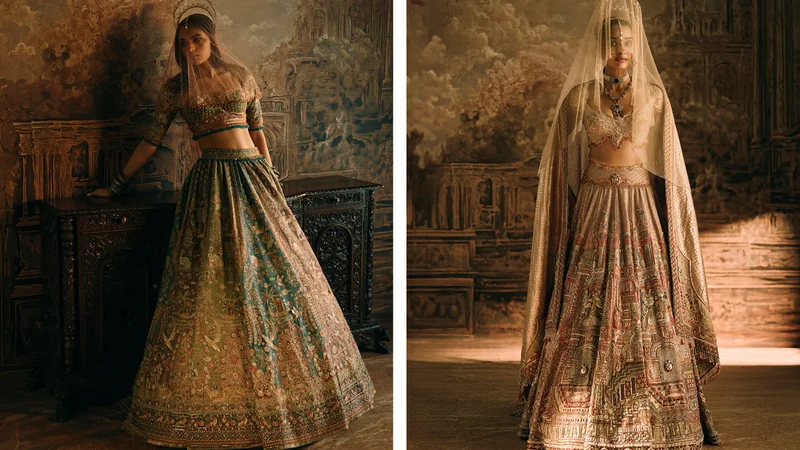
Context, in Tarun Tahiliani’s universe, is as carefully constructed as a corset. That instinct has long set him apart. Long before “immersive experiences” became the Indian fashion industry’s favourite phrase, Tahiliani, 64, was inviting editors to spend time in his studio before a show, walking them through the process rather than merely the finished product.
For his 25th anniversary, he transported guests to the Qutub Minar after opening the doors of his atelier. For his 30th year, he turned Hyderabad into an extended meditation on India Modern, beginning with a lecture in the famed Jade Room at the Taj Falaknuma Palace before moving to the restored British Residency, where architecture, AI projections, history and couture folded into one another. In the closing segment, the narration of Where the Mind is Without Fear by Rabindranath Tagore brought Tahiliani’s unifying vision into focus.
Now, as India Couture Week returns, Tahiliani is abandoning the conventional runway yet again. Instead of the familiar blur of a seven-minute spectacle, Navaratna, his presentation at Bikaner House, invites guests to slow down.
Stop and stare
“There are just 12 outfits on the ramp,” he says over a morning phone call, days before the show. “People can come in between 5 p.m. and 8 p.m. There won’t be that crush that is often the case at couture week. “Those dozen looks will move continuously through a central hall while visitors wander through nine galleries housing more than 50 mannequins, multimedia installations and projections. Rain sounds drift through some rooms. Percussion fills another. One gallery is draped entirely in beige flowers. Rather than catching a glimpse of embroidery as a model disappears backstage, viewers are encouraged to stop and inspect.
“The models go by at the usual fashion show and how much do you see?” he asks. “This way you can take your own time and stand and stare at the detailing.” The presentation feels like the logical extension of Tahiliani’s lifelong obsession with storytelling. Every collection of his has carried echoes of India’s layered cultural inheritance — Mughal clothing, miniature paintings, architecture, temple details, draped textiles, Banaras, Kutch, the Kumbh — refracted through what he has spent decades calling “India Modern”. Never nostalgia and certainly not costume. “I always have references from the miniatures or Mughal clothing,” he says.
Evolution over revolution
Tahiliani’s philosophy has matured over three decades. At his Hyderabad anniversary showcase in January, he traced Indian fashion as a continuum: draped textiles, Central Asian embroidery introduced through the Mughals and British tailoring eventually coalescing into a distinctly contemporary vocabulary. Evolution, rather than revolution, has become his refrain.
“We don’t have to be something we are not,” he says now, referring to fabrics and construction techniques abroad that have not come here yet. “We still want drape. We still want fabrics. A lot of women still want to wear a beautiful lehenga. We keep evolving that.”
That idea extends to the body itself. Years before conversations around size inclusivity became commonplace in luxury fashion, Tahiliani was celebrating generous curves. His playful “tashreef bustle”, unveiled during ‘30th years of TT’, exaggerated the hips rather than disguise them. He says they were especially popular among his skinny clients. “You can borrow it anytime you want to be super voluptuous,” he chuckles. “Just zip it up and drape over it and you have the hottest rump.”
Tricky corsets, Kumbh hair
This season, Tahiliani is turning his attention upward. “We’ve been working on these corsets that come down to the hip,” he says, sharing work in progress photographs on WhatsApp with me. Sculptural bodices, one in cream, another in black, create an almost stone-like torso, a contrast to the fluidity below. “You can drape beautifully on them. Almost like a stone statue,” he says, then lets out a laugh.
“You’ve always got to have a little trick up your sleeve and have fun.”
The wit has never disappeared from his work. The “tashreef bustle” amused guests in Hyderabad. This time, the models’ hair borrows from the ascetics of the Kumbh, transformed by a French hairstylist into something, as Tahiliani happily predicts, “insane”.
“If someone walked into a wedding dressed like this,” he says, “I would pass out from the sheer joy.” But the humour masks a more serious point about beauty. He recalls walking through Tiruvannamalai in Tamil Nadu, and being struck not by wealth but by the authenticity in this spiritual centre: women tending tea stalls, sadhus, shining skin, flowers tucked into hair, silk, gold and kohl.
“Who says that some Western idea of beauty is better than ours?” he asks. His frustration is reserved instead for excess masquerading as luxury. “The emeralds at our weddings have become so big that if the brides leaned out of a window, they might fall out.” It is a classic Tahiliani observation: irreverent and pointed.
Wearable clothes, please
The conversation turns naturally to Paris couture, where he had recently watched collections from houses he continues to admire. “I saw some beautiful things and some scary things too,” he says. “I don’t see why people do that in a show. What is the purpose? Showing fantastical clothes that no one can wear? Send it straight to a museum.”
He lights up instead when discussing conceptual presentations such as Viktor & Rolf’s theatrical experiments and the sensuality of Dolce & Gabbana Alta Moda, their couture universe rooted in Italian culture. “We must keep pushing the boundaries,” he says, “so that eventually translates into a fantastic experience for the wearer.”
That emphasis on the wearer has quietly defined Tahiliani’s career. He has often argued that brides should not have to suffer beneath kilos of embroidery. Technical innovation, for him, is useful only if it makes garments lighter and more pleasurable to inhabit.
His own body has made that philosophy newly personal. Last year, he underwent a hip replacement just before fashion week. Weeks ago came another operation on his heel, complete with screws and enforced weeks in a wheelchair. “I call myself the Bionic Man,” he says, laughing. “I set off alarms at airports.” He returned to work within two days of both surgeries. “The only way I can forget the pain is to work.”
Where Iyengar yoga meets AI
Tahiliani’s mornings always begin before dawn. Now it’s gym first, then Iyengar yoga. And sketching. By 7.15 a.m., he is out of the house “like a good boarding school boy”.
“I take all this [attention to health and self] super seriously,” he says. “If you want to work, if you want to travel and you like what you do, then this has to take priority over everything else.” That discipline perhaps explains why, even after three decades, Tahiliani seems less interested in resting on legacy than adding chapters to it.
Artificial intelligence? He has completed courses, subscribes to ChatGPT and distributes printouts to different departments. “It’s for efficiency,” he says quickly. “Not for design.” That said, clients have begun arriving with AI-generated sketches. His teams use the technology to visualise colourways and reduce wastage, but creativity, he insists, remains resolutely human.
Likewise, expansion only interests him if it feels authentic. A watch collection with Nebula by Titan is coming soon. A fragrance line arrives later this year after a decade of development, inspired by ginger lily that blooms during Mumbai’s monsoon and the elusive scent of petrichor. “Smell has the deepest emotional connect,” he says.
Bikaner House sets the stage
The thread, whether perfume, couture or architecture, remains a search for contemporary Indian luxury that neither imitates the West nor freezes India inside nostalgia.
He still speaks with admiration about understated Indian elegance, whether in historic buildings, Oberoi hotels or women styling a simple length of chiffon with flowers and kohl.
And perhaps that is why Bikaner House feels like such an apt stage for Navaratna. Tahiliani has always preferred places with heritage and stories. Buildings where proportion, craftsmanship and history already exist. “I just like the proportions of these historical buildings. When I was building my farmhouse I said this is like the Lutyens house I grew up in and I want to be connected to my past. I don’t want something that looks like an airport terminal with Italian marbles or ceilings.”
I ask him about his term India Modern being freely used by other designers and campaigns. “I don’t care. We are all Indians and we are going to be inspired by the same thing over different times. Take the ‘Indian goddesses’ being seen on runways, for instance. The problem today is that designers keep hiring away people from my studio. Such people begin replicating and they start to look derivative. Suddenly they have no point of view.”
Tahiliani has often talked about how art influences his fashion. He has been known to spend European holidays sketching in front of the largest sculptures in museums in Copenhagen and Milan. Take into account that the artist Anjolie Ela Menon used to paint in his parents’ garage, and you will see why there is more to the Anjolie Ela Menon printed T-shirts in his latest OTT collection. And why the campaign for this collection has been shot against the Khajuraho temple backdrop. Yes, Tahiliani delights in gentle irony and exceptional craftsmanship and his audiences can expect to see much of both with Navaratna later today.
Published - July 26, 2026 12:58 am IST