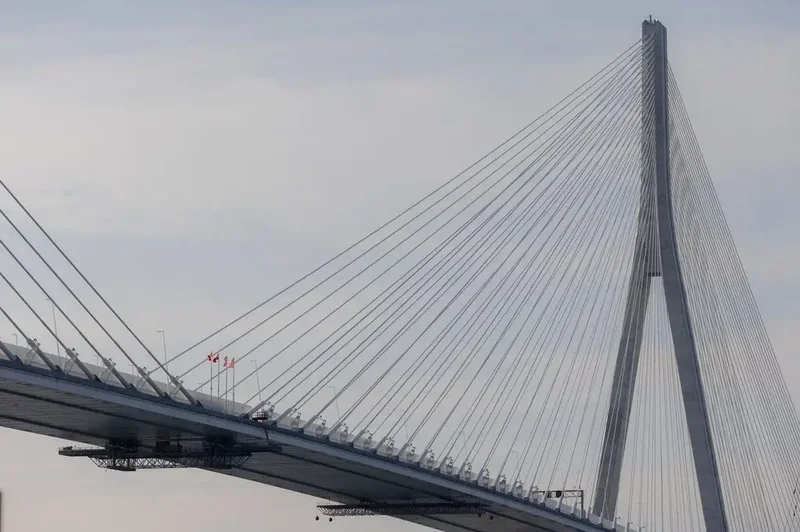
Canadian manufacturers are already losing U.S. orders as businesses brace for President Donald Trump’s latest tariff threats, even as the Gordie Howe International Bridge prepares to open Monday.
William Pellerin, an international trade lawyer, told Global News on Saturday that some Canadian companies report already feeling the effects of Trump’s proposed 50 per cent tariff before takes effect Aug. 19.
“We’re already speaking with a large number of clients who, because of this tariff threat of 50 per cent that would come into force next month, are already losing massive orders to their U.S. customers,” Pellerin said.
Trump threatened the tariffs on certain Canadian goods last Sunday, along with another 10 per cent tariff affecting goods outside the Canada-U.S.-Mexico Agreement.
Pellerin said the proposed 50 per cent tariff would make many Canadian products too expensive to compete in the U.S., particularly in sectors such as furniture and electronics.
“A 50 per cent tariff really makes those Canadian businesses uncompetitive in the United States,” he said.
He said the uncertainty alone is already affecting employers, with U.S. buyers pulling back over concerns they could soon face significantly higher costs.
Get breaking National news
“We’ve already seen some layoffs by Canadian manufacturers just because of that threat,” Pellerin said.
Furniture and wood products could be among the hardest-hit sectors, with manufacturers in smaller communities depending heavily on exports to the United States.
“A lot of these furniture manufacturers are often two or three hundred jobs in a small rural town somewhere,” he said. “This is going to shut down Canadian towns altogether. So we’re hearing the word ‘catastrophic’ from some of our clients.”
The latest tariffs threats are part of an escalating trade dispute between the two countries following Canada’s retaliation against previous U.S. tariffs.
Pellerin said Ottawa’s immediate priority should be returning to the negotiating table before the tariffs take effect, while also moving ahead with legislation aimed at strengthening Canada’s forced-labour rules.
The trade uncertainty comes as the Gordie Howe International Bridge prepares to open Monday, creating another major commercial crossing between Canada and the United States.
- Alberta premier says she won’t retaliate Trump’s latest threats with alcohol ban
- Calgary’s Nose Hill parking lot, pathway closed as search continues for Parker
- Canadian intern at NATO military HQ arrested in Belgium on spying charge
- More than 250,000 people flee their homes in France and Spain as wildfires burn
As it stands, the agreement states that Canada will share 50 per cent of net toll revenues with the U.S. during the bridge’s first 15 years, with the money going toward economic development on the American side of the border, according to the government of Canada.
Trump’s post on his Truth Social platform came during a ribbon-cutting ceremony being held by Canadian officials in Windsor last Sunday to mark the opening of the new bridge to Detroit, which is officially set for Monday.
“Canada disinvited the United States of America to the opening of the Gordie Howe Bridge, which is fine, considering they are paying substantial TARIFFS to the United States,” Trump wrote.
“The original Deal on the Bridge, which was terribly negotiated by a previous Administration, no longer stands. We changed the terms of the Deal so that the United States of America now gets 50% of the Profit.”
Despite the recent tensions, Housing and Infrastructure Minister Gregory Robertson said the two countries continue to have a strong working relationship.
“There’s times when the elbows get up a bit… but we come out of this stronger and we’ve got a beautiful bridge here that’s going to serve Windsor in Detroit, Canada and the U.S. for generations to come.”