The Green Party wants a one-year pause on consents for new AI data centres, until stronger rules and regulations are put in place.
It comes after New Zealand's first AI factory moves closer and closer to reality.
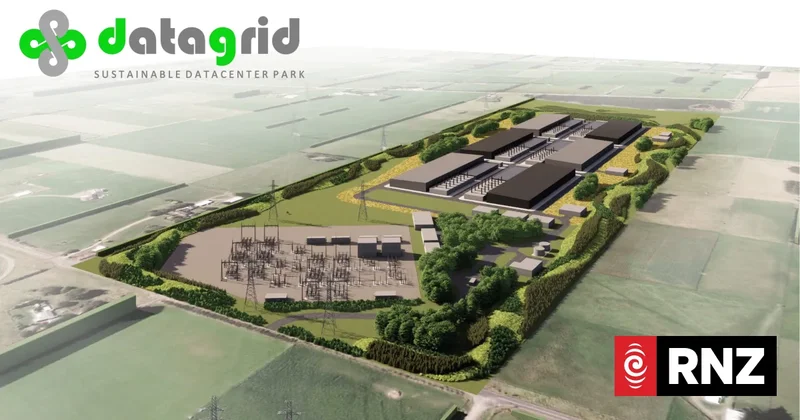
Singapore-based company Datagrid has been given resource consent to develop a new $3.5 billion data centre in Southland.
The 78,000 square metre factory in Makarewa would use 280 megawatts of power, making it the second-largest electricity user behind the Tiwai Point aluminium smelter.
Its consents would include the ability to draw more than 600,000 litres of groundwater every day, although Datagrid has been adamant it will not use any groundwater, preferring Invercargill's naturally cool air temperatures, and rainwater when needed.
Mercury Energy has recently announced a $53 million investment for a 12.7 percent minority equity stake in Datagrid NZ, following the signing of a 140 megawatt power purchase agreement in March.
But Green Party co-leader Chlöe Swarbrick said the rules on data centres needed to be written before any concrete was poured.
"Some may argue these AI data centres could build their own renewable energy, or that they're increasingly using closed-loop water cooling systems. That may well be the case, but our current rules don't require any of those things," she said.
"New Zealanders haven't even had the opportunity to discuss and decide whether they want them."
Swarbrick said the Datagrid centre was expected to use about six percent of New Zealand's total electricity supply.
She insisted the moratorium was not a ban on data infrastructure, but a pause on the most resource-intensive developments until intentional regulation was developed.
"Currently, councils get to decide through their planning rules whether to consent these developments. These can be on a non-notified basis with no public input required.
"As other cities and countries are quickly discovering, you can't put that genie back in the bottle. Let's take a moment to figure out the right way to do this."
The Australian government recently announced it would establish an 'Office of AI' within the Department of the Prime Minister and Cabinet, to manage the development of AI standards and force data centres to be net producers of energy and to limit their water usage.
Swarbrick pointed to the Australian example, as well as New York's pause on new hyperscale data centres until a framework was developed, as reason for New Zealand to be cautious.
"If an AI data centre project does not meet basic standards for power, water use, and environmental impact, why should we allow it to be built here? Anyone who argues the opposite needs to explain why New Zealanders should shoulder the cost of something they didn't get any say on."