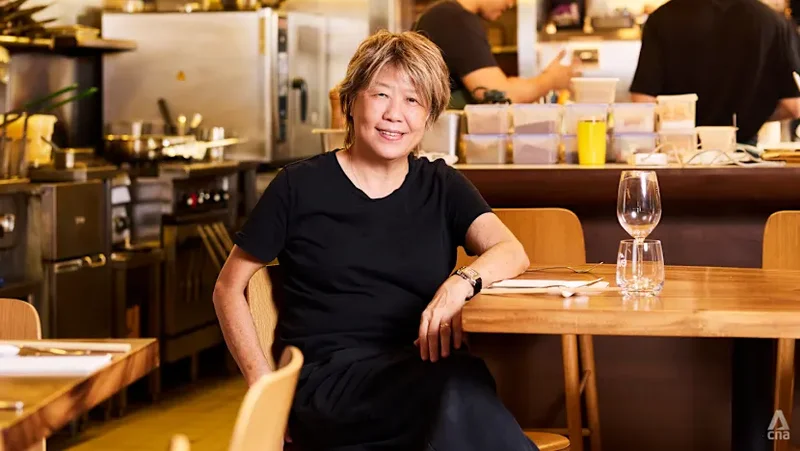
She sold her house to save Mag’s. Nearly 30 years on, the Singapore restaurant is still evolving
Magdalene Tang turned a Circular Road wine bar into one of Singapore’s enduring independent restaurants, weathering financial crises, changing dining habits and the pandemic along the way.
Mag’s executive chef and owner Magdalene Tang may come across as gruff at times, but her tough exterior belie a hospitable heart who loves making people feel at home.
Tang opened the restaurant as Mag’s Wine Bar Bistro on Circular Road in 1996. The 64-year-old former forex trader said: “I’ve always been intrigued by wines and collected them, so I opened the restaurant as a place for others to enjoy what I personally love.”
When the 1997 Asian financial crisis hit and her partners pulled out, Tang sold her house to take over the business. She later renamed it Mag’s Wine Kitchen to reflect its focus on food and wine.
She said wryly: “I could have gone back to being a forex trader or a private banker, but I’m not very good at sucking up to people. You can say I really, really love this business.”
INTO THE HOT SEAT
With no prior F&B experience, Tang began voraciously reading books on wines and practising the pronunciation of French wine labels until they rolled smoothly off her tongue. She didn’t think twice about asking her then chef how she could improve her culinary skills while she experimented with magazine recipes, adding dishes such as prawn pasta, beef stroganoff, fish and steak to the menu.
She deadpanned: “For a while, we were a one-meal kind of restaurant where you come to drink and eat whatever I cooked that day. You don’t like [my cooking], don’t eat.”
In 2019, the restaurant moved to Keong Saik Road and introduced a more refined menu. In September 2025, it relocated to a two-storey shophouse at 82 Neil Road and shortened its name to Mag’s.
Head chef Ian Tan joined Mag’s in 2024. His wafu-style cooking combines Japanese flavours and techniques with local and European influences. Signatures include lobster risotto and cold capellini with uni, while less expected creations have included puffed rice with abalone and crab paste, and perilla oil noodles with bafun uni and toasted seaweed.
The extensive wine list features Burgundies such as a 2005 Domaine Leflaive Batard-Montrachet Grand Cru and a 2012 Dominique Laurent Grands-Echezeaux.
As one of the few wine-focused venues in the 1990s, Mag’s had enjoyed brisk business with healthy profit margins. Their wines were sourced directly from London brokers and auction houses and were bottles that weren’t available through most Singapore distributors at that time, said Tang.
She also co-owned the now-defunct Oenotheque by Wine Universe at Millenia Walk from 2009 to 2011.
“It was not difficult to sell wines then because there was no such thing as Google. The ones who knew the most were the ones who read the most,” she said.
“For example, we sold a 1989 Jean-Louis Chave Hermitage at S$160 (US$124). If you were following the region through Decanter or Wine Spectator magazines back then, you’d have snapped a wine of that calibre without hesitation, even in 1997.”
By 2005, the wine-bar business had changed as customers could buy directly online from London merchants such as Cru World Wine and Corney & Barrow. Pricing became transparent and customers increasingly preferred to bring their own bottles. Tang decided to maintain “a very strict corkage policy” of S$65 per
WEATHERING THE DOWNTURN
While there have been valleys on this journey, the tenacious Tang recalled only crying over the business once. When the Singapore Government announced that circuit breaker measures would start on Apr 7, 2020 and that all in-person dining would be replaced by takeaways and deliveries, her worst fears were confirmed.
She said: “Lockdown had already happened in the US and I was following the news to see what restaurants were doing. I knew that it was a matter of time before it would happen to Singapore. I told my staff then to start thinking about high-end bento boxes and other similar food items, but they laughed and thought I was nuts.”
When her prediction came true, she was so angered by the team’s earlier nonchalance that she lashed out at them. A few days later, after cooling down, she wrote a personal letter to each employee, apologising for her outburst and assuring them that they would not lose their jobs.
Tang reached out to her circle of friends to drum up orders and came up with innovative meals that could be easily put together at home. She personally delivered the orders and assured her customers that they could video-call her anytime for guidance.
“That period taught me how to be resilient and how to treat your staff well, because you’re not the only one panicking,” she said.
Ironically, while the restaurant broke even during the COVID-19 pandemic and the Sars outbreak, it went into the red in 2024.
“With what is happening to the industry now, it’s very heartbreaking for me to work so hard and not be able to achieve what I previously did. Profit margins were a lot better from 2000 to 2015, when the costs of rent, labour and produce were lower and the quota of foreign employment was less restrictive,” Tang said, candidly.
“Intense competition within the F&B industry has made it difficult to raise prices accordingly. So we’ve absorbed much of these rising costs to remain competitive and to continue offering value to our customers.”
She also laments the lack of grit in the younger generation, saying: “They only want to do the things they want, but they don’t learn the business. Being a manager is like following a textbook, someone asks you something and you flip to the page with the answers. But understanding the business, your customers and the psychology of pricing is very important for survival.”
Still, she trains them to be proactive, with room for them to make mistakes. “I don’t micromanage them unless they go overboard,” she said.
Business has improved since Mag’s moved to Neil Road. Tang said “weekends are very busy and weekdays have also been strong, particularly with corporate events”. The second-floor private dining room, which seats 18 or accommodates up to 30 standing guests, receives six to seven bookings a month.
Tang said: “Interestingly, we seem to be attracting many of the same customers who frequented Mag’s 1.0. During the weekdays, we often see brokers, bankers and lawyers returning, while Fridays and Saturdays tend to bring more families, friends and couples. We also have a counter by the kitchen that we affectionately call ‘The Friends Table’, where solo diners and regulars can enjoy a meal while catching up with Ian or me.”
While she finds that “we live in an age that too often rewards the cheap and fleeting over the considered and enduring”, she tries to stay true to her belief of serving diners good ingredients and wines.
“It all comes down to honest hospitality, honest food, and being unpretentious,” she said. “We call it ‘Mag’s hospitality’.”