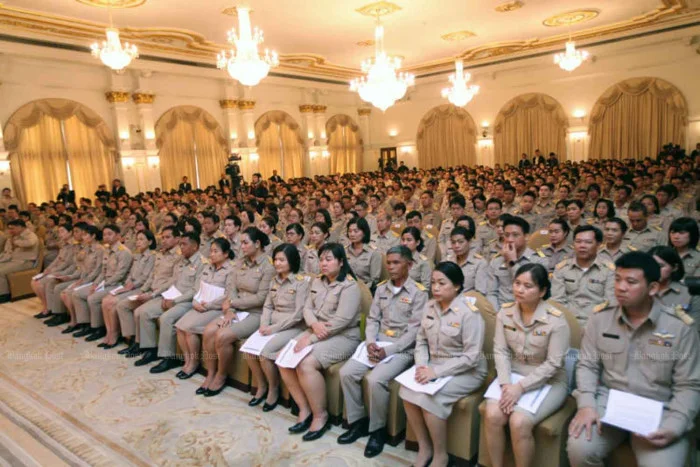
The government plans to reduce the public workforce from three million to two million under civil service reforms.
Deputy Prime Minister Pakorn Nilprapunt said public consultations on the proposed early retirement scheme are being held from July 22 to Aug 5. More than 8,000 comments were received during the first three days, with a summary of recommendations to be submitted to the cabinet in mid-August.
The government will also ask the cabinet early next month to approve measures freezing the overall number of civil servants, military personnel and police officers, whose combined workforce exceeds three million.
Mr Pakorn said vacant positions created through retirement or dismissal would be abolished where they are no longer necessary, while important positions would be retained following a review by the Office of the Public Sector Development Commission.
"By reducing the public workforce while keeping the same budget, the average salary and welfare benefits of civil servants who remain will increase, making public service more attractive to talented recruits," Mr Pakorn said.
If the restructuring proceeds as planned, the government would also be able to raise salary scales across the civil service.
The details of the early retirement package -- including eligibility criteria, lump-sum payments and pension arrangements -- are still being reviewed by the Office of the Civil Service Commission (OCSC), the Public Sector Development Commission, the Comptroller General's Department and the Budget Bureau.
Mr Pakorn said the government must balance financial incentives for participants with long-term fiscal sustainability.
Government spokeswoman Rachada Dhnadirek said the proposal remains under public consultation. More than 10,000 people have already participated in the ongoing consultation process.
She said the initiative aligns with the government's efforts to ramp up public sector efficiency while maintaining fiscal discipline, following parliamentary approval in principle of the fiscal 2027 budget bill.
Personnel expenses, healthcare benefits and pensions now account for more than 70% of recurring government expenditure, highlighting the need for long-term workforce restructuring alongside greater use of digital technology and more efficient public administration, the government says.
According to a source at OCSC, the public consultation focuses on key elements of the proposed early retirement scheme, including the target groups eligible to participate and financial incentives.
The proposed participants are divided into two groups: civil servants aged 50 or above, or those with at least 25 years of service, and those aged 40-49 with at least 10 years of service.
The consultation seeks opinions on whether participants from both groups should receive lump-sum benefits calculated at between eight and 12 times the relevant base amount.
It also asks whether government agencies should abolish positions equivalent to the number of employees joining the scheme.
Another issue is whether participants should be prohibited from returning to government service or becoming permanent employees in any public sector agency after receiving benefits.
The consultation also seeks views on allowing agencies to hire outsourced personnel at specified ratios to support digital transformation, such as allowing one outsourced worker for every five employees who join the early retirement scheme.
Pakorn: Workforce to be reduced