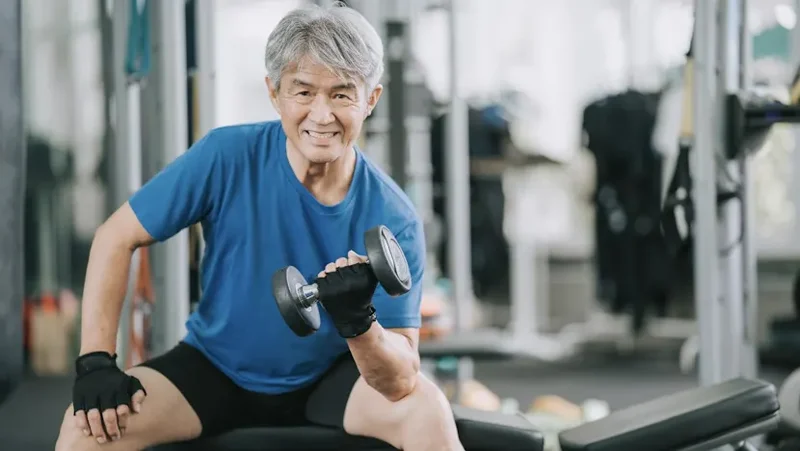
Why every senior should strength train – and it's not just to prevent falls
Weakening muscles don't only increase the risk of falls in seniors. A new study suggests sarcopenia may also reduce the body's cancer-suppressing ability. Here’s why strength training is one of the best things your parents can do – along with exercise demonstrations by a 77-year-old.
You are reminded of how time exacts its toll on the human body when you see the way your aged parents move. What were once robust limbs that carried schoolbags and groceries, and strode you to tuition and swimming lessons now falter at traffic crossings and staircases.
You start to notice Ma and Pa walking less steadily, how they shuffle rather than take regular steps. Even daily activities such as going to the market tire them more easily now. At home, you see them struggling to get up from a chair.
“Some people may also notice that they are moving more slowly or avoiding activities they used to comfortably do. Over time, these changes can increase the risk of falls and make it harder to stay active and independent,” said Dr Chen Shuyu, a consultant with Tan Tock Seng Hospital (TTSH), Department of Geriatric Medicine.
What you're seeing are the effects of sarcopenia or age-related muscle loss. And as Singapore’s population ages, more patients are being diagnosed with the condition. In fact, 60 per cent to 80 per cent of the patients at TTSH’s Falls And Balance Clinic are at risk of sarcopenia, said Dr Chen.
What’s also concerning is the age at which the falls start to occur. “I have seen patients as young as 65 years old admitted following a fall, which is at the younger end of the older adult age spectrum,” said Yang Wenshan, the principal physiotherapist at National University Hospital’s Department of Rehabilitation
To put things into perspective, senior physiotherapist Lee Yi Ting from TTSH’s Department of Physiotherapy, explained that after age 50, muscle mass naturally decreases by about 1 per cent to 2 per cent each year.
NEW STUDY FINDS SARCOPENIA AND CANCER LINK
Researchers have discovered a direct link between ageing muscles and cancer, according to a new Duke-NUS study published in April 2026.
Our skeletal muscles secrete anti-tumour messengers known as extracellular vesicles (EVs). Simply put, EVs are fat-wrapped packages of proteins, fats and genetic material that are sent between cells to share information, coordinate immune responses, and repair tissues.
EVs also secrete a micro-RNA molecule known as miR-7a-5p, which controls the types and amounts of proteins cells produce – and in effect, plays a role in restraining tumour growth.
Working with collaborators from Singapore General Hospital (SGH) and Cardiff University in the UK, the researchers found that sarcopenic muscles secrete fewer EVs. What’s more, the EVs produced contain lower levels of miR-7a-5p.
In other words, sarcopenic muscles don’t produce as much cancer-inhibiting EVs. And in those EVs produced, they don’t secrete enough tumour-suppressing signals.
The good news is, the team discovered that the muscles’ release of EVs can be reactivated through exercise.
“With advanced age, it is even more important to engage in regular resistance and aerobic exercises in order to maintain healthy muscle volume,” said one of the study’s authors, Dr Kenon Chua, a consultant with SGH’s Department of Orthopaedic Surgery.
Furthermore, sarcopenia’s progress is insidious. “The decline in muscle strength and function is often subtle, even to the person experiencing it,” said Dr Chen.
“For family members, the signs to look out for include needing to use both hands to push up from a chair, avoiding stairs or longer walks, walking significantly more slowly, becoming less confident with balance, or giving up hobbies because they feel they 'don't have the energy' anymore.”
HOW CAN YOU ADDRESS YOUR PARENTS’ PUSHBACKS?
You’re not alone if you’re facing resistance from your parents to exercise. Here’s a look at how you can counter the common excuses with facts from the experts:
"I'M TOO OLD TO EXERCISE"
The good news, said Dr Chen, is that it is never too late to start strength training. “With consistency and the right programme, older adults can improve their strength, confidence and balance, reduce their risk of falls, and most importantly, maintain their independence for longer.”
Lee described a patient who initially had to rely on taxis to attend her exercise programme. “After a few sessions, she excitedly told me she is now confident enough to use public transportation on her own. That is what functional strength training is about – helping seniors regain confidence and independence in daily life.”
"MY (INSERT BODY PART) HURTS"
Pain does not always mean you should stop exercising, said Dr Chen. “Appropriately prescribed exercise is one of the most effective treatments for conditions like knee osteoarthritis.”
The key, she said, is choosing the right exercises and adjusting the intensity – not avoiding exercise altogether. “In many cases, staying active helps reduce pain, and improves function over time.”
"I'M ALREADY BRISK WALKING / DOING TAI CHI / LINE DANCING / PLAYING GOLF"
Unfortunately, exercises that many seniors think are apt for them – brisk walking, line dancing and tai chi, for instance – aren’t quite hitting the mark where muscle growth and maintenance are concerned.
“Walking is great but it's not enough to build muscle or bone density, and it doesn't prevent the kind of strength loss that leads to falls and dependence,” said Davin Choo, a personal trainer and founder of Informed Exercise, who works with 20 seniors ranging from their 60s to 80s.
While tai chi, line dancing and golf are good for coordination and social connection, they don't build the muscle and bone density that protects against fractures and falls, he added. But don’t ditch what the seniors enjoy. “These activities can coexist. I actually encourage them to continue doing them,” he said.
"I CAN’T EVEN CARRY MY GRANDCHILDREN; WHAT MORE LIFT WEIGHTS?"
“That is one of the best reasons to start exercising,” said Dr Chen. “Regular strength training can improve your strength, stamina and confidence, making it easier to keep up with your grandchildren, and enjoy more meaningful moments together.”
“BUT I’M ALREADY DOING THE EXERCISES GIVEN BY THE PHYSIOTHERAPIST”
“This is a wonderful first step in the right direction,” said Dr Chen. “But if the exercises have become too easy, it may be time to progress them. Our muscles only become stronger when they are gradually challenged with increasing resistance or difficulty.”
WHAT SHOULD SENIORS BE DOING?
The words “strength training” may still conjure up images of bodybuilders in your parents’ minds. But that’s not what strength training means for seniors when the emphasis is on improving movement quality and balance that transfers to daily activities, said Yang.
Instead of lifting dumbbells worth your body’s weight, the exercises would “focus on movements that support everyday activities, such as standing up from a chair, climbing stairs, walking, and maintaining stability during movement”, said Yang.
But first, get the doctor’s clearance before starting Ma and Pa on any exercise programme. And it is always better to start with a personal trainer to guide them and look out for fall risks – rather than copy the movements on a TikTok or YouTube video.
“Older adults should be cautious when following workouts on social media platforms as not all online exercise content is designed with their physical abilities, health conditions and safety needs in mind,” cautioned Yang.
For instance, “if the workout looks more like a Jackie Chan action movie than an exercise class, it is probably not the best place for most seniors to start”, said Dr Chen.
If your parents are generally well and game to try online workouts, said Lee, start slow and pay close attention to how their bodies feel, while ensuring they exercise in a safe environment. “There is no need to rush or keep pace with the workout video,” she said.
HOW WILL SENIORS RESPOND TO STRENGTH TRAINING?
According to Choo, the functional improvements typically come first. "Within two to four weeks, seniors may start to notice that getting up from the chair feels easier, walking further doesn't tire them out as quickly, and climbing stairs causes less knee pain."
But for seniors to notice visible muscle growth, Choo said "it takes longer, typically six to eight weeks of consistent training but it is absolutely possible at any age".
It goes to show that at the core, said Yang, the principles of strength training are the same for everyone. That means training all major muscle groups at least twice a week with progressive overload. Simply put, it’s about gradually increasing the stress placed on the body during exercise over time, whether by increasing the load, repetitions, sets; changing the tempo; or decreasing the rest time between sets.
Choo agreed. “The fundamentals of how the body adapts to exercise don't change just because someone is 70 instead of 30.” What changes is how the exercises are executed, he said. “The margin for error is smaller and recovery takes longer.”
That means reducing seniors’ fall risk, progressing exercises gradually and avoiding excessive fatigue, said Lee. “This is especially important for seniors who have been sedentary as they may need more time to recover, and may be at higher risk of injury if the exercises are not performed correctly.” Your parents may also need more time to learn and become familiar with a new exercise programme, she reminded.
GETTING SENIORS STARTED
It may be difficult to believe but the senior that you see demonstrating the exercises in the videos below had only started strength training five months ago. And he is a 77-year-old retiree. Meet Bernard Wong.
By his own admission, engaging Choo for personal training was Wong's last-ditch attempt to alleviate the nerve pain at the back of his leg. But Wong is glad he did. "From a pain level of 7 or 8 out of 10, I can say it's now a 2 or 3 on most days," he said.
Lest you think Wong was an athlete in his younger days, he wasn't. "I was a businessman and had little time to exercise. The only sport I did was golf."
Now, Wong trains with Choo once a week and follows up with twice-weekly “homework” that he does consistently on his own, along with walking for cardio. "My legs are stronger now and I can even do more pull-ups than I did as a young man," said Wong.
Below are five exercises that Choo trained Wong on when he was starting out. Don't forget to include low-intensity cardio two or three times a week. "This can be brisk walking, cycling or swimming at a pace where they can hold a conversation," said Choo. "Start with 15 to 20 minutes and build by 5 minutes every week when it feels manageable."
1. INCLINED PUSH-UPS: 8 TO 10 REPETITIONS, 2 SETS
Push-ups build upper body and chest strength, said Choo, for real-life applications such as pushing open a door or bracing yourself to prevent a fall. “The wrist and upper body strength developed will support moments when your upper body needs to catch or support your weight,” he said.
Start at a higher angle (eg. placing your hands at chest level) and eventually progress to doing push-ups on the ground. You can even try elevated push-ups like what Wong demonstrates below.
2. BODYWEIGHT ROWS: 10 REPETITIONS, 2 SETS
These precursors to pull-ups, said Choo, build back strength, improve posture, and develop grip strength – “all of which decline significantly with age, and affect daily function like carrying bags and opening jars”.
Start by gripping the edge of a sturdy table or low bar, and pull your chest towards it. Once that becomes easy, Choo recommended trying pull-ups with an elastic band to help support your weight.
3. STEP-UPS: 10 TO 12 REPETITIONS, 2 SETS
“Stairs and kerbs are unavoidable in daily life,” said Choo. “Yet, they are some of the biggest challenges for seniors with knee pain.”
But if step-ups feel too strenuous or painful for your knees, start with sit-to-stands first. It’s the same action you do when you sit down on a chair and get up from it – without using your hands to push off. As you get stronger, you can even progress to split squats, said Choo.
4. STANDING HIP ABDUCTIONS: 10 REPETITIONS PER SIDE, 2 SETS
This hip-opening action strengthens the hip stabilisers and glutes, said Choo, which are critical for balance and fall prevention. “This means more controlled, confident movements – whether walking, stepping over an obstacle, or recovering from a stumble.” Once the hip abductions feel easy, perform them without holding onto any support.
5. STANDING HEEL RAISES: 10 TO 12 REPETITIONS, 2 SETS
Walking, climbing stairs, and standing for long periods of time demand calf strength and ankle stability, said Choo. “Tight calves and water retention around the ankles are common in older adults, and heel raises directly address both issues by improving circulation and strengthening the lower leg.”
Again, once the heel raises feel easy, perform them without holding onto any support.
The exercises shown may not be suitable for everyone. Older adults should seek medical clearance before starting strength training and, where possible, learn the exercises under the supervision of a qualified trainer or physiotherapist.