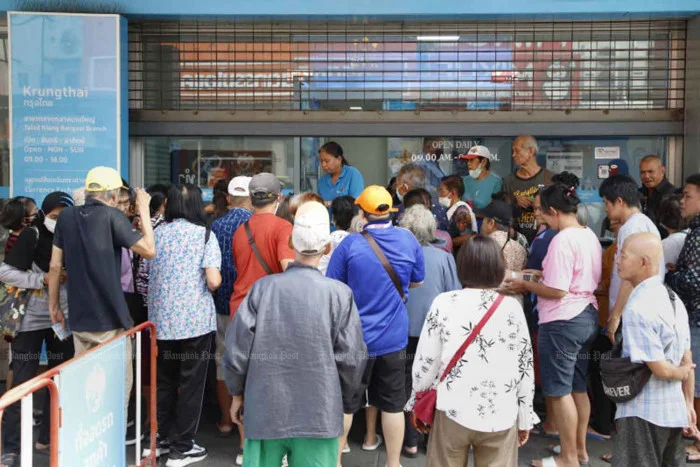
For 77-year-old Wimol Suanngam, the state welfare card is more than a monthly benefit. It represents a small measure of security in a life marked by hardship, disability and isolation.
Living alone in Surin province, Ms Wimol survives mainly on elderly and disability allowances. She had repeatedly submitted documents to apply for the state welfare card, but when the latest results were announced, her name was nowhere in the eligibility database despite completing the registration process through local officials.
Confused and desperate for answers, she travelled to a bank branch to check her status. Officials could find no record of her application and advised her to register again when the programme reopened.
Her experience is not unique. Across Thailand, thousands of elderly people, farmers and low-income workers have questioned why they lost benefits after the government tightened screening rules to ensure assistance reaches only those considered genuinely poor.
The controversy has exposed one of the biggest challenges in designing welfare programmes: how to identify poverty accurately while preventing public money from going to people who do not qualify.
Rules meet reality
The state welfare card programme was introduced in 2017 under the Gen Prayut Chan-o-cha government to direct assistance towards low-income households and reduce inequality. The scheme provides a monthly allowance of 300 baht for essential goods, together with discounts on cooking gas, electricity, water and public transport. Annual spending on the programme exceeds 50 billion baht.
This year, however, the government introduced stricter eligibility criteria. Of 18.82 million applicants, only 9.51 million qualified, fewer than the roughly 13 million people who had previously received benefits. The biggest reason for rejection was vehicle ownership, accounting for 41% of unsuccessful applications, followed by outstanding loans above 100,000 baht.
Many applicants insisted the rules failed to reflect real life. Some owned ageing pickup trucks or motorcycles used for farming and work, while others had borrowed money to build homes or support their children's education.
Defining true poverty
Somchai Jitsuchon, research director for Inclusive Development at the Thailand Development Research Institute (TDRI), said the controversy illustrated why identifying poverty is far more complicated than simply examining a person's assets.
"Poverty is harder to identify than people think," Mr Somchai said.
"A housekeeper may save enough to buy gold, own a pickup truck or build a modest house in their hometown. None of those things automatically tells us whether that person is poor."
He said the large informal economy made income-based screening especially difficult because many workers had irregular earnings that were impossible to verify accurately.
"For street vendors, the state does not know exactly how much they earn each day, what their costs are, or whether they make a profit or a loss. Sometimes even the sellers themselves do not know."
Governments often rely on asset ownership, including land, bank deposits and vehicles. However, Mr Somchai warned such indicators frequently failed to capture people's real financial circumstances.
Some applicants, he noted, had vehicles registered in their names even though they no longer owned them, while others relied on decades-old pickup trucks worth very little but essential for earning a living.
"A vehicle should not automatically mean someone is not poor," he said. "Some second-hand vehicles are worth less than 100,000 baht and are simply tools for earning a living."
Mr Somchai believes national databases should be supplemented by local verification through village heads, village health volunteers and local administrative organisations.
"They know who genuinely needs help," he said.
Such cooperation, he argued, could reduce both long-standing welfare problems: people receiving benefits despite not qualifying and genuinely poor households being excluded. He believes the government's increased focus on people who have fallen through the cracks is a welcome change.
"There are always two problems -- leakage and exclusion. A good welfare system has to reduce both."
Varakorn Samakoses, economist and president of Dhurakij Pundit University, agrees.
Cash assistance, he said, remains one of the most effective ways of helping poor households, but accurately identifying eligible recipients has challenged governments around the world.
"The correct approach is to discuss the issue and go into communities to see the reality," Mr Varakorn said.
He said some of the poorest people were often those least able to deal with government procedures, including people lacking proper identification documents or living in informal settlements.
"They may not even dare to visit district offices because they fear problems arising from their documents."
Mr Varakorn said the Interior Ministry's local administrative network is best placed to identify genuine hardship because village heads and district chiefs understand conditions within their communities. He criticised earlier screening rules for assuming poor people should not own vehicles or certain assets.
"Those rules were created from imagination rather than reality," he said. "Poor people can own old motorcycles because they need them to work."
Voices from villages
The issue gained wider attention after several elderly applicants faced difficulties while attempting to appeal.
In Nan province, Ngao, 65, from Pua district, travelled from a mountain village to a Bank for Agriculture and Agricultural Cooperatives branch to appeal after losing her welfare entitlement. After waiting from afternoon until evening, she collapsed outside the bank and later died in hospital. Her younger sister Amphai said the family was devastated and wanted the government to reconsider procedures that placed additional burdens on elderly people living in remote areas.
Villagers said many residents in the area had also lost their benefits because of old vehicle registrations or loans used for farming, building houses and supporting children. In Phetchabun, another elderly woman died in a road accident while travelling to appeal her welfare status.
The cases prompted Prime Minister Anutin Charnvirakul to instruct agencies to adopt a more proactive approach. Mr Anutin said government agencies should not wait for people to travel to appeal but should instead visit communities to verify cases directly.
Deputy Interior Minister Polapee Suwunchwee said the ministry would work with village heads, district chiefs and local officials to review rejected applications. Officials would examine vehicle conditions, housing, financial records and cases where personal information may have been used without consent.
The Interior Ministry has opened one-stop service centres at district offices and deployed mobile teams to assist older people, people with disabilities and bedridden patients with appeals and document checks.
Meanwhile, the Department of Land Transport is allowing rejected applicants to check vehicle registration records free of charge. Between July 17 and 23, 101,838 people sought record checks or lodged appeals.
The Ministry of Commerce has also instructed the Department of Business Development and provincial commerce offices to help 122,324 applicants whose welfare applications were rejected because they were listed as company directors, shareholders or business partners, including cases where names may have been used without consent.
Rebuilding welfare trust
The government is reviewing the welfare card scheme after complaints that the revised screening criteria excluded many genuinely poor households.
The Finance Ministry plans to seek cabinet approval on July 27 for new eligibility rules and an extension of the appeal period until Aug 31. Existing cardholders would continue receiving benefits until Sept 30, with successful applicants under the revised scheme due to receive benefits from Oct 1.
Proposed changes would exempt cars more than 20 years old and motorcycles more than 15 years old from automatic disqualification. Applicants whose vehicles have been scrapped, left unregistered, sold without formal ownership transfers or registered in their names without consent would also be able to seek reconsideration. Students in non-formal education programmes would remain eligible, subject to income and asset checks.
For Ms Wimol, the debate is not about a large sum of money but recognition and dignity. Living alone with health problems, she said the welfare card would help reduce everyday expenses. As the government reforms the welfare system, the challenge is ensuring databases reflect the realities of poverty while restoring public confidence that assistance helps the needy.
Somchai: Village heads know all
Varakorn: Cash assistance works