France and Spain12:24 p.m. July 26
Latest
One person died in a wildfire near the Spanish coastal city of Castellón, where more than 16,000 people were evacuated on Saturday, local media reported. “The news about the wildfire’s progress is not favorable,” the mayor of the affected town told Spanish public television.
Roughly 90,000 people in Madrid, the capital, and neighboring areas had been evacuated or ordered to take shelter because of the wildfires, the authorities said on Sunday.
The wildfires in the mountains west of Madrid were partly contained overnight, they added, but blazes were advancing toward the neighboring provinces of Toledo and Ávila. Temperatures were expected to rise slightly on Sunday, but easing winds were likely to give firefighters some respite.
Prime Minister Pedro Sánchez of Spain said on Sunday that some of the wildfires in Madrid, the capital, and neighboring areas were being brought under control. But he warned that the situation remained dangerous and more land was being destroyed by the blazes.
“Some difficult hours still lie ahead, but the night has been very positive,” Mr. Sánchez said in a news conference in Ávila, a city northwest of Madrid, where blazes are still active.
“The scale of this crisis is very difficult to grasp,” he said. “Yesterday, we said that 130,000 hectares had burned so far this year. Now, that figure has reached 150,000 — an increase of 20,000 hectares in less than 24 hours.”
The fires in France have displaced more than 220,000 people in the region around Bordeaux, local officials said on Sunday, after 55,000 more people were ordered to evacuate. Many roads are closed and the fire was spreading rapidly in the area, the regional government of Gironde said in a statement.
Across the country, about 30 fires were burning and about 100,000 hectares have been burnt, Prime Minister Sébastien Lecornu of France said on social media on Saturday night. About 4,600 emergency personnel have been deployed to help deal with the fires in the southwest, he added. Officials are worried that high winds could threaten to reignite fires around the country.
La France fait face à une situation historique : près de 100 000 hectares ont déjà brûlé, un niveau sans précédent, et une trentaine d’incendies sont simultanément actifs sur le territoire. Plus de 167 000 personnes ont déjà été évacuées pour être mises en sécurité.
— Sébastien Lecornu (@SebLecornu) July 25, 2026
La situation…
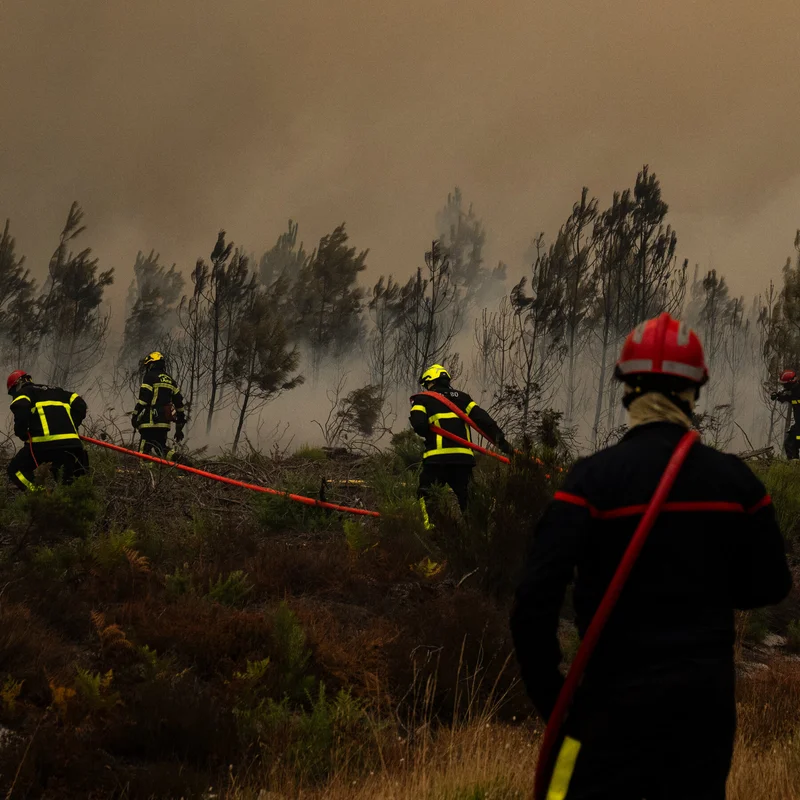
Firefighters in Spain and France were battling fast-moving and deadly wildfires early Sunday, with extreme heat and strong winds fueling new fronts even as others were contained. The string of rapidly spreading blazes near Madrid and Bordeaux have engulfed fields, forests and homes, forcing hundreds of thousands of people to evacuate or take shelter.
Some of the wildfires in the mountains west of Madrid were contained overnight, the authorities in Spain said, after ash and thick smoke had prompted evacuations around the capital. But other blazes were advancing toward the neighboring provinces of Toledo and Ávila, and new fronts were emerging hundreds of miles away near the coastal city of Valencia, Spain’s third largest, on Sunday morning.
“The scale of this crisis is very difficult to grasp,” Prime Minister Pedro Sánchez of Spain said Sunday in a news briefing. He said fires had torn through 20,000 hectares of Spanish territory — an area larger than the District of Columbia — in the past 24 hours alone.
In total, more than 85,000 people had been ordered to evacuate or shelter at home in the regions of Madrid, Ávila, Toledo and Valencia, local officials said.
In France, the fires have displaced more than 220,000 people in the southwestern region of Gironde, after the authorities there ordered 55,000 more people to evacuate overnight. Blazes there and in the bordering Landes region have burned through an area about three times the size of Paris and have been drawing closer to the city of Bordeaux, which is in the heart of a renowned winemaking region. Officials have said they do not intend to evacuate the city, but they were making plans in case the situation worsened.
France has mobilized the military, with 1,500 troops sent to assist firefighters, and it has for the first time deployed a military cargo aircraft that has been adapted to drop flame retardant. Prime Minister Sébastien Lecornu of France said on Saturday that 30 fires were ablaze and warned that the situation in the Gironde region would be “particularly critical” after worsening weather conditions had accelerated the fires.
As of Sunday, the local authorities in Spain said one person had died in the eastern city of Castellón and another person had died in Manises, a town in Valencia.
Mr. Sanchez said on Saturday that there was a “window of opportunity” over the weekend to fight the fires, with temperatures predicted to ease. Still, he urged caution, as there were potentially complicating factors including strong winds and dry thunderstorms.
Here’s what else we’re covering.
- Scorching summer:Record-setting heat waves in western Europe created the conditions for the wildfires in France and Spain, parts of which had already faced unusually hot and dry summers. Read more ›
The wildfires torching Spain and France are a culmination of Western Europe’s extreme summer, in which record-setting heat waves and dry conditions set the stage for vast areas that could easily ignite.
Though it is difficult to connect a single wildfire to global warming, scientists said broiling temperatures last month, which hit both Spain and France, were made likelier because of the burning of fossil fuels. The Intergovernmental Panel on Climate Change, the world’s pre-eminent climate science body, said in 2021 that “fire weather” would likely increase across the Mediterranean over the course of the century.
In general, wildfires are closely linked to heat and drought, which sap grasses and forests of moisture. Those conditions allow for fires to spread more quickly — if there is a spark.
“Let me call it the drying out of the European continent,” said Johann Georg Goldammer, the director of the Global Fire Monitoring Center, in Freiburg, Germany. “The vegetation is suffering from this heat and drought stress. And this is accumulating.”
The wildfires were “absolutely” connected to the earlier weather extremes, he said on Saturday.
In western France, firefighters have battled flames in the same area that was a center of earlier heat waves. The city of Bordeaux, where thousands have evacuated from the suburbs, faced its hottest stretch on record in late June, with temperatures reaching 42 degrees Celsius (107.6 degrees Fahrenheit) three days in a row.
Since June 1, Bordeaux has had 20 days with highs of at least 35 degrees Celsius (95 degrees Fahrenheit), compared to five over the same period last year. It has rained only three days, never more than slightly.
Western Europe experienced its hottest June on record, according to Copernicus, the European Union’s climate monitoring service. Copernicus also reported “widespread dry conditions” and soil moisture well below average in Spain and France.
Samantha Burgess, the deputy director of the Copernicus Climate Change Service, said that the heat waves, coupled with warm European waters, posed “growing risks for people, ecosystems and infrastructure.”
To that end, across Europe — the world’s fastest-warming continent — those risks are now playing out in many ways. The Danube River recently reached its lowest water levels in 30 years, partly disrupting shipping. This month, low levels on the Rhine forced cargo ships to cut loads. The Netherlands has declared a water shortage, and much of France is facing water restrictions.
And then there are the fires.
According to the European Forest Fire Information System, France has already recorded its most fires and largest burned area of the last 20 summers. Between 2006 and 2015, France saw 15 fires in a typical year. This year, it has recorded 312 fires, with more than 70,000 hectares burned, and weeks left in summer.
Spain had one of its worst recent fire seasons last year. This year’s destruction is roughly 40 percent of last year’s. Normally, in Europe, wildfire risk is most intense in mid-July and August.
In 2021, the European Environment Agency said that the average yearly burned area in the Mediterranean had decreased slightly since the 1980s because of improved fire management. But, the agency said, wildfires were striking in parts of central and northern Europe “not typically prone to fires.”
A wildfire scorching tracts of southwestern France is inching closer to Bordeaux, the city at the heart of a famed wine-producing region.
On Saturday, the Saumos wildfire came within 20 miles of the city, Laurent Nuñez, France’s interior minister, said during a news briefing. Officials said they did not intend to evacuate Bordeaux, but were drafting plans in case it became necessary.
The city, the ninth largest in France with a population of around 270,000 people, is about 30 miles inland from the Atlantic Ocean and about 300 miles south of Paris. It is east of the wine-growing area of Médoc, which produces some of the most well-known Bordeaux reds, including Cabernet Sauvignon and Cabernet Franc. Most of the region’s wine industry is concentrated north and east of Bordeaux, and not to the west, where fires are burning.
Bordeaux has been populated since the Bronze Age and its historic city center is a UNESCO World Heritage site. The city contains the ruins of a Roman amphitheater, bell towers from the 15th Century and the Grand Théâtre, a neoclassical building completed in the late 1700s. During World War II, the city was heavily bombed before it was occupied by German troops, and bombed further by the Allies before it was recaptured.
Some of the city and surrounding region’s most famous natives include Jacques-Yves Cousteau, the oceanographer; Édouard Molinaro, the filmmaker perhaps best known for “La Cage Aux Folles” (1978); Rosa Bonheur, one of the most famous female painters of the 1800s; and Montesquieu, a jurist whose ideas on the separations of powers during the Enlightenment helped inspire revolutions in France and the United States.
Millions of visitors each year flock to the city and its surroundings, many for wine-focused travel, such as exploring local wineries or visiting the Cité du Vin, its wine museum.
In photos and video
Wildfires in France and Spain this past week have blazed toward cities, forced evacuations by land and sea, and wreathed the skies of southern Europe in stifling smoke.
Already broiling under intense summer heat, some 200,000 people in France and Spain have fled their homes or been ordered to remain indoors as dozens of fires moved across parts of each country. In France, one official called two severe fires the “ogres of the summer.” In Spain, another labeled one blaze “the worst wildfire in the Madrid region’s history.”
The Spanish government has declared the fires in the Madrid region a national emergency, and both countries have requested additional aid from the European Union to combat the fires and help people affected.
Sunday
A scorched forest near Robledo de Chavela in the Madrid region.
Firefighters in Saumos, France.
A wildfire in Ares, France, that was moving toward the city of Bordeaux.
Fighting the flames in Andernos-les-Bains, France.
A deer caught in the fire near Robledo de Chavela.
Battling a blaze in San Martín de Valdeiglesias, west of Madrid.
Charred boats in Pelayos de la Presa, Spain.
Firefighting efforts in Ares.
Saturday
Firefighters working overnight in southwestern France.
An aerial view of destroyed homes in Le Porge, France, on Saturday.
Burned-out cars in Le Porge, in southwestern France.
The aftermath of a wildfire in the Gironde region of France.
A wildfire burned on a hillside in eastern Spain on Saturday.
A volunteer attempts to fight a fire with a branch in the village of El Tiemblo, Spain.
Firefighters in El Tiemblo, west of Madrid.
Burned-out cars from the wildfires in Lège-Cap-Ferret, France.
A military plane dumping fire retardant over the Gironde region of France.
Evacuees in a bullring in Valdemorillo, west of Madrid.
A scorched property and van after wildfires in the Valdesanmartin neighborhood of El Tiemblo.
Spanish firefighters collecting water from a swimming pool in El Tiemblo.
A long line of fire trucks and other vehicles near Lacanau in southwestern France.
Friday
Beach goers in Lacanau, southwestern France, as clouds of smoke rise into the sky from a wildfire.
Battling flames on Friday in a forest in Lège-Cap-Ferret, in France’s southwest.
Students from a martial arts gym in Spain worked to extinguish a fire outside their teacher’s home in El Tiemblo.
Evacuees sheltered from wildfires in Cebreros, Spain, west of Madrid.
People who left Lège-Cap-Ferret arrived in Arcachon during an evacuation of the Cap Ferret peninsula on Friday.
Traffic jams built up from the areas threatened by the fire. Cap Ferret, a popular vacation destination, is a geographically isolated peninsula with one major road going in and out.
Juana Gonzalez, a resident of El Tiemblo, covered her face to protect herself from smoke.
Some evacuees in Spain took shelter in a Madrid sports center.
A wildfire burned in a forest near the Arcachon Bay.
Firefighters in Spain carried out controlled burns in the village of Navas del Rey to slow the spread of wildfires.
Thursday
A French Civil Security aircraft flying past flames in a forest surrounding Cotignac, in southeastern France.
Smoke darkened the skies near the beach in Andernos-les-Bains, in southwestern France.
A firefighter working near a burning building in Lège-Cap-Ferret.