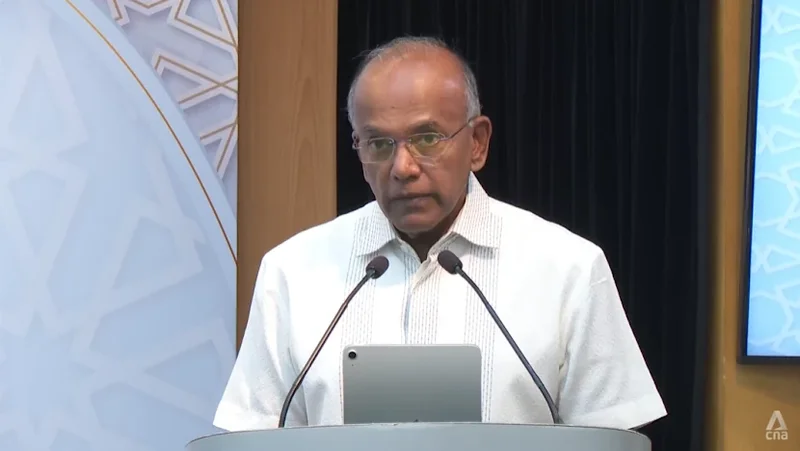
Lawyer attrition concerns need to be taken seriously, more data needed: Shanmugam
Law can be a demanding profession, but that does not excuse poor supervision, harassment, bullying or unreasonable treatment of lawyers, says Coordinating Minister for National Security and Minister for Home Affairs K Shanmugam.
SINGAPORE: Issues raised about lawyer attrition and workplace culture must be taken seriously, but more detailed and objective data is needed to assess the extent of the problem, Coordinating Minister for National Security and Minister for Home Affairs K Shanmugam said on Sunday (Jul 26).
At the same time, aspiring lawyers should be aware of the high pressure that "comes with the territory", he added.
Speaking at the National University of Singapore (NUS) Law freshmen inauguration ceremony on Sunday, Mr Shanmugam referred to a recent Law Society study on lawyer attrition.
The study identified issues including long working hours, toxic workplace culture, pressure, derogatory or unfair treatment in court, concerns over whether legal practice remains a sustainable career and the impact of artificial intelligence on lawyers.
Mr Shanmugam said official figures showed attrition had remained "broadly stable" over the past decade.
Citing data Minister for Law Edwin Tong gave in Parliament in May, Mr Shanmugam said that about 60 per cent of lawyers remained in practice after five years between 2015 and 2024, while about 40 per cent remained after 10 years.
Over the same period, the number of practising Singapore lawyers grew by 26 per cent, while the number of in-house counsel increased by about one-third to around 4,800.
"The rate of attrition is stable over the past 10 years. And the size of the profession has grown steadily.
"But that does not mean there is no problem, and everything is okay," he said.
Mr Shanmugam said it was important for the profession and the courts to address the issues raised by the study, while collecting more detailed and objective data. This should include how many lawyers have such complaints, as well as perspectives from law firms and the courts, he said.
"You need to size the problem and verify it, and then deal with it," Mr Shanmugam added.
Addressing the incoming law students, Mr Shanmugam said those who aspire to practise law at the top end of the profession should expect demanding work, considering Singapore's competition with other leading legal centres and the high remuneration offered.
He noted that a first-year qualified lawyer at a top local firm can earn more than S$100,000 (US$77,480) annually, with pay at the very top firms ranging from S$120,000 to S$140,000.
After six to eight years, the best-performing lawyers may make junior partner and earn about S$200,000 to S$300,000 a year, he said.
He also said that the government, legal service and judicial service offer competitive salaries to attract talent, though not at the level of the highest-paying private firms, reflecting the different pressures and demands of the roles.
Mr Shanmugam said: "When you get paid like that, then the expectations and demands will also be high. Work is expected almost round the clock. It is even more intense in London, New York. The pressure comes with the territory. So it's a choice. You want that?
"Or do you want a different pace of life? Then you must choose a firm that makes quality of life a part of its work culture. There are firms like that," he said.
"But let me also be clear. None of what I have said about law being a demanding profession excuses poor supervision, lack of training, harassment, bullying and unreasonable treatment of lawyers," he added.
"These issues need to be taken seriously."
Mr Shanmugam also highlighted what he described as the foundations of Singapore's successful legal industry.
He said the profession's success rested on two factors - policies that have generated economic growth and Singapore's adherence to the rule of law.
"Without the macro-economic growth, the legal profession will not be where it is now, and not many will want to get into it," Mr Shanmugam said, adding that the legal profession thrives when businesses thrive.
Mr Shanmugam cited South Korea as a comparison, noting that it has about 50 million citizens, nearly 15 times Singapore’s citizen population.
He noted that Singapore has around 6,400 lawyers, while South Korea has about 34,000 lawyers.
Singapore also has four law firms with more than 250 lawyers, compared with South Korea's nine, and one lawyer for every 570 citizens, while South Korea has one lawyer for every 1,470 citizens.
"We don’t have any resources so we focus on our people and our service industries, including our legal sector. So far, we have been successful," he said.
Mr Shanmugam said Singapore had also become the world's second most preferred seat for international arbitration after London, attributing this to deliberate active government policy over many years, including legislative changes and efforts to promote arbitration in the country.
But he warned that the country's position could not be taken for granted, noting that adherence to the rule of law underpins Singapore's financial and economic success.
Investors also know that the rule of law is observed in Singapore.
"MNCs, other investors trust that their money is safe here. The legal framework provides certainty and stability," Mr Shanmugam said.
"Contracts are enforced. The courts are well functioning and credible," he added.