Tom's Hardware Verdict
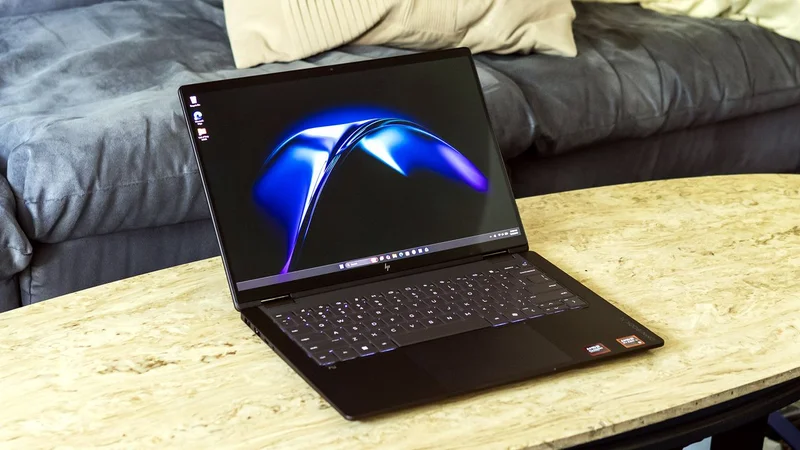
The HP OmniBook X Flip 14 offers a beautiful convertible design, comfortable keyboard, and practical battery life, but its performance and dimmer OLED display leave room for improvement.
Pros
- +Impeccable build quality
- +Comfortable mouse and keyboard
- +Decent battery life
- +Good speakers and webcam
Cons
- -Expensive
- -1920 x 1200 OLED display isn't bright enough, and is only 60 Hz
- -Middling performance
Why you can trust Tom's Hardware
The best laptops must do more than look expensive; they need to justify their price with the right mix of design, performance, display quality, and daily usability. HP’s OmniBook X Flip 14 (starts at $1,399.99; $2,599.99 as tested) gets much of that formula right, with a sublime metal chassis, a choice of two refined colors, AMD Ryzen AI processors, and the convenience of a 2-in-1 design. It feels every bit like a high-end machine, with solid entertainment features and impressive build quality, but its high price, middling performance, and merely decent 1920 x 1200 OLED display keep it from fully standing out.
Design of the HP OmniBook X Flip 14
The OmniBook X Flip 14 is HP’s design at its best. The deep espresso finish gives the laptop a rich, almost executive character. (The other available color is atmospheric blue.) Its matte metal surfaces felt reassuringly solid in my hand. HP also claims a MIL-STD-810H durability rating.
At 12.32 x 8.6 x 0.57 inches, the OmniBook’s footprint is slightly larger than Dell's XPS 14, though the weight is essentially a wash: 3.09 pounds for HP versus 3 pounds flat for Dell. Lenovo’s Yoga Slim 7i is much lighter at 2.15 pounds, but HP is the only one offering a 2-in-1 form factor, with a 360-degree display hinge that lets it fold into a tablet. While its size and weight prevent it from being a good iPad replacement, the functionality can be handy in cramped places like an airplane seat where it might not be as comfortable to use it as a laptop.
The laptop offers just enough connectivity– two USB4 ports, one USB-A port (10 Gbps), HDMI 2.1, and an audio jack. The compact 65 W power adapter plugs into either USB4 port, conveniently split across both sides of the chassis. A Realtek 8922AE-VS networking card supports the latest Wi-Fi 7 standard.
HP OmniBook X Flip 14 Specifications
|
| AMD Ryzen AI 9 465 |
|
| AMD Radeon 880M graphics (integrated) |
|
| 32GB LPDDR5X-8533 |
|
| 2TB SSD (Samsung MZVL82T0HBL1) |
|
| 14-inch, 1920 x 1200, OLED, touch, 60 Hz |
|
| Wi-Fi 7, Bluetooth 5.4 (Realtek 8922AE-VS) |
|
| 2x USB4, USB 3.2 Gen 2, HDMI 2.1, audio |
|
| 5MP IR |
|
| 59 Wh |
|
| Type-C (65 W) |
|
| Windows 11 Pro |
|
| 12.32 x 8.6 x 0.57 inches (313 x 218 x 15 mm) |
|
| 3.09 pounds (1.4 kg) |
|
| $2,599.99 |
Productivity Performance on the HP OmniBook X Flip 14
We tested a high-end OmniBook X Flip 14 configuration featuring a Ryzen AI 9 465 processor, 32GB of RAM, and a 2TB PCIe Gen 4 SSD.
Our comparison systems include the 14-inch Apple MacBook Pro featuring the M5 processor (was $2,349 as tested, but is now $2,549), the Dell XPS 14 with a Core Ultra X7 358H ($2,199.99), and two Lenovo models: the Yoga Slim 7i ($1,629.99 with a Core Ultra 7 355) and the Yoga Slim 7x ($1,579 with a Snapdragon X2 Elite X2E-88-100). The OmniBook is the only 2-in-1 design in the group.
The OmniBook landed in the lower half of the pack. In Geekbench, where it scored 13,734 points in multi-core, and our Handbrake 4K-to-1080p video transcoding test, which it completed in 4 minutes and 56 seconds, it outpaced the Core Ultra 7 355-powered Yoga Slim 7i (11,555 points and 5:56), but it couldn't match the stronger Core Ultra X7 358H in the XPS 14 (16,927 points and 4:30). The MacBook Pro proved even more potent (17,926 points and 3:31) but it was outgunned by the Snapdragon-powered Yoga Slim 7x (20,563 points and 2:11).
Get Tom's Hardware's best news and in-depth reviews, straight to your inbox.
The OmniBook's average speed in our 25GB file transfer test was 1,477.3 MBps, essentially tying the XPS 14 (1,419.76 MBps) but trailing the Yoga Slim 7i (1,659.21 MBps). The MacBook Pro (1,917.35 MBps) and Yoga Slim 7x (1,934.78 MBps) led.
Though it didn't top our charts, the OmniBook still offers performance a step above what many thin-and-light laptops offer and decent multitasking capability, with its 10-core/20-thread design.
To stress test productivity laptops, we run 10 loops of Cinebench 2026. The OmniBook started at 3,465 points and slowly descended to 3,070 points by the fifth iteration, then steadily recovered and completed the last run with 3,306 points. During the test, the Ryzen AI 9 465 CPU ran at an average frequency of 2.79 GHz.
Graphics Performance on the HP OmniBook X Flip 14
In 3DMark Steel Nomad, the OmniBook's Radeon 880M integrated graphics offered basic performance at best, outpacing the Intel Graphics in the Yoga Slim 7i (513 points), but coming nowhere near close to Adreno X2-90 GPU in the Yoga Slim 7x (1,115 points), MacBook Pro (1,122 points) or the Arc solution in Dell's XPS 14 (1,446 points), powered by the Core Ultra X7 358H.
Display on the HP OmniBook X Flip 14
The HP OmniBook X Flip 14 is available with three touch display options: a 1920 x 1200 IPS, a 1920 x 1200 OLED, or a sharper 2880 x 1800 OLED. Our unit came with the middle option, the 1920 x 1200 OLED. It’s unquestionably colorful – watching Star Wars: Return of the Jedi, Endor’s green forests looked lush, and OLED’s excellent contrast provided inky blackness in space scenes.
Brightness, however, is the weak point. Stormtrooper armor didn’t have the crisp white pop that it should, and blaster bolts and lightsabers looked a bit muted. HP rates this panel for just 300 nits, which is low even by OLED standards and feels out of place given the rest of the laptop’s excellent execution.
That said, the 2880 x 1800 OLED panel should solve that problem. HP rates it for 500 nits in SDR and 1,100 nits in HDR, and it also increases the refresh rate to 120 Hz – all the other panels are limited to 60 Hz. Since the 2880 x 1800 panel is only $80 more than the 1920 x 1200 version through HP’s online configurator, it looks like the display upgrade to get.
The OmniBook is also compatible with a digital MPP 2.0 pen, which we didn’t test, but HP offers as a $30 option.
Our charts confirm the OmniBook’s limited brightness, registering just 266 nits. The OLED-equipped XPS 14 and Yoga Slim 7x are considerably brighter, but none of them come close to the Yoga Slim 7i. The MacBook Pro proved the brightest, though it’s not an exact comparison since it uses a mini LED panel. Color-wise, however, the OmniBook topped the charts, with sRGB and DCI-P3 coverage just as high as the Yoga Slim 7x.
Keyboard and Touchpad on the HP OmniBook X Flip 14
The OmniBook has a keyboard that I can type on for long sessions without feeling fatigued. The keys offer just enough travel to feel engaging, with good cushioning at the bottom of the keystroke and a flex-free deck. Though key spacing is minimal, the angled edges of the keys provide a sense of separation.
On the MonkeyType test, I hit 120 words per minute with perfect accuracy, which is as quickly as I can go on any keyboard. White backlighting provides excellent visibility; toggling backlight brightness (F10) briefly brings up a handy menu to adjust backlight duration.
Layout-wise, the half-height up and down and full-size left and right aren’t intuitive, and dedicated home, end, page up, and page down keys are absent. The F1 key, which doubles as volume mute, offers a convenient orange LED indicator when the volume is off.
The touchpad is mechanical rather than haptic. Its nicely sized, matte surface offers seamless finger swiping – my fingers didn’t stutter or drag – and predictable clicking action.
Audio on the HP OmniBook X Flip 14
The OmniBook’s dual speakers provide decent audio for a laptop. While not loud – there’s just enough volume for movie watching in a quiet room – the setup sounds balanced and has audible bass. In Phil Collins’ “Don’t Lose My Number”, the drum hits had a satisfying sharpness and some punch at the low end. Vocal and instrument separation is good, with no hint of strain. The Chainsmokers’ “Summertime Friends” also sounded pleasant: crisp vocals, enough bass to satisfy, and an airy soundstage.
HP includes a DTS Headphone:X license (useful if you have supported headphones, which I don’t) and DTS:X decoder license via the DTS Sound Unbound app, though it doesn’t provide any equalizer controls. Confusingly, to get software EQ, you need to use the HP app, which provides music, movie, and voice presets and a graphic EQ. I found the Music preset sounded best and didn’t hear improvements while tweaking the EQ.
Upgradeability of the HP OmniBook X Flip 14
Four small Philips-head screws secure the OmniBook’s bottom panel, which are not all the same size – the fronts are shorter than the rears. I used a plastic trim tool to pop the clips securing the panel, starting along the rear edge and working my way around the edges.
Upgradeable components include the M.2 2280 SSD, M.2 2230 wireless card, and the battery. The memory is not upgradeable.
Battery Life on the HP OmniBook X Flip 14
The OmniBook X Flip 14 lasted a respectable 14 hours and 53 minutes in our battery test, which consists of web browsing, running OpenGL tests, and streaming videos with the screen at 150 nits while connected to Wi-Fi. It outlasted Dell’s XPS 14 (12:23) but it was almost two hours shy of the Yoga Slim 7i (16:38) and couldn’t catch the MacBook Pro (18:14) or Yoga Slim 7x (19:25). That said, the OmniBook’s numbers still make it perfectly practical for a full workday without a charger.
It’s notable that configurable models come equipped with a more powerful 70 Wh battery if they are also equipped with the 2880 x 1800 OLED panel. It's possible the higher-resolution display requires more power.
Heat on the HP OmniBook X Flip 14
During our 10-loop Cinebench 2026 stress test, the OmniBook's surface temperatures peaked at 79 degrees Fahrenheit on the touchpad, 109 F between the G and H keys, and 113 F on the underside. Internally, the Ryzen AI 9 465's average temperature was 69 degrees Celsius across all cores. The laptop felt borderline hot to the touch in certain places. Without the stress of a benchmarking run, the laptop felt lukewarm at most. Its cooling fans sound unnoticeable for general use and are quiet enough to be ignored under load.
Webcam on the HP OmniBook X Flip 14
HP’s 1080p webcam delivers a balanced picture. In my living room with overhead lighting, my face was properly exposed despite a bright window in the background, which wasn’t blown out. Some noise was evident in darker shadows, but the picture looked smooth and detailed. The detail is also good – I could make out writing on my chalkboard about a dozen feet away. The webcam also offers an IR sensor for Windows Hello sign-ins and a physical privacy shutter.
Software and Warranty on the HP OmniBook X Flip 14
The main app included on the OmniBook is the HP app, which provides software updates, battery smart charge settings, touchpad gesture control, diagnostics, a virtual support assistant, and support access. Audio equalizers are also available, though spatial settings are in the tandem DTS Sound Unbound app.
HP also includes its Omni+ app for secure password management, HP Smart for connecting printers, and HP TV+ to centralize streaming apps. A McAfee trial was also installed. These apps are not unique to the OmniBook, though, and don’t directly add value.
HP covers the OmniBook X 14 Flip with a one-year warranty.
HP OmniBook X 14 Flip Configurations
We tested the OmniBook X Flip 14 in a built-to-order configuration direct from HP with a Ryzen AI 9 465 processor, Radeon 880M integrated graphics, 2K OLED display, 32GB of RAM, 2TB SSD, and Windows 11 Pro. It retailed for $2,599.99 as of this writing, though a 13% off sale briefly appeared during the review period.
Models from HP start at $1,399.99 with a Ryzen AI 5 430/Radeon 840M, 2K IPS screen, 16GB of RAM, and a 512GB SSD. Customization options include Deep Espresso or Atmospheric Blue colors, several CPU choices – a Ryzen AI 7 445/Radeon 840M, Ryzen AI 7 450/Radeon 860M, and Ryzen AI 9 465/Radeon 880M. CPUs starting with the Ryzen AI 7 445 automatically upgrade to 32GB of memory. Storage choices range from 512GB to 2TB.
HP also sells a version of this laptop with Intel Core Ultra Series 3 internals, which aren’t priced too differently from the AMD models.
Bottom Line
The HP OmniBook X Flip 14 is a polished premium convertible with excellent build quality, comfortable inputs, and practical battery life, but its high price, middling performance, and underwhelming 2K OLED display make the value equation tricky.
Lenovo’s Yoga Slim 7i offers a superior screen for less money, while Dell’s XPS 14 delivers better performance if you’re willing to sacrifice some battery life. Still, HP remains worth considering if the 2-in-1 functionality is a priority, especially if you configure it with the sharper, brighter 2880 x 1800 OLED panel.