As the AI infrastructure buildout and global geopolitical developments spur massive spending, an old-guard sector of the economy is getting a level of attention from investors that rivals the action in tech. The industrials sector of the S&P 500 is trading at a price-to-earnings ratio above 30, a level investors more often associate with high fliers, and a P/E ratio that is well above industrials' long-term average, which is closer to 20.
"If you look at [Industrial Select Sector SPDR] XLI from State Street, its valuations are really high relative to the S&P 500," Cinthia Murphy, director of research at VettaFi, said on the most recent "ETF Edge."
"It's as high as tech, so it really is a sector that has really had its moment in the sun and picked up a lot of attention," Murphy said.
The race to construct AI data centers in hopes of gaining a durable business advantage in a rapidly-shifting digital infrastructure has gripped the corporate world and the tech sector. Alphabet, as part of its earnings report on Wednesday, forecast capex for this year of $195 billion to $205 billion. Prior guidance was for spending of $180 billion to $190 billion.
McKinsey & Company estimates suggest that this investment won't be stopping anytime soon – with reports showing that global spending on data centers could reach nearly $8 trillion by 2030. The vast majority of this spending will be dedicated to data center infrastructure and IT equipment.
Alphabet warned those spending numbers could go even higher in 2027.
"AI is a tech play, but nothing happens without the build out of the infrastructure," Murphy said. "There's a whole backbone infrastructure that needs to be built, and that has really pushed up industrials."
"We have only just begun this buildout. We are a few hundred billion dollars into it. Trillions of dollars of infrastructure still need to be built," Jensen Huang, Nvidia CEO, said in a March blog post. "This is becoming the largest infrastructure buildout in human history."
The vast majority of projects in the next stages of a nationwide data center expansion are expected to take place in rural areas. In order to accommodate the staggering power demand associated with data centers, expanding rural power grids may prove essential. Peak production capacity for rural power grids in the U.S. remains comparatively limited, on average. Now, there exists a push to develop facilities that regularly consume up to twenty times their existing power capacity, intensifying corporate demand and the need for industrial support. This demand comes despite rising public animosity towards new data center construction, driven by local concerns surrounding strained power grids and rising electrical costs.
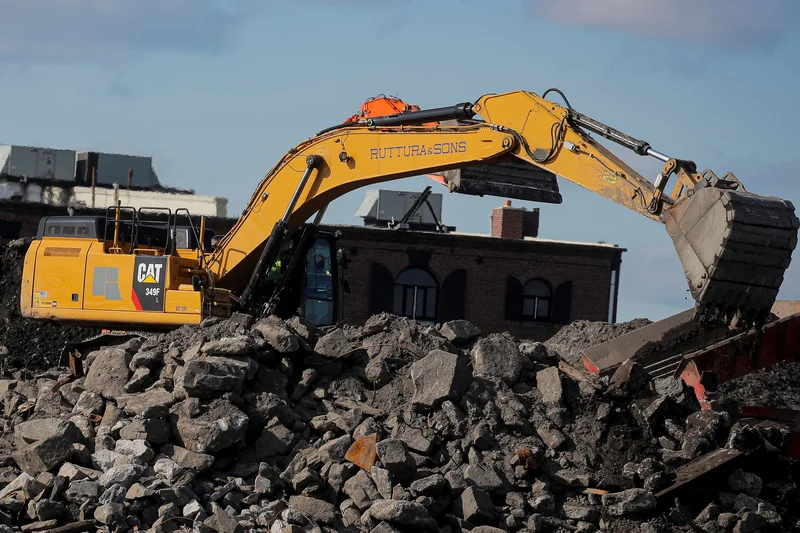
Constructing this AI backbone across the U.S. requires new electrical substations, strengthening high-speed fiber internet capabilities, and developing new energy-saving battery technology. Mass amounts of power generation and backup equipment, construction machinery, and electrification software have all come into the mix as necessities for scaling. As a result, production firms within the machinery and electrical equipment industries, which make up 20.89% and 14.16% of XLI holdings, respectively, have surged.
Caterpillar, the ETF's top holding, and GE Vernova, the third-largest holding in the industrials index, are both up over 50% this year. Caterpillar is up nearly 160% from where it was two years ago. GE Vernova continues to benefit from bookings related to the AI buildout, while its renewable energy business has been hit by the downturn in the wind power sector, leading to a selloff this week after earnings despite a $176 billion business backlog at the end of Q2. It's not just the heavyweights that have benefited, either. Emerson Electric, the 29th-largest holding in XLI, is trading at nearly 20% more than it was in July of 2024, despite experiencing slight losses over the past year. Hubbell, the 60th-largest holding, is up 30% in the two-year period dating back to July 2024.
Inside XLI, it's not just the AI boom that is supporting stock valuations, and dozens of other industrials ETFs have been launched targeting multiple niches within the sector.
"There are over 60 industrials ETFs that fall into that sector category, and collectively they've seen about $23 billion in net inflows year-to-date," Murphy wrote in an email to CNBC. "Industrials have not only performed really well relative to the market, but industrials ETFs have seen momentum in asset gathering (relative to recent years) as investors focus on the secular growth trends tied to the AI infrastructure buildout as well as to [the] aerospace and defense theme."
Lockheed Martin, one of the top 20 stocks in the industrials index, is part of a defense industry that has boomed on the increase in defense spending with the U.S. and around the world amid multiple wars. The defense contractor reported quarterly earnings this week that beat on both earnings and revenue, leading to a post-earnings rally of over 10% on Thursday. LMT and its peer RTX Corp., which is the fourth-largest holding in XLI, are both up roughly 35% over the past year.
Most popular industrials ETFs in 2026
(Source: ETFdb.com. net flow, year-to-date)
- iShares Defense Industrials Active ETF (IDEF): $4.4 billion
- State Street Industrial Select Sector SPDR (XLI): $3.6 billion
- GlobalX Defense Tech ETF (SHLD): $2.6 billion
- First Trust RBA American Industrial Renaissance ETF (AIRR): $2.5 billion
- Tema Space Innovators ETF (NASA): $2 billion
Aerospace and defense companies comprise 25% of XLI's sector allocation and have gained momentum, not only from increased defense spending, but also from the recent popularity of space stocks and the longer-term outlook for the space economy. That momentum, however, has faded, with the NASA ETF down close to 20% over the past month.
Jon Maier, J.P. Morgan's chief ETF strategist, says in an increasingly digital world, defense and AI buildout may be interlinked – a picture that bodes well for industrials. "Security and resilience is really important, and that's going to play even bigger and bigger of a role," he said on "ETF Edge."
The traditional aviation sector is also represented in the industrial sector, including Boeing, a top ten XLI holding, as well as Delta Air Lines. Delta CEO Ed Bastian recently told CNBC that conditions in his business remain strong, with high demand for air travel amidst resilient consumer sentiment enduring continuously high air fares. Delta's shares have risen 45% over the past year despite the rise in oil prices currently pressuring airline margins.
Maier added that as the investments being made into industrials peak, it is important to recognize that a significant portion of these trades into index funds like XLI are passive, indicating investor confidence in the fund's long-term horizon.
"The market is always forward-looking, and that's really what a stock price is – the cash flow of future earnings," he said.
"The flows into [industrials] really have been strong, [at] $17 billion," Maeir noted, adding the fact that there is also significant investor interest beyond the core industrial sector index. "34% of all the flow[s] have been actively managed."