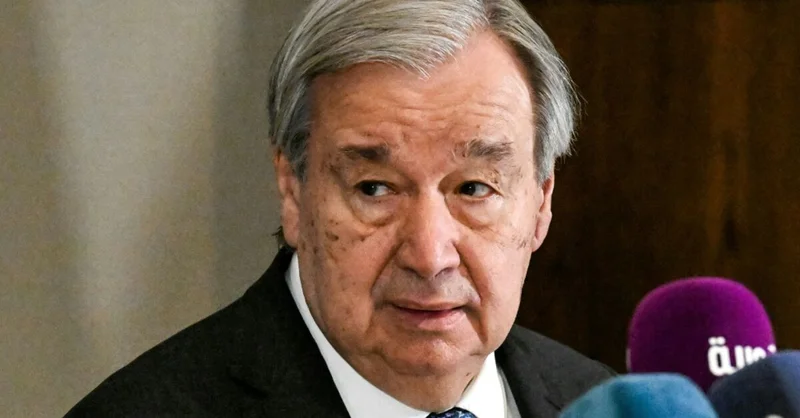
UN chief urges immediate removal of all Syria sanctions
United Nations chief Antonio Guterres on Sunday urged the removal of all sanctions imposed on Syria during the era of ousted ruler Bashar al-Assad, as he concluded a two-day visit to the country.
Syria's new authorities, who took power in December 2024, are trying to turn the page after more than 13 years of war, and to reboot the economy and rebuild infrastructure and institutions.
Western countries including the United States have announced the easing of sanctions on Syria, but investors have remained cautious, while the World Bank has estimated the country's post-war reconstruction could cost $216 billion.
"I welcome steps that have eased sanctions, and opening new possibilities for economic recovery, but all these sanctions must be removed immediately," Guterres told a press conference in Damascus, concluding what he called a "deeply meaningful and productive visit".
"The United Nations stands with the people of Syria at this pivotal moment. And I came carrying the strongest possible appeal to the international community, an appeal to spare no effort to support the Syrian people and to support the Syrian government," Guterres said.
"Syria today is at a crossroads."
Guterres is the first UN chief to visit Syria since his predecessor Ban Ki-moon in 2009, two years before the start of Syria's war, which killed more than half a million people.
"Syria needs investment in its people, its economy and its institutions. Syria needs support to restore essential services, rebuild infrastructure, revive livelihoods," he said.
It also needs help "for the safe, voluntary and dignified return of refugees and internally displaced people", he added.
Since Assad's ousting, some 1.7 million refugees have returned to Syria, according to the UN, while around 5.5 million people remain displaced inside the country and six million overseas.
- 'Right direction' -
During his visit, Guterres met senior officials including President Ahmed al-Sharaa, Foreign Minister Asaad al-Shaibani and the speaker of the new transitional parliament which held its first session this month.
Also in Damascus, he met members of the UN peacekeeping force deployed in the Israeli-occupied Syrian Golan Heights, as well as representatives of Syria's civil society, diverse communities, women and young people.
He also visited Sednaya prison near the capital, Syria's most notoriously brutal facility under Assad.
Since Sharaa took power, the international community has urged the new Islamist authorities to establish a governance system that includes all components of Syria's multi-ethnic, multi-confessional society.
"I have no doubt to say this transition is going in the right direction," Guterres said.
He also reiterated that "violations of Syria's sovereignty and territorial integrity are unacceptable", hours after Syrian state media said Israeli forces had carried out an incursion and artillery shelling in the country's south.
After Assad's overthrow, Israel sent troops into the UN-patrolled buffer zone that had separated Israeli and Syrian forces on the Israeli-occupied Golan since 1974.
It has also carried out strikes and repeated incursions deeper into southern Syria, where it seeks a broader demilitarised zone.
mam-lk-lg/jsa