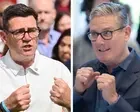
Six weeks ago Andy Burnham was not even an MP; now the former mayor of Greater Manchester is the most important political figure in Britain. After orchestrating a bloodless coup against Keir Starmer, in which he was crowned as Labour leader unopposed, the new prime minister has started his tenure in Downing Street with some eye-catching policies and a radically different approach to communication. A week into the job, how do their leadership styles compare?
Freewheeling v traditional media
Ever since his first big speech at the People’s History Museum in Manchester, at which he took no questions but made all the headlines anyway, Burnham has resisted media scrutiny. He did just three interviews as an MP before becoming prime minister – and since entering No 10 has had a brief huddle with political editors and several broadcast pool clips. Instead, his early focus seems to be on social media, answering softball questions on Reddit, appearing alongside viral TikTok stars Bus Aunty and Max Klymenko, and replying to X posts by members of the public.
While Keir Starmer has upped his social media game in recent weeks, his Downing Street operation recognised that “traditional” media still had power to drive the narrative and – while he didn’t much like it – he regularly subjected himself to scrutiny. Burnham’s team say he will take more questions, but it hasn’t happened yet.
Relaxed style v sticking to the script
Before he became prime minister, Burnham promised to do politics differently, and he didn’t just mean wearing T-shirts and jeans. “I want to answer questions honestly in this job … I’m determined to keep working in that way.” One of his big selling points with Labour MPs was that he could connect more naturally with the public than Starmer, who was often criticised for sticking to the script and coming across as wooden.
But, as Burnham has already found, his words now carry greater weight. He has already been accused of performing U-turns over issues including raising the income tax threshold – when he was really just speaking openly about his ideas before they were fully formed. “It’s funny, these days you can’t answer a question honestly without then people reading everything else into it,” he said. His critics may call him naive, but his more relaxed style may go down well with the public.
Sugar rush v long-term change
Grabbing public attention has been one of the big ambitions for Burnham’s first week in office – partly so voters know he’s there, but also to show that he’s different from Starmer, and will shout about what his government is doing. As a result, there have been a series of “sugar rush” cost of living announcements designed to give the public some much-needed breathing space – a VAT cut on electricity bills, a £2 bus fare cap and a 20% business rate cut for pubs.
In contrast, Starmer wanted to focus on long-term solutions over what he called “short-term sticking plasters”. Burnham’s energy bills announcement – the equivalent of reducing electricity bills by £45 a year on average – crystallised their different approaches. It is to be paid for by scrapping the digital ID system, which advocates argue could have saved the government tens of billions in the long term by making public services more efficient. The question remains: what happens when the sugar hit wears off?
Whitehall break-up v managed decline
Burnham’s first big announcement on returning to Westminster was that he was going to set up No 10 North as the “nerve centre of a rewired Britain” to oversee a devolution of power and resources across the UK. While opposition parties have dismissed this as a gimmick, the new PM says he is determined to oversee a genuine shift of power from Whitehall to local communities via his Manchester operation.
Yet he has also created a powerful new PM’s department taking in both No 10s, parts of the Cabinet Office, Treasury and housing ministry – all overseen by his close ally Louise Haigh, to become the “dominant driver of the UK’s economy”. Antonia Romeo, the United Kingdom’s most senior civil servant, has reportedly been given a seat in the coveted space of No 10’s outer office just outside the prime minister’s study.
Starmer also promised to kickstart a new era of devolution, passing a bill allowing mayors to ask for new powers at the end of April – just before the local election trouncing that precipitated his downfall. He also pledged to reverse what he called “the tepid bath of managed decline” in Whitehall, putting his chief secretary, Darren Jones, in charge of its “rewiring” in January this year. Jones said civil servants who did not meet expectations would be “shown the door” – in the end, he followed his boss through it six months later.
Labour love-in v painful neglect
Burnham, who first became an MP in 2001 before resigning to become mayor of Greater Manchester in 2017, is steeped in the party’s lores and traditions. Back in 2009 he told the Guardian that the three most important things in his life, aside from family, were “Everton FC, the Labour party and the Catholic church – in that order”. After becoming a candidate to lead the party at his third time of asking, he insisted in a letter to the parliamentary Labour party that he would never use party discipline to “stifle debate” and wanted to create a “different culture where everyone has a part to play”.
MPs, apart from angry Starmer loyalists, lapped it up. Not least because of the contrast to the hard line against dissent that Starmer and his team showed in the early days of his tenure, when many were suspended for defying the party line. But there are already those questioning Burnham’s pledge to end factional infighting after he removed or demoted more than half of the outgoing prime minister’s cabinet in his first reshuffle.