Samsung’s latest foldables have arrived with much fanfare. There’s the uniquely proportioned Galaxy Z Fold 8, which looks to be the precursor to the foldable iPhone Ultra later this year; the more conventional-looking Galaxy Z Fold 8 Ultra; and Samsung’s thinnest and lightest flip phone ever in the Galaxy Z Flip 8.
The first two of those three phones boast Samsung's new Flex Titanium display technology, which gives them thinner, flatter, and more robust displays than any Galaxy foldables before them. And having spent time with the Galaxy Z Fold 8 Ultra already, I’ve been impressed with the progress Samsung has made in reducing the appearance of the crease, specifically.
From front-on, you can hardly make out the crease at all, and at an angle, it’s less obvious than on the Galaxy Z Fold 7. Running my finger across the middle of the Galaxy Z Fold 8 Ultra's display, there’s only a very subtle undulation running down the center. It’s so subtle that I’d wager you’ll stop registering that it's even there after spending a few weeks with the new phone.
And yet, for how impressed I am with the Galaxy Z Fold 8 Ultra’s display, I know there’s already something better available.
Enter the contender
The Oppo Find N6 launched in March 2026, four months earlier than Samsung’s Z8 series, and the big selling point was the claim that Oppo had managed to remove the crease in the foldable screen entirely.
Now, while that isn’t strictly true — at some acute angles, you can still see the crease — what is pretty amazing is the fact you can run your finger across the entire 8.12-inch display and not feel any interruption on the part of the screen that bends when folded.
I’ve been fortunate enough to have used most foldables, including reviewing the original Galaxy Fold, and the screen crease has always been there.
Sign up for breaking news, reviews, opinion, top tech deals, and more.
Most of the time, when you’re looking straight-on at the screen, it does disappear as your eyes focus on the content, but have the light hit at a certain angle, or run your finger across, and you’re immediately reminded of the minor imperfection.
I was stunned when I first got my hands on the Oppo Find N6. Swiping my finger back and forth across the middle of the display and feeling nothing, I thought, 'This is the next frontier of foldables.'
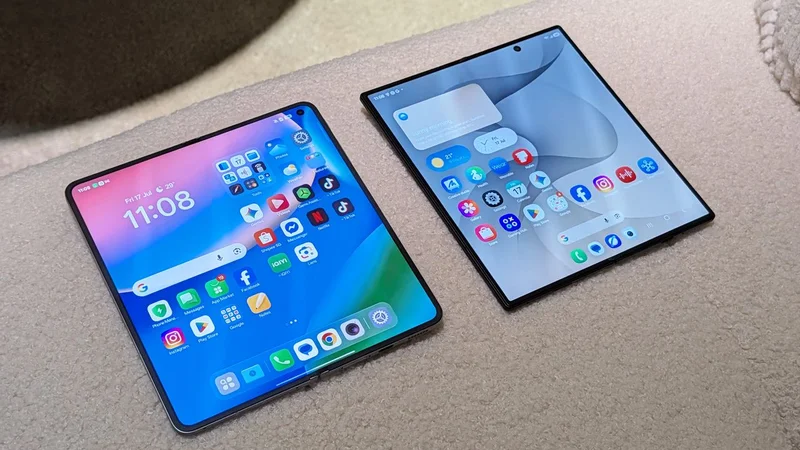
To make sure I wasn’t just looking at the Oppo through rose-tinted specs, I took it to the Samsung preview event so I could experience it side-by-side with the Z Fold 8 Ultra. And sure enough, the Oppo continued to impress with a screen that is smoother and flatter than Samsung’s, but not by much.
Which one is right for you?
Make no mistake, these are two very accomplished, flagship foldables. Both have similarly sized exterior and interior screens, and both are powered by Qualcomm’s Snapdragon 8 Elite Gen 5 chipset.
The Samsung Galaxy Z Fold 8 Ultra is thinner, lighter, and actually readily available in multiple markets. It also has a brighter display (a peak brightness of 3,000 nits vs 2,500 nits on the Oppo) and the firm’s Galaxy AI, Now Brief, and Now Nudge features on top of Google’s Gemini assistant.
The Oppo Find N6 has the smoothest, flattest foldable display, an edge in the camera hardware, a bigger battery and faster charging — yet its availability is limited to just a few Asian markets at the time of writing.
So, the Samsung Galaxy Z Fold 8 Ultra wins by default, which doesn’t feel particularly satisfying as a conclusion, but this shouldn’t diminish the progress that’s been made.
The main issue with foldable displays has been conquered. The next major hurdle we need manufacturers to clear is price.
The Z Fold 8 Ultra is available for pre-order for a lofty $2,099.99 / £1,899 / AU$2,999, which makes it Samsung’s most expensive foldable ever (if we ignore the limited-run TriFold). The Z Fold 8 (from $1,899.99 / £1,699 / AU$2,699) and Z Flip 8 (from $1,199.99 / £1,149 / AU$1,949) are cheaper, but they’re still not cheap.
So, if a manufacturer can find a way to deliver the same premium features for under $1,200/ £1,200 / AU$1,500, it could open the foldable floodgates.
And of course you can also follow TechRadar on TikTok for news, reviews, unboxings in video form, and get regular updates from us on WhatsApp too.
John has been a technology journalist for more than a decade, and over the years has built up a vast knowledge of the tech industry. He’s interviewed CEOs from some of the world’s biggest tech firms, visited their HQs, and appeared on live TV and radio, including Sky News, BBC News, BBC World News, Al Jazeera, LBC, and BBC Radio 4.