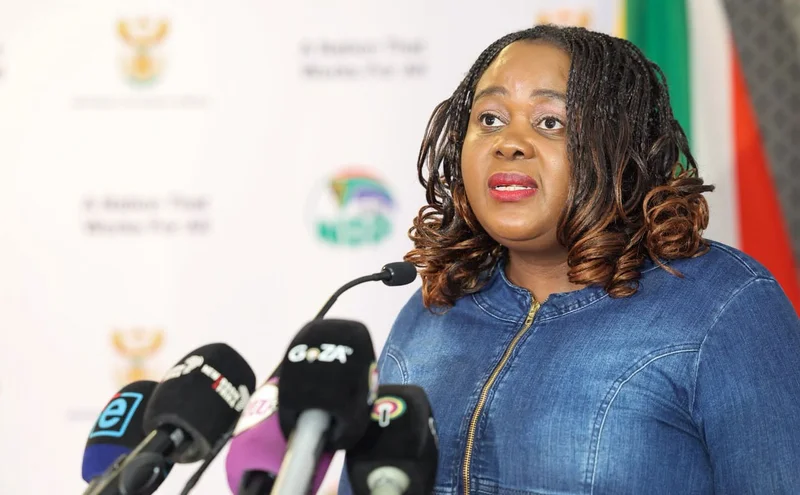
Committee chairperson and Justice and Constitutional Development Minister Mmamaloko Kubayi provided an update on the governmentâs migration intervention at a media briefing on Sunday, 26 July.
President Cyril Ramaphosa established the committee in June to coordinate the stateâs response to migration management after the announcement of the governmentâs five-point migration plan on 7 June.
The plan focuses on:
-
Cracking down on immigration and labour law violations;
-
Strengthening border security;
-
Stamping out corruption in the immigration system;
-
Closing legal loopholes in migration policies; and
-
Working with other African countries.
Warning against vigilantism
Kubayi reiterated that only state authorities were empowered to enforce immigration laws and warned members of the public against taking matters into their own hands.
âAllow us to do this work. When you go and do your own thing, you are disrupting and distracting us from the focus that we have,â Kubayi said, while also condemning groups impersonating Home Affairs officials and conducting unlawful identity checks on people they suspected of being foreign nationals.
Kubayi said some of these activities were increasingly resembling extortion. She said that those committing crimes under the guise of anti-foreigner movements would face criminal prosecution, noting that seven people had recently been arrested in Polokwane.
Repatriation and processing
Kubayi said 68,138 foreign nationals had been deported or voluntarily repatriated between 14 June and 24 July after Malawian nationals first assembled at the Sherwood processing site in KwaZulu-Natal. She said most were processed through the Musina Temporary Repatriation Processing Centre in Limpopo.
The Border Management Authority separately processed 72,906 repatriations through ports of entry between 7 June and 14 July across various nationalities, including those processed through the Musina facility.
Since the number of people requiring processing has been declining over the past three weeks, the government will reduce operations at the Musina centre from 1 August. The facilityâs capacity will be reduced from 20,000 people to 1,500.
Immigration courts and law enforcement
The Inter-Ministerial Committee on Migration (IMC) said that progress in immigration-related prosecutions had been made through dedicated immigration courts. Between 1 April and the end of June, the courts finalised 28,736 immigration-related matters, primarily linked to deportations.
Almost half the cases, 13,312, were heard in Gauteng, followed by KwaZulu-Natal with 4,973 cases, most through Durban Centralâs dedicated immigration courts. The Western Cape finalised 3,334 matters, while the Eastern Cape concluded 2,019.
Kubayi said work was under way to establish a dedicated immigration court at OR Tambo International Airport on land designated by Airports Company South Africa. At the same time, upgrades to the immigration court at the Lindela Repatriation Centre would also begin.
The IMC said integrated operations involving the South African Police Service, the Border Management Authority, Home Affairs, the Hawks and other agencies continue to target:
- Illegal border crossings;
- Human trafficking networks;
- Labour exploitation;
- Fraudulent documentation syndicates;
- Illegal mining; and
- Criminal enterprises facilitating unlawful migration.
Metro intervention expands
The IMC also announced a new focus on migration-related challenges affecting metropolitan municipalities. Kubayi said the IMC met the mayors and officials from Johannesburg, Ekurhuleni and Tshwane on 22 July to discuss a coordinated framework for addressing hijacked and abandoned buildings, illegal land occupations, illegal mining and illegal trading.
The talks covered properties owned by municipalities, provincial and national government departments, state-owned entities, including Transnet and the South African Post Office, as well as privately owned buildings.
According to the committee, the metros outlined ongoing interventions, operational challenges and areas where national government support was needed. The IMC has directed the National Joint Operational and Intelligence Structure (NatJoints) to finalise both a national framework and an operational plan to tackle the issues, which it said posed safety risks and contributed to significant revenue losses.
Officials said the remaining metropolitan municipalities would be consulted over the coming week before the framework was finalised.
Regional engagement
The IMC also used the briefing to reiterate that its migration response was intended to remain within the rule of law. This follows a statement by the Department of International Relations and Cooperation (Dirco) earlier this week after the Economic Community of West African States raised concerns about migration developments in South Africa.
Dirco reaffirmed South Africaâs commitment to Pan-African solidarity, rejected xenophobia and said migration management would continue to be guided by constitutional principles and the rule of law.
International Relations Minister Ronald Lamola has also called for migration to become a standing agenda item at future African Union summits, arguing that African states should work together to address the root causes of irregular migration through improved governance, democracy and economic development. DM