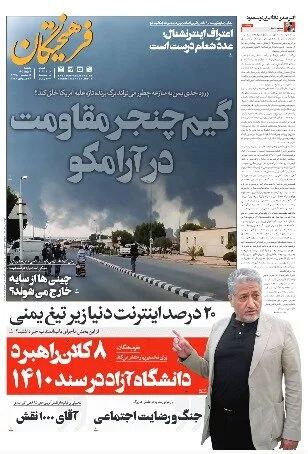
Hegseth’s Hollywood dream destroyed in the Ramadan War
Farhikhtegan wrote in a commentary about the bitter outcome of Pete Hegseth’s dream: In the real world, wars are not measured by the scale of destruction; they are measured by their results. Forty days into the war, neither the regime change dream materialized, nor Iran’s ability to mount an effective defense was eliminated, nor did people come to the streets to overthrow the government.
The only thing that changed was the closure of the Strait of Hormuz. In reality, the Ramadan War became a useful test for judging whether Hegseth’s view of war was right or wrong. He believed the Epic Fury operation should have produced an absolute victory, but it didn’t. Many now speak of America’s defeat; a defeat that exposed the limitations of the US military and the gap between America’s claims and its actual power; a defeat that created the largest energy‑supply shock in history; a defeat that showed the world’s largest navy in history lacked the courage to enter the conflict and untie the knot of the energy crisis; a defeat that triggered an intensified wave of distrust and dissatisfaction among America’s long‑time allies.
Iran: The Shanghai summit standing beside Iran
The Iran newspaper wrote about the Shanghai Cooperation Organization foreign ministers’ meeting hosted by Kyrgyzstan and their support for Iran: The heavy shadow of war hung over the latest SCO foreign ministers’ summit. The meeting was held only hours after one of the most intense US military attacks on Iranian cities, directly shaping the atmosphere of the discussions. The result of Iran’s diplomatic efforts at the summit was the renewed support of SCO members for Iran’s territorial integrity, and their condemnation of attacks against the country. Through these consultations, the members once again reaffirmed their previous positions, stressing the need to respect international law and opposing any action that violates Iran’s sovereignty — a stance that reflects a relative alignment between SCO members and Tehran’s security and political concerns.
Javan: No possibility of dignified, rational negotiation
Javan analyzed Donald Trump’s narcissistic and dual personality and the impossibility of trusting such a figure. The claim that dignified and rational negotiations with Trump are impossible is not a political slogan but a scientific and experiential conclusion. For Trump, negotiation is a performance meant to make him appear stronger. His goal is not agreement but extracting a symbolic surrender from the other side to reinforce his illusion of invincibility. Therefore, any optimism about negotiating with Trump is doomed from two angles: Practically, because his signature carries no guarantee; and morally, because sitting with him legitimizes antisocial and violent behavior. Iran has learned well that in confronting this enemy number one, standing firm and relying on internal capabilities is not just a choice but a vital necessity.
Donya‑e‑Eqtesad: Iran’s sensitive position in the new energy order
Donya‑e‑Eqtesad wrote about the emerging order in the global energy industry: Today, the value of the energy sector lies in controlling logistics chains, financing, and commercial flexibility. Iran’s position in this new order is more sensitive than ever. But the country’s energy policy has drifted away from the realities of the global market. Slow progress on the North–South corridor, delays in expanding energy swaps with neighbors, weak development of export‑oriented refineries, and the absence of active diplomacy with key players like India and China have left part of Iran’s strategic opportunities unused. The government must elevate energy diplomacy from merely managing sanctions to designing energy corridors. Geopolitics of energy is no longer defined by where oil is extracted, but by where it passes through — because the global market still needs oil, but more than ever it needs assurance that oil will arrive.
Jam‑e‑Jam: Decoding Ali al‑Zaidi’s trip to Tehran
Jam‑e‑Jam analyzed the recent visit of Iraq’s new prime minister, Ali al‑Zaidi, to Tehran: This trip, his first regional visit, is significant in many respects. Choosing Iran as his first regional destination reflects the special status and strategic importance of relations between the two countries. The visit took place at a highly sensitive moment, as the region witnessed US attacks on Iran. Iraq is also among the regional states hosting some American forces. Iran, relying on its good relations with Iraq, has tried to ensure that bilateral issues are not overshadowed by US military operations, and that Baghdad can play a constructive role in coordinating its relations with both Iran and the United States. Given that Iraq’s main export and import routes pass through the Persian Gulf and the Strait of Hormuz, Iran has granted special facilities to Iraq so that the country does not face restrictions in trade. This measure is a positive advantage for Iraq and helps maintain economic balance there. The visit raises the question of what initiatives and actions the Iraqi prime minister pursued.