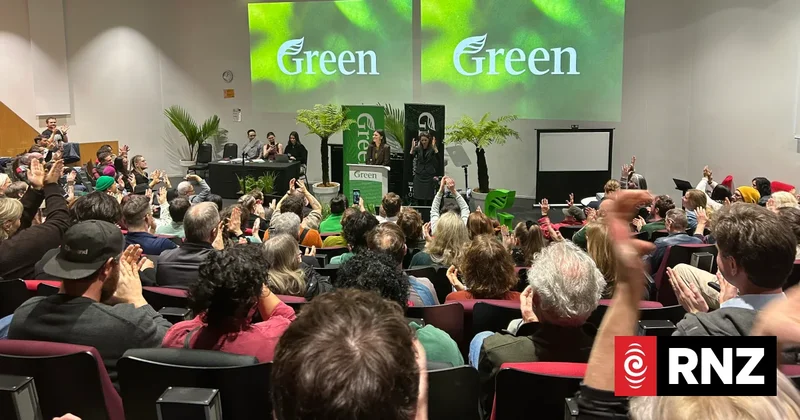
Green Party supporters have made clear what their priority for the election is: tax the rich.
Green MPs, candidates and the party faithful gathered in south Auckland over the weekend for their annual general meeting, where the party's 2026 manifesto was unveiled.
RNZ spoke to a number of party supporters and members at the AGM.
One member told RNZ he would "love putting a tax on wealth".
"We've got GST, we've got income taxes and the people that are working week to week - all their expendable money is taxed. [But] the people that are privileged beyond that, they have a lot of increase in wealth that's not taxed and I'd like to see that redressed," he said.
That was backed up by another member, who said it was "energising" to have other members on the same page.
"We need tax reform so that we can do all the good things, so we can look after each other and our nature," she said. "Tax reform is fundamental to all of the policies."
"Even people who have got a lot, they say to us they're happy to pay more if we can have healthcare for everyone, good schools that work for everyone, better public transport, and we look after our natural places - absolutely," she claimed.
The Greens want a suite of new taxes on wealth, inheritance, and corporations, and want to adjust tax settings to introduce a tax-free threshold for income below $10,000, while increasing the tax rate for income over $160,000.
One supporter told RNZ making income below $10,000 tax-free was "essential".
"How is this not a policy already?"
"My mum was on the benefit and then had a job as a cleaner, and she was getting taxed and then when WINZ made a mistake in that she had to pay that back as well as get taxed, as well as be trying to support someone as a solo parent," she said. "That's the kind of policy that will actually materially support our most vulnerable people."
A volunteer attending his first ever Green Party AGM told RNZ he joined the party because its policies were "evidence-based" and "rooted in caring".
"We've got the wealth tax that we'd love to bring in, that's awesome, fully support that," he said. "[The] most kind of like, interesting radical ones are the ones I really want to push for."
Speaking to media, party co-leader Marama Davidson said the party's priorities were clear.
"Our priorities so far are that we will tax the super-rich and address corporate greed so that we can invest that back into the services that people rely on," she said.
Fellow co-leader Chlöe Swarbrick said their "evidence-based" policy spoke for itself.
"In the 1930s and 40s, our great-grandparents did something that had never been done before. They established public healthcare, public education, public housing, and they paid for it all by higher taxes on those who profited handsomely during a time of hardship for many," she said.
Speaking to media at a National Party policy announcement, Finance Minister Nicola Willis said the issue was simple.
"If you impose a wealth tax, you're kicking wealth out the door," she said.
Willis made reference to a Treasury paper which found a wealth tax would see taxable wealth go either offshore or avoided.
"The Treasury evidence on that point is very clear. They say the higher your wealth taxes, the more you will lose and it's interesting to me that Chloe Swarbrick, who often says 'evidence-based policy' on this issue, has just completely ignored the international and Treasury evidence because it doesn't suit her," she said.
Prime Minister Christopher Luxon said a wealth tax was "not the way forward" for New Zealand.
"The way forward is to follow the plan to lift and improve affordability for New Zealanders and have a proper long-term economic plan that's actually about driving growth into the economy. That's how we propel our way forward, not by taxing it and putting a wrecking ball through the economy," he said.