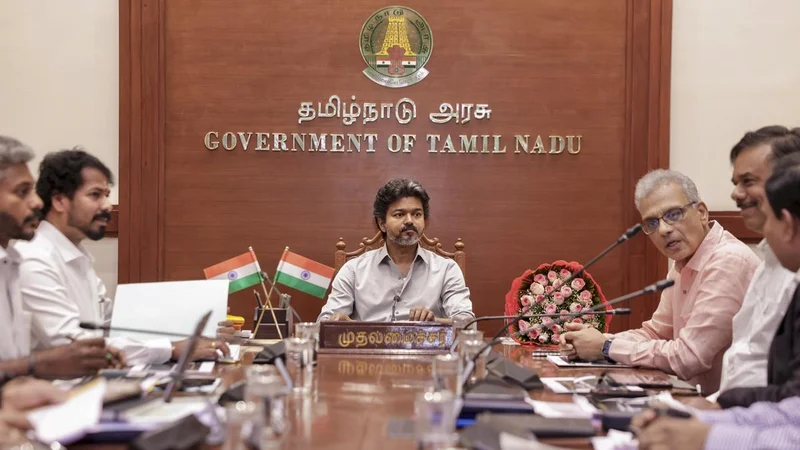
Tamil Nadu Chief Minister and Tamilaga Vettri Kazhagam (TVK) president C. Joseph Vijay’s decision to initiate talks with his Karnataka counterpart D.K. Shivakumar on the Cauvery issue marks a departure from the State’s traditional policy over the Cauvery dispute.
The purpose of Mr. Vijay’s visit to Bengaluru is to impress on the upper riparian State the imperative for it to release the share of water due to Tamil Nadu, as stipulated in the final award of the Cauvery Water Disputes Tribunal (CWDT) in 2007 which was amended by the Supreme Court 11 years later. Between June 1 and July 23, the State should have realised around 32 thousand million cubic feet (tmc ft) of water but what it got was about 3.5 tmc ft. Keeping in mind the deficient rainfall from the southwest monsoon over the river’s catchment and its own formula of proportionate reduction, Tamil Nadu feels that it should have received at least three tmc ft more.
A new strategy
Mr. Vijay’s outreach has evoked disapproval from many political parties, farmers’ leaders, and experts alike, as direct negotiations, in their assessment, would amount to bypassing the established implementation mechanism — the Cauvery Water Management Authority (CWMA) and the Cauvery Water Regulation Committee — as per the final award and the Court’s judgment. Besides, Tamil Nadu has been, since the CWDT’s establishment in June 1990, a strong votary of adjudication to resolve the vexatious problem of sharing river water in contrast to its neighbour’s preference for talks. On several occasions, it had outrightly spurned offers for talks made by various leaders of Karnataka. In the last 35-odd years, there were occasions when the State took part in bilateral and multilateral discussions but this was part of the Supreme Court’s intervention.
Even though the CWDT’s formation itself was an outcome of the failure of 26 rounds of negotiations held over 22 years, Mr. Vijay seems to be receptive to the idea of chalking out a path that his predecessors did not favour. What should be helpful to him is that in Karnataka, the ruling party is the Congress, a junior partner in his coalition government. The Congress’ former president, Rahul Gandhi, was a prominent attendee at Mr. Vijay’s swearing-in event in May. Further, Mr. Shivakumar himself was among the early leaders from other States to greet Mr. Vijay on becoming the Chief Minister. It is possible that the TVK chief has thought of capitalising on his equations with Mr. Shivakumar and the Congress party to break new ground in the Cauvery problem.
At the same time, Mr. Vijay should know, by now, that personal relationships and striking a deal on contentious and long-standing disputes are two distinct matters. After all, many of his predecessors, especially M. Karunanidhi and M.G. Ramachandran (MGR), had equally good, if not better, ties with their Karnataka peers such as Veerendra Patil, D. Devaraj Urs, R. Gundu Rao, Ramakrishna Hegde, and J.H. Patel. Rao had even invited MGR, according to diplomat-political writer R. Kannan’s biography on the latter, to join the Congress after his exit from the Dravida Munnetra Kazhagam in 1972.
Nine years later, MGR, as Chief Minister, visited Bengaluru in October 1981 originally for a day’s talks with Rao but had to extend his stay by one more day. Even then, no breakthrough was achieved.
It is well known that when it came to the Cauvery, the upper riparian State’s Chief Ministers would give substantively nothing to the other side.
Clubbing of issues
What is also troubling several parties and groups in Tamil Nadu over the proposed talks is the possibility of the Karnataka government using this occasion to raise the Mekedatu dam project, which the lower riparian State has been opposing on the ground that it will jeopardise its irrigation requirements. There is substance in their apprehension but Tamil Nadu has to convey to Karnataka that it can have talks separately, as and when necessary, as it has sought the formation of an exclusive tribunal to handle the subject. For the time being, its focus is on obtaining immediate relief from Karnataka in terms of water release.
If the two States go beyond and agree on a distress water-sharing formula which can be presented to the CWMA for ratification, it will be a real feather in Mr. Vijay’s cap.
Published - July 27, 2026 12:22 am IST