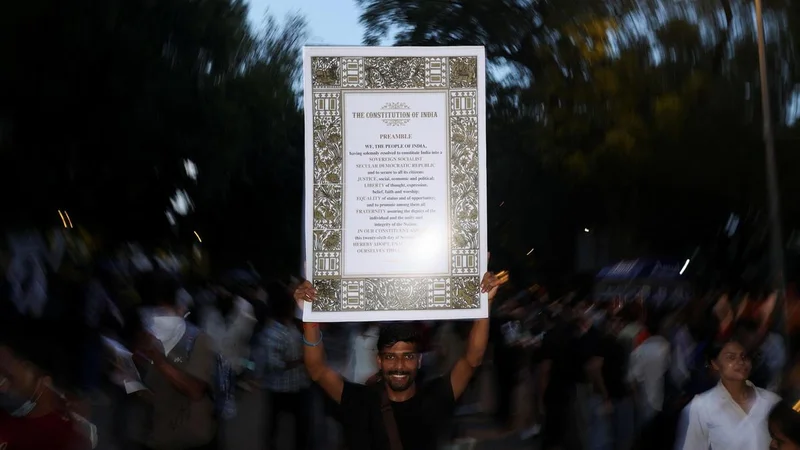
India stands at an important moment in its democratic journey. Large student demonstrations which were demanding fairness in examinations and Sonam Wangchuk’s prolonged fast and hospitalisation along with the start of the Monsoon session of Parliament have together captured the nation’s attention. These events viewed together tell a larger story. They signal a growing desire and demand among citizens to be heard, to participate, and shape India’s democratic future.
This moment can be described as the Indian Monsoon.
Just as the annual monsoon follows months of intense heat, societies too experience seasons when accumulated aspirations, frustrations, and exclusion seek peaceful democratic expression. Such moments should not be feared. They should be welcomed as opportunities for reflection, dialogue, reform and redesign.
On imagining a future
India has much to celebrate. The country has expanded digital public infrastructure, modernised transportation, strengthened financial inclusion, and demonstrated achievements in science, technology, and space. These accomplishments have brought recognition for India.
At the same time, many young Indians worry about the credibility of competitive examinations, access to quality education, and the availability of meaningful employment. Farmers continue to face economic uncertainty and income inequality remains a major concern. Public discourse has become increasingly polarised, with many citizens questioning institutional autonomy, the role of the media, the undermining of civil society, and the quality of democratic debate. These concerns should not be viewed through a partisan lens. They should be understood as democratic signals.
The strength of a democracy is measured not by the absence of criticism but by its willingness to listen and reform.
India’s greatest asset has always been its extraordinary diversity — of languages, religions, castes, cultures, traditions, trade, ideas, and aspirations. The Indian Constitution transformed that diversity into the foundation of national unity. It affirmed that justice, liberty, equality, and fraternity are not just abstract ideals but practical principles for governing a vibrant society.
As India moves toward the centenary of its Independence in 2047, there is an opportunity to renew that constitutional promise. The real question is: what kind of India do we want to build for the next generation? Do we aspire merely to become a larger economy, or do we seek to become a more inclusive, more equitable, more scientific, more innovative, more peaceful and compassionate society?
This Monsoon moment calls for a new national agenda.
The government must restore complete confidence in our education and examination systems. It must create millions of meaningful jobs by encouraging decentralisation, district-level development, entrepreneurship, innovation, and local manufacturing. It must also strengthen public healthcare, improve nutrition, low-cost housing, safety, security, schools, vocational training, invest in scientific research, reduce bureaucracy, and expand technology and opportunities for every young Indian, regardless of their background.
Above all, India must prepare for the age of Artificial Intelligence (AI). AI is not simply another technological revolution. It will reshape and redefine work, education, healthcare, agriculture, manufacturing, communities, villages, cities, governance and employment.
India possesses the raw young talent, entrepreneurial spirit, and digital foundation to become a global leader in AI for public good. Its challenge is to ensure that technology serves every citizen sustainably. No algorithm can replace trust and no AI system can replace human wisdom.
Our future therefore depends upon combining technological excellence with constitutional values, scientific temper, ethical leadership, and respect for humanity.
The idea of India
Perhaps, the greatest challenge before India today is not economic or technological. It is philosophical — the idea of India rooted in our Constitution. That ideology needs to be the core of our development, and the prerequisite for a path to prosperity. For far too long has the world measured success primarily through the pursuit of power and profit. The time has come to rebalance our priorities: to place people and the planet at the centre of development. If we empower every young person, reduce inequality, strengthen democratic institutions, focus on humanity and not religion, and use technology to expand opportunity rather than privilege, India can offer the world a new developmental model — one that combines economic progress with human dignity.
The Indian Monsoon is therefore not a political movement. It is a democratic season of renewal. It reminds us that governments derive strength by listening to their citizens, and that India’s greatest achievements have always come when we have chosen dialogue over division.
History will judge us by whether we had the wisdom to listen, the courage to reform, and the imagination to build an India worthy of its civilisational heritage and its democratic promise.
If we seize this moment with humility, confidence and vision, the Indian Monsoon will not merely mark another season of public debate. It will mark the beginning of India’s next democratic renaissance.
Sam Pitroda is a telecom inventor, entrepreneur, development thinker, and policy maker.
Published - July 27, 2026 12:32 am IST