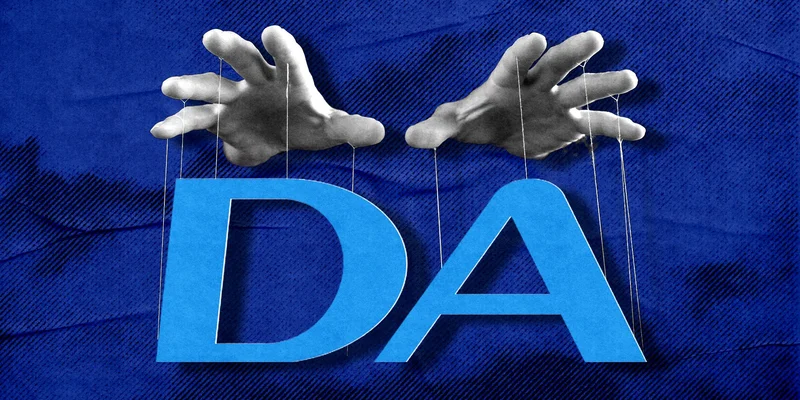
The revelation that former DA strategy head Ryan Coetzee was involved in the partyâs decision-making while running an international PR firm lifts the lid on how decisions are really made. While the partyâs leadership may think this is just how business is done, this is not how voters will see it. And this now has the potential to cause lasting damage to the DA among its core constituency.
Fridayâs reporting by Daily Maverickâs Rebecca Davis shows Coetzee is clearly currently playing an important role in the DA.
While there are many different aspects to this, perhaps the most damaging is the possibility that an outside PR company - Consulum, the firm with which the DA is revealed to have signed a secret 6-month contract to manage the partyâs involvement in the GNU - was playing a role in decisions that would be made by ministers in government.
Were the DA to find that a private company was doing the same for government ministers from the ANC, its response would be predictable, especially if that company had once worked in Moscow - since Consulumâs clients have included notorious authoritarian regimes.
Even the claim that this company was working individually with ministers is damaging; it leads to questions about what its role actually was.
Outsiders influencing decisions?
Crucially, it also leads to the question about whether a private outside interest, a PR firm based in Dubai, was influencing government decisions in secret.
Unfortunately for the DA, it appears many in the top leadership have come to accept, or even create, this practice. Certainly, there is no evidence that before Davisâ reporting there was any questioning of this practice. None of the ministers involved appear to have said they were uncomfortable with it.
For many voters, it is important to know how decisions are made in a party. Certainly, it is often the main question that political journalists try to answer. If you can know who is making a decision, you can understand what will happen.
Crucially, it reveals the real interests behind the decision.
It now appears outsiders, people outside the DA, were very involved in the decision-making process. And this was not previously known to voters. Or even, perhaps, to many in the DA leadership structures.
It may also reveal how power in the DA really works â it does not follow the published organogram.
Rather, Coetzee appears to have significant power and influence, perhaps even a veto about certain issues.
The presence of such accumulated power in someone outside the formal structures might well come as a shock to voters.
Coalition talks
Some DA leaders may be embarrassed to be reminded that an outsider was playing such a crucial role in the negotiations with the ANC that led to the formation of the national coalition.
One can forgive the ANCâs Nkenke Kekana his surprise at finding he was not negotiating with an elected official of the DA. He is a member of the ANCâs national executive committee and would have been given a mandate by the top officials of his party. And here he was negotiating with someone who played no such role in the DA.
There are other questions too.
Did the top leadership of the DA feel they were not up to the task of negotiating with the DA? Or did they not trust each other to do it? And is that why this was, effectively, outsourced?
The other problem for the DA might well be the previous track record of Coetzee and his company.
Anti-democratic causes
As Davis points out, Coetzeeâs firm worked for various anti-democratic causes, including the Saudi government after the journalist Jamal Khashoggi was strangled, suffocated and then dismembered by agents working on the express instruction of Mohammed Bin Salman.
Coetzee was personally named in news reporting in 2020 as leading Consulumâs contract to spin for the Hong Kong government after its crackdown on pro-democracy protestors due to pressure from China.
The fact he was happy to do this may well raise questions about his commitment to democracy.
And in turn, what does it say about the DA that it was happy to work with such a person, or it seems, almost rely on such a person?
While some may argue Coetzeeâs past, regardless of taking on âbadâ clients, should not be held against him, the DA has shown no such generosity to ANC officials in the past.
It was certainly quick to reject and condemn the reappointment of Dina Pule to Cabinet based on her previous behaviour. If she should be condemned for allowing corruption then, why is it acceptable to use Coetzee now, when he has advanced such anti-democratic causes?
All of this suggests the DAâs top leadership might well battle to explain this to their core constituency. These are voters who have believed that the DA has a core of elected officials who make decisions. That has been the narrative that was sold to them.
At the same time, just months before an election, the ANC and others are obviously going to use this (and the Resolve Communications issue) against the party.
Just when the DA appeared to be about to make major progress in an election, suddenly there will be discussions in society about the partyâs own internal arrangements.
Internal turmoil, or golden opportunity?
But the worst damage might well be internally.
Members who have felt their progress was stopped, or leaders outside the inner circle who were unable to win policy arguments, might well ask if Coetzee, or people hired by him, were responsible for this.
This can have a hugely corrosive effect on an organisation, as people now doubt whether they can trust their leadership. After all, they may no longer be sure where power really lies.
Geordin Hill-Lewis, the relatively new leader of the DA, might already be wondering how he can deal with all of this.
It is both a difficult situation and a golden, perhaps a once-off, opportunity.
Hill-Lewis may feel he is hemmed in by his political seniors. Tony Leon, the DAâs first leader, is at the centre of the Resolve Communications issue. Coetzee, a former DA strategist and MP who appears not to have been a full-time resident of this country for close to 15 years, is now at the centre of a separate controversy again involving an external firm possibly exerting undisclosed influence.
Both may have the admiration of certain constituencies, or DA donors, which might make it difficult for him to simply order that every DA member cut ties with them.
And part of the DAâs operations in government may well have become almost dependent on Coetzee or his employees due to the partyâs inexperience in this regard.
Difficult choices
This makes a hard break difficult.
On the other hand, if Hill-Lewis can make some kind of decisive break with these practices, he will be able to show both voters, and more importantly DA members, that he is in charge.
He could even claim he is âtaking our party backâ. Combining this with a series of new (or even just refashioned) policy ideas could well create the image of him as a new decisive (and young!) leader.
This could resonate with younger voters at a crucial time.
The major question, however, is how Hill-Lewis would walk back the reported fact that it was he personally who brought Coetzee back in to manage the DAâs GNU operations in April 2026 after he became leader, more than a year after the original Consulum contract had expired.
Intriguingly, there is another former leader who may well have a strong view on all of this. Helen Zille is one person who might be called on by Hill-Lewis for advice, and Davisâ reporting records that during the GNU negotiations she was already chafing against Leon and Coetzeeâs attempt to take over the process.
She also appears to still have a strong constituency in the party, which might be important in terms of what happens next.
To paraphrase a common remark about sausages and laws, no one really wants to know how political parties make decisions. It is always messy.
But generally speaking, we know who the cooks are. The fact that an outsider is one of the DAâs top chefs may give this story important power for some months to come. DM