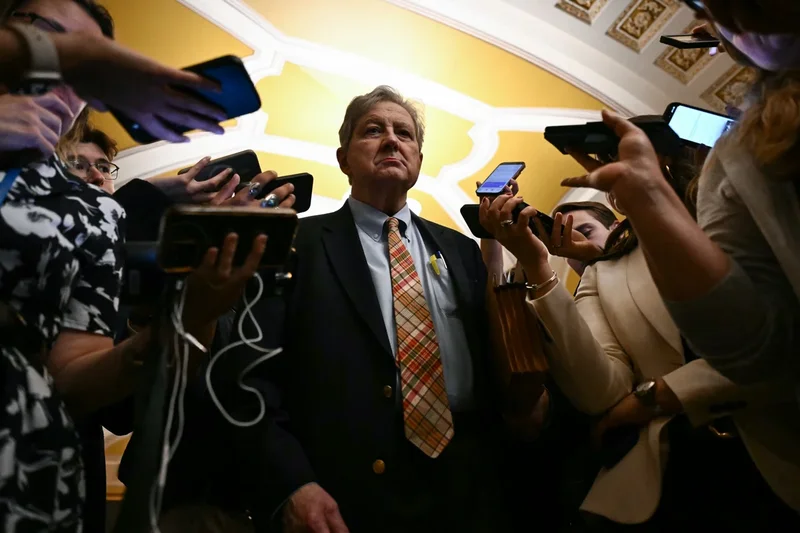
A prominent GOP senator is splitting with Donald Trump over his plans for a controversial nuclear agreement with Saudi Arabia, the latest sign that the White House’s Middle East policy is dividing the Republican Party.
The deal signed by Energy Secretary Chris Wright is designed to streamline the development of a civilian nuclear program for Saudi Arabia, which does not currently possess nuclear weapons and is considered one of the U.S.’s main strategic allies in the region. Just hours later, Trump himself confirmed that the normalization of ties between Israel and Saudi Arabia would be a factor on which the deal was contingent.
Now, a key Republican senator who has previously stopped from going as far as publicly condemning the president’s Middle East strategy is doing just that.
Sen. John Kennedy appeared Sunday on CBS’s Face the Nation, where he questioned the idea of providing the technology to another Gulf state at the same time that the U.S. was trying to permanently shut down Iran’s nuclear program.
Asked directly whether he was comfortable with the Saudi deal, as it had been presented, Kennedy replied: “Nope.”
“Maybe some day, but not right now,” added the senator. “We’re bombing a country to keep them from getting a nuclear weapon, but we're signing a deal with another country, I know it’s a commercial agreement, but that the world perceives as possibly some day leading to a nuclear weapon.”
He went on to say the world was operating on a “hair-trigger”, with the fear of nuclear proliferation and geopolitical instability leading more countries to consider building up their own nuclear stockpiles, a trend he said was a mistake and one that the U.S. should work to counteract.
“It’s just not good timing,” said Kennedy, who added: “I don’t think it’s going to happen anyway.”
He went on to note that Trump’s precondition of normalization of diplomatic ties between the Saudi government and Israel would be a bridge too far for the U.S.’s Gulf allies. Despite Trump and his administration’s persistent efforts to promote the Abraham Accords and the softening of ties, the Saudi government has remained adamant that it will only normalize ties with Israel on the condition of the establishment of a free and sovereign Palestinian state. Israel is adamantly opposed to this.
Kennedy’s opposition would be a bad sign for the treaty’s eventual survival on the Senate floor, were that likely in the cards, but the chances of the administration submitting this deal to Congress at any point, for now, seem low if not merely for the reasons the senator stated.
In general, however, the senator’s remarks are a sign that the president’s grasp on the Republican Party’s caucuses in Washington continues to weaken, and his command of his administration’s foreign policy continues to alienate traditional conservatives. The war with Iran has proved a costly and time-consuming quagmire from which the president has yet to extract himself, despite pledges from senior administration officials that the war would end in just a few weeks. Coming up now on its five-month mark, the war shows no signs of slowing down as a ceasefire extension the president signed last month has collapsed and the Strait of Hormuz has once again become unsafe for global shipping traffic.
Destruction and removal of Iran’s remaining nuclear materials remains a priority for the Trump administration, though there’s still no plan for that to occur. The two sides had agreed to begin discussions around that matter in June, but the collapse of the ceasefire agreement put those talks on hold once again.
Trump and his allies are now barreling towards the midterms with a potentially painful dynamic at play for Republicans — his party is on the ballot this fall without the president’s name at the top of the ballot, dragged down by his war in Iran and the associated gas price hikes that have only gotten worse since the ceasefire ended, and unable to be buoyed by Trump’s own candidacy this time around.
Republicans like Kennedy in the Senate are particularly incensed at the administration, following Trump’s back-to-back endorsement against two GOP incumbents and after public clashes between the GOP caucus and the White House over both Iran and Trump’s desired $1.776 billion “weaponization fund” for persons “targeted” by the Department of Justice during the Biden years.
The president was angrily confronted by one of those two incumbents, Kennedy’s colleague from Louisiana, Bill Cassidy, on Iran at a tense peacemaking summit in the Senate last month. The president took an earful from the Republican senator, who called the war a mistake.
Trump, meanwhile, has maintained that the political consequences of the war are worth his vision of preventing Iran from obtaining a nuclear weapon in the future.