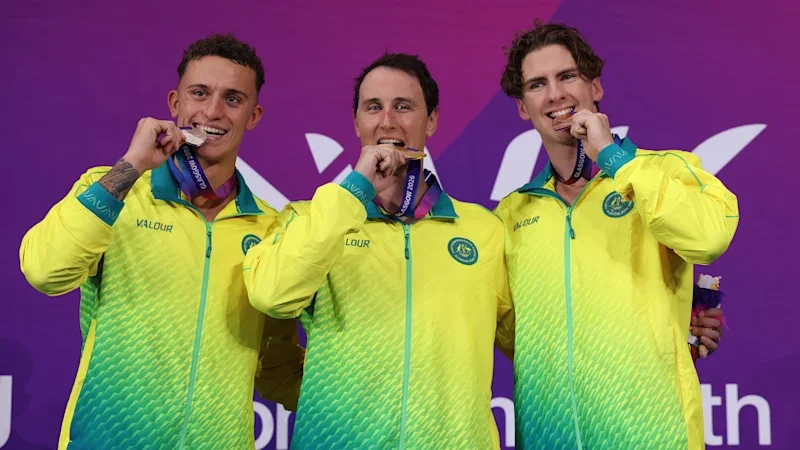
Glasgow: World record holder Cam McEvoy blitzed his rivals with a scintillating start and showed why he is swimming’s greatest sprinter, but declared he can’t rest on his laurels if he wants to defend his 50m freestyle crown at the 2028 LA Olympics.
With a blistering reaction time of 0.55 seconds, 36 strokes and without taking a breath, McEvoy became the first man in history to break 21 seconds twice in the 50m freestyle, clocking the fourth-fastest time in history (20.97) – just 0.09 seconds outside the world record he set in March.
It was a full circle moment for the 32-year-old, who wasn’t even swimming four years ago, as he won his maiden individual Commonwealth Games gold medal and chopped more than a second off the time he swam at these Games 12 years ago in Glasgow.
With Olympic, world championship and Pan Pacific gold already secured, McEvoy has little left to achieve but is determined to join Gary Hall jnr and Alexander Popov by defending an Olympic 50m freestyle title after his breakthrough triumph in Paris in 2024.
Australia added another five swimming gold medals on night three in Glasgow, with Tim Hodge (100m freestyle S9), Iona Anderson (100m backstroke) and Lani Pallister (1500m freestyle) winning individual titles before Kai Taylor, son of Hayley Lewis, anchored the men’s 4x200m freestyle relay with a superb final split of 1:44.10 to hold off a dogged England team.
The hard-luck story of the night was Australia’s Matt Temple missing out on 100m butterfly gold by 0.01 seconds.
But the sight of McEvoy atop the medal dais alongside Flynn Southam (21.44) and Jamie Jack (21.47) underlined Australia’s sprint revolution. Southam slashed 0.28 seconds off his personal best, while Jack also recorded a best time, improving by 0.05 seconds.
To put their times in context, Southam and Jack would have finished third and fourth at the Paris Olympics. It’s even more impressive when you consider McEvoy was the first Australian male to win a medal in the one-lap dash in 36 years of racing.
There is an irony in the fact McEvoy knows he is partly to blame, given he is an open book when it comes to his training methods and spreading the gospel that less is more in the pool. It would have given McEvoy immense joy having two other Australians with him on the medal dais.
Many swimmers and coaches are fiercely protective of their secrets and methods – looking at you, Dean Boxall – but McEvoy could not be more relaxed about it, even if someone younger ends up beating him one day.
After his latest victory, McEvoy said he would go home and share his analysis with a community of swimmers infatuated with his methods.
If an Olympics were held today, McEvoy would likely win – Russia’s Egor Kornev is the next biggest threat after posting a time of 21.06 last month – but he knows that being complacent could cost him the chance to defend his title before 50,000 fans at SoFi Stadium in LA.
He will contest the world shortcourse championships later this year and the longcourse world championships in Budapest next year before embarking on a fifth Olympic campaign.
“I can’t cruise into LA. I’ve still got to be locked in the whole time,” McEvoy said. “That time today is not something you can pull out of your pocket any day of the week.
Cam McEvoy’s fastest 50m freestyle times
- 20.88 - China Open, March 2026 (world record)
- 20.97 - Commonwealth Games 2026 in Glasgow
- 21.06 - World championships 2023 in Fukuoka
- 21.13 - World championships 2024 in Doha
- 21.14 - World championships in 2025 in Singapore
- 21.23 - World championships in 2024 in Doha
- 21.25 - Paris Olympics 2024
“I’m very happy with the gold, but still LA is the priority. I want to defend my title. There’s some low-hanging fruit I can still work on and maybe move the needle a little bit more. The world is also catching up.
“By LA, I think there will be an unprecedented amount of people on that very, very low 21. Maybe a few knocking on that high 20 ceiling.”
Meanwhile, Pallister backed up her 400m freestyle gold by winning the 1500m freestyle in 15:41.03, just shy of her personal best of 15:39.14. Her quest for a treble of individual gold medals remains on track, with the 800m freestyle to come on Monday.
“The Australian media talked about it a lot coming into this, and normally I’m quite chatty and sit with the girls in the room. I feel like I’ve been quite reserved this week,” Pallister said.
“Being over a lot of my best times this week ... I’m actually I’m OK with. I think when you get to that top level, it’s hard to PB every single meet and every single race.”
Another pivotal part of Australia’s gold rush in the pool was Anderson, who clinched gold in the women’s 100m backstroke – a seismic achievement given the 20-year-old’s previous history with back issues.
After winning, she made a beeline for her grandmother Pam, who lives in Grangemouth, Scotland.
“She was really emotional. There wasn’t many words,” Anderson said.
The 20-year-old was born in Australia, but has Scottish heritage. She is named after the tiny island off the southwest coast of Mull, in Scotland’s Inner Hebrides. So tiny in fact, that it has less than 170 residents.
One reporter asked Anderson how special it was to win in Scotland, adding it was perhaps only was second-best to Victoria?
“Well, personally, I think Glasgow is better than Victoria,” Anderson said with a sheepish smile.
“I love the Scottish. I’ve got quite a few friends here, and obviously my family. So it’s great to come back here and do it.”
Susie O’Neill, Ian Thorpe and Emma McKeon can also breathe a sigh of relief for now.
Mollie O’Callaghan’s bid to become the most decorated swimmer at a single Commonwealth Games is over after the Australian star confirmed she has withdrawn from Monday’s 50m backstroke heats.
O’Callaghan already has two gold medals in the women’s 200m freestyle and 4x100m freestyle relay.
O’Neill (1998), Thorpe (2002) and McKeon (2022) each won six gold medals at a single Commonwealth Games – in Kuala Lumpur, Manchester and Birmingham respectively – but no swimmer, Australian or otherwise, has ever won more than six at one Games.
There are still four gold medals up for grabs for O’Callaghan in Glasgow: the 100m freestyle, 4x200m freestyle relay, women’s 4x100m medley relay and mixed 4x100m medley relay, but that is dependent on being selected for both medley relays.
O’Callaghan’s maximum haul is now six gold medals rather than seven.
Get around our Commonwealth Games coverage
- Safety fears: Runners told not to wear uniforms while training, after Glasgow violence
- Wiggle in the wild: Why the original red Wiggle is in the stands at these Games
- As it happened: The action on day three in Glasgow
- Comeback gold: Why Williamson’s win in the 100m breaststroke was extra special
Follow our coverage of the Commonwealth Games with live blogs covering every moment of the action from 6pm AEST daily.** **