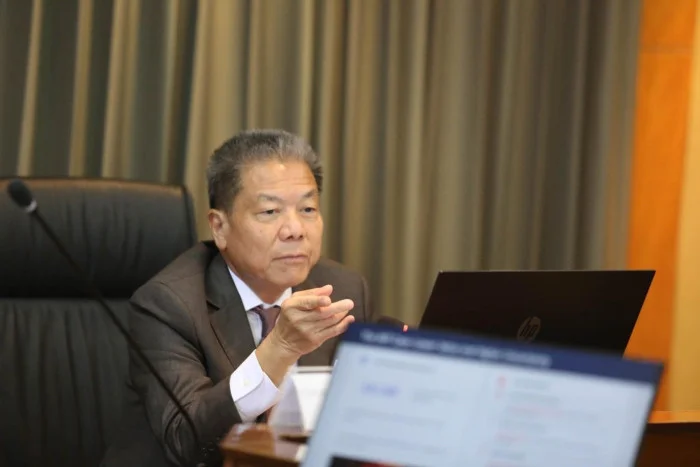
With the National Broadcasting and Telecommunications Commission (NBTC) selection committee deciding to disqualify chairman Dr Sarana Boonbaichaiyapruck, there are several legal implications, including the potential impact on the validity of the regulator's past and future resolutions.
Trairat Viriyasirikul, acting secretary-general of the NBTC, said a board meeting is scheduled for Monday, and it is hard to predict what will happen.
He said he doubts the chairman would attend the meeting, as being embroiled in a legal dispute might affect the validity of its resolutions.
Mr Trairat said the chairman still holds the position and authority because he was appointed by the Royal Gazette, and no notices in that publication have removed him from office.
In addition, he said Dr Sarana can file a lawsuit against the selection committee's resolution, claiming unfair treatment.
However, the chairman has to wait for the committee to send its official ruling to him before making any legal move, Mr Trairat said.
Prime Minister Anutin Charnvirakul told reporters last week any legal implications of the committee's ruling must be considered using the relevant laws, adding that all parties have the right to appeal.
On July 17, the NBTC selection committee voted that Dr Sarana was prohibited from serving as chairman under Article 8 (2) of the 2010 NBTC Act. As a result, he is ineligible to serve in that position, according to Article 18 of the 2021 NBTC Act.
Article 8 (2) states commissioners must not be employees of state agencies or state enterprises, nor directors or advisors to state enterprises or state agencies.
Under Article 18, people approved by the Senate to serve as NBTC commissioners are obliged to present evidence to the Senate president showing they are not prohibited under Article 8.
The evidence submission must take place within the time frame set by the Senate president, before the prime minister submits their names for royal endorsement.
If they fail to submit evidence within the specified time frame, the nominees waive their right to become commissioners and a search for replacements can begin, according to the law.
On Dec 20, 2021, the Senate voted in favour of five of the seven prospective candidates put forward by the selection committee to become new NBTC board members.
On Dec 22, it instructed the five candidates, including Dr Sarana, to resign from any prohibited posts mentioned in Article 8 (1), (2), and (3) by Jan 11, 2022.
All of them were royally appointed on April 13, 2022.
Later, the NBTC selection panel was shown evidence that Dr Sarana still allegedly held temporary employee status as a physician at Ramathibodi Hospital's Faculty of Medicine, with hourly payments from Jan 8 to April 12, 2022.
The selection committee said Dr Sarana can lodge an appeal against its vote with the Central Administrative Court within 90 days after issuance.
Last week, Dr Sarana said he was not a government officer, having resigned from government service on Jan 8, 2022, nor was he an employee.
He said while he was awaiting royal endorsement, he still had duties and responsibilities as a physician, including outpatient consultations.
"These were imperative -- as a physician, I cannot abandon patients and I have to complete my duties," Dr Sarana said.
He said he would consider his legal options regarding the selection committee's vote.
Legal implications
A telecom analyst who requested anonymity said the panel's ruling could prompt both the NBTC office and the government to review the legal validity of board resolutions in which Dr Sarana was involved, as well as any future resolutions.
The NBTC board still faces several major decisions, such as finalising the roadmap and strategies for the digital TV segment as broadcasters' licences expire in 2029.
While Dr Sarana was chairman, the board considered the merger of True Corporation and Total Access Communication. On Oct 5, 2022, the NBTC board (which only had five members at that time) voted 3-2 that it had no authority to consider approving or rejecting the planned merger, paving the way for the amalgamation.
The initial vote was split 2-2, with AM Thanapant Raicharoen choosing to abstain.
Dr Sarana used his power as chairman to cast the deciding vote for the 3-2 decision, supporting the stance that the NBTC has no power to approve or reject the merger. The resolution acknowledged the deal and issued remedy measures.
Prinya Thaewanarumitkul, a law lecturer at Thammasat University, posted on Facebook on July 18 that, according to Article 20 of the 2010 NBTC Act, if commissioners have to leave office after breaching Article 8 (2), the prime minister must seek royal approval to remove them.
This removal takes effect for the dates for which they lack qualifications or are prohibited, depending on the case, according to the law.
Mr Prinya also cited Article 19 of the Administrative Procedure Act of 1996, which states if any administrative officials are found to lack qualifications or were appointed unlawfully, resulting in their removal from office, such removal will not affect any activities they performed in accordance with their duties.
AUTHORITY QUESTIONED
The telecom analyst also questioned whether the selection committee has the authority to vote to disqualify Dr Sarana.
The source said the prime minister submitting the NBTC nominee list for royal approval indicated that the Senate had already verified Dr Sarana's qualifications.
Selection committee member Wisanu Waranyu said earlier during the committee's selection process for Dr Sarana, he was found to be eligible to hold the office.
However, Dr Sarana later faced a complaint about his qualifications. The Senate information and communication technology committee then examined his qualifications and found he had qualification issues.
The secretariat of the prime minister already consulted the Council of State on how to proceed with the complaint regarding Dr Sarana's qualifications.
The Council of State declined to provide an opinion on the matter, noting it was within the selection committee's purview to consider Dr Sarana's case.
Another telecom industry source who requested anonymity said the government should disband the entire NBTC board and start a fresh selection process. This would address issues related to Dr Sarana's qualifications as well as the alleged lack of unity among some NBTC commissioners, said the source.
The NBTC is subject to government oversight, so Mr Anutin should not allow the regulator's problems to hamper its functions any longer, noted the source.
Mr Anutin says any legal implications arising from the panel's ruling on Dr Sarana's qualifications need to be considered under relevant laws. Chanat Katanyu
The NBTC head office on Phahon Yothin Road. A telecom analyst says the prime minister should prevent the regulator's problems from affecting its functions as the agency is subject to government oversight.