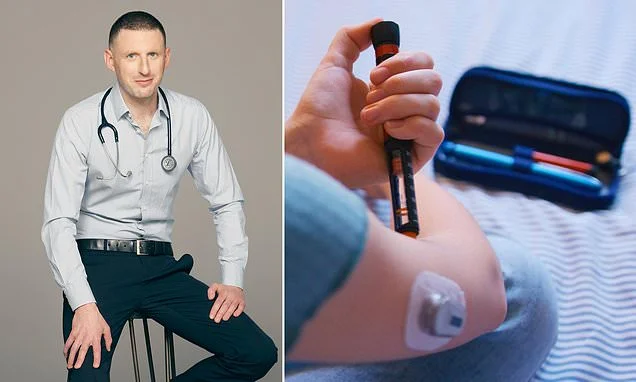
When I was a medical student, type 2 diabetes was thought of as a ‘later-life’ disease, one that typically affected those in their 60s and 70s.
Many people today, some doctors included, still picture type 2 as something that catches up with you in midlife.
Yet figures published last week found a ‘worrying increase’ in women in their 20s developing the condition.
Researchers at Imperial College London, who analysed NHS data between 2011 and 2024, found a 69 per cent increase in new diagnoses of type 2 in women aged 20-29.
The rise in young men of the same age was 43 per cent, so the overall trend for more cases of type 2 in young people seems to be driven by women.
Type 2 diabetes develops when your body stops responding to, or producing enough of, the hormone insulin, causing blood sugar levels to rise.
Now I have no wish to alarm or shame anybody, but many people are very vague about this disease – and long-term complications can be very serious. They include damage to blood vessels leading to heart disease and stroke, foot problems such as ulcers and infections and sight problems including diabetic retinopathy and even blindness.
And developing it at 25 is not a milder version of developing it at 65.
Type 2 diabetes develops when your body stops responding to, or producing enough of, the hormone insulin, causing blood sugar levels to rise
A diagnosis in your 20s means 40 or 50 years of raised blood sugar: during this time, the damage builds quietly and gradually in the small vessels of the eyes and kidneys, in the nerves of the feet and in the arteries of the heart.
Diabetes UK calculates that every week in this country, type 2 diabetes leads to 184 amputations, more than 1,010 strokes, 700 heart attacks and 3,340 cases of heart failure.
What troubles me most is how quietly it arrives. A thirst that never settles, going to the loo more often, tiredness that a good night’s sleep doesn’t shift, blurred vision or cuts that take an age to heal can all be subtle ways type 2 signals its arrival.
Every one of these symptoms can be so easily attributed to stress or simply being run off your feet.
And this is where that old assumption is so damaging. A woman of 25 with those symptoms is unlikely to think of diabetes. I have lost count of the patients who have told me that they had felt ‘off’ and put it down to the stress of work for the best part of a year before finally being diagnosed.
So what are the signs you need to look out for? Women should be alert to recurrent episodes of thrush and repeated urinary infections. Both conditions are miserably common of course, but you should take repeated episodes seriously as they can also be early consequences of raised sugar levels in the urine (as these can encourage bacteria to grow more easily).
Polycystic ovary syndrome and gestational diabetes also mean a raised risk of type 2 and tend to be picked up in this age group. Type 2 is also increasingly linked to obesity and lifestyle factors.
The rising number of young women (and men) who are overweight plays a major role in this spike in diagnoses. This is not because of a lack will power, but because the environment we live in has profoundly changed.
Most of the food within easy reach has been specifically designed to make you consume a great deal of it very quickly – and it can arrive on your doorstep within 20 minutes of being ordered, without even needing a trip to the shops.
But there is more hopeful news, too. Type 2 diabetes can be reversed – as the groundbreaking DiRECT trial demonstrated – and this is easier for a younger person to do than an older one.
In the 2018 DiRECT trial, 46 per cent of the volunteers who had been newly diagnosed with type 2 put the condition into remission within a year following a low-calorie soup and shakes diet for up to five months.
This meant their blood sugar levels had returned to normal and they did not require medication. Success rates were closely linked to the amount of weight lost: 57 per cent of those who lost between 10kg and 15kg reversed their type 2.
This ‘soup and shakes’ programme now forms the basis of the NHS’s effective Type 2 Diabetes Pathway to Remission programme. So if you are worried about a daughter or a granddaughter, don’t start with a lecture about her diet.
We all know that approach rarely works. Instead, ask her when she last had a blood test.
The charity Diabetes UK also has a helpful free online risk score that takes a couple of minutes to complete and a simple blood test at the GP will give a definite answer.
Caught in time, this is one of the few serious diseases that can still be pushed back – and that’s easiest to do at exactly the age many of us still overlook.
Why I worry for Harper
Harper Beckham, the youngest child of David and Victoria Beckham, attending her father's ceremony to receive his star on the Hollywood Walk of Fame
Harper Beckham turned 15 a fortnight ago and, even with her GCSEs ahead of her, is said to be preparing to launch a skincare range called Harlo by Harper, aimed at teenagers with acne-prone skin.
Her name was registered as a trademark when she was only five.
This reminded me of the statement her older brother posted on Instagram earlier this year about the paramount importance of Brand Beckham to his family. In it, Brooklyn said that affection was measured by how much you posted. His parents never publicly commented and I have no idea if this a fair account.
However, it is a description of a particular sort of childhood that I immediately recognise having seen it in my patients.
Children work out very early what earns them warmth. If approval appears to hinge on what they produce, they turn into adults who are marvellous at delivering what is required of them, but are never sure if they are loved or merely useful.
Thousands of people with multiple sclerosis in England became eligible last week for a tablet that may help them to walk again. Fampridine works by helping electrical messages to bypass sections of nerve damaged by MS. In trials it improved the walking speed in 43 per cent of patients by around a quarter. NHS England reckons it will benefit 5,000 people in the first year alone. Yet the drug has been available on the NHS in Wales since 2019, in Scotland since 2020 and in Northern Ireland since 2023. NICE rejected it for England in 2022, deeming it poor value for money. What changed last week wasn’t the science, it was the price as the patent had expired.
Dr Max prescribes... Sliced Bread on Radio 4
The popular BBC Radio 4 series Sliced Bread investigates trending products and consumer fads to see if they are actually revolutionary or not
I’m often asked by patients whether some health gadget or supplement they’ve seen advertised is worth the money – often I have to admit I don’t know. So I am delighted to see that Greg Foot’s brilliant Radio 4 series is back this month to evaluate just this. The programme asks leading researchers in the field to examine products suggested by listeners in a polite but relentless quest to see if the evidence holds up. The programme is worth an hour of anyone’s week. It could save you from poor purchases.