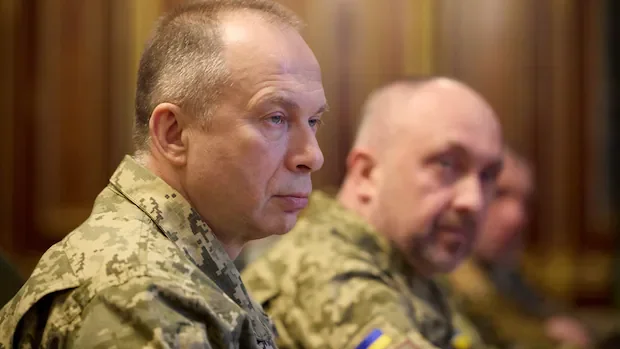
Ukrainian President Volodymyr Zelenskyy on Tuesday fired Gen. Oleksandr Syrskyi as commander-in-chief of Ukraine's armed forces and named his replacement, following days of mass protests in Kyiv, the country's capital, and other cities nationwide demanding his removal.
It was the second major reversal Zelenskyy has made under street pressure, after protests last summer forced him to undo a law weakening Ukraine's anti-corruption watchdogs.
Zelenskyy appointed Mykhailo Drapatyi as the new army chief, according to a statement on social media.
"Our shared wish is one — victory over the enemy and conditions at the front and in pressure on Russia that would force Russia toward peace," Zelenskyy said.
Activists, holding a portrait of Oleksandr Syrskyi, are seen attending a rally in Kyiv on Saturday, in which protesters demanded the army chief's ouster. (Efrem Lukatsky/The Associated Press)
The Ukrainian leader said he made the decision after a series of meetings with military commanders. They began shortly after protests broke out demanding the reinstatement of former defence minister Mykhailo Fedorov, seen by demonstrators as a driver of military modernization, and the removal of Syrskyi, who they said embodied the army's old, Soviet-style command culture.
Zelenskyy thanks outgoing army chief
Zelenskyy thanked Syrskyi for his achievements in Ukraine's fight against Russia and praised him for the defence of Kyiv and for operations in Kharkiv and Kursk.
"I am grateful to Oleksandr Syrskyi and to every one of our warriors for Ukraine's strong front-line positions," he said. "I am grateful to Mykhailo Drapatyi for holding that same view."
Mykhailo Drapatyi, the new commander-in-chief of Ukraine's Armed Forces, looks on during his meeting with Ukrainian President Volodymyr Zelenskyy in Kyiv on Monday. (Ukrainian Presidential Press Office/The Associated Press)
Drapatyi wrote in a Facebook post that serving Ukraine "has always been an honour for me, and during this war for independence, it means absolute responsibility." He thanked Syrskyi for his consistent work strengthening the Ukrainian military.
"I grew up in it," he said, referring to the army. "I will work responsibly, with focus and with respect for the people defending our state today."
Zelenskyy said Drapatyi and other commanders must present an updated defence strategy, including continued reform of the corps system, faster weapons and drone deliveries, stronger air defence against Russian strikes and a clearer mobilization plan.
Zelenskyy met separately with Fedorov on Tuesday and offered him what he called a respected position in government that would unify the country's technology sector. It wasn't clear if Fedorov accepted the offer, or if the latest moves would satisfy protesters.
Fedorov voices approval
Fedorov congratulated Drapatyi, calling the appointment "new hope in the fight of free people for freedom and justice" and "a voice for change that could not go unheard."
Mykhailo Fedorov, seen speaking to journalists in Kyiv last week, congratulated Drapatyi, calling the appointment 'new hope in the fight of free people for freedom and justice' and 'a voice for change that could not go unheard.' (Dan Bashakov/The Associated Press)
Fedorov had criticized Syrskyi publicly before his dismissal, saying the general was blocking his reform efforts and needed to be replaced for Ukraine not to fail in its resistance against Russia.
He said Ukrainians' high expectations must now be met with a clear vision for ending the war, decisive action to preserve soldiers' lives, expand robotic warfare at the front, strike asymmetrically and exhaust Russia's economy.
Fedorov called Syrskyi to thank him for defending the Kyiv region, the Kharkiv operation and other battles, calling it "already an important part of Ukraine's history" but adding that the country must "move even faster and write new chapters, correcting all previous mistakes."
WATCH \| The ballistic missile threat Ukraine faces:
Is Ukraine running out of interceptors? \| About That
Andrew Chang breaks down why Ukraine’s air defences failed to intercept any of the ballistic missiles Russia fired during its latest attack.
Images provided by The Canadian Press, Reuters, Adobe Stock and Getty Images
The crisis began last Thursday, when Zelenskyy overhauled his wartime government, replacing his prime minister and firing Fedorov as defense minister after just six months in the post.
Zelenskyy cited an unworkable rift between Fedorov and Syrskyi, telling reporters that as the two couldn't resolve their dispute, he would "have to resolve it."
Following his dismissal, Fedorov publicly accused Syrskyi of blocking military reforms and fostering a top-down command culture, criticism that echoed complaints from soldiers and veterans over heavy casualties in costly front-line assaults.
Backlash spread to military
The reshuffle immediately drew thousands of protesters into the streets of Kyiv and other cities, framing Fedorov's removal as Zelenskyy siding with an entrenched military old guard over a reformer.
The backlash promptly spread to the military: the Air Force's deputy commander resigned in protest, warning the move would weaken Ukraine's air defences; veterans and soldiers on leave joined the protests in Kyiv and other cities and numerous public figures among soldiers spoke out publicly against Syrskyi on social media.
Syrskyi has long been associated with a Soviet-style, top-down command culture, and many protesters said they wanted a new generation of generals who would place a higher priority on preserving soldiers' lives.
Within the military, Syrskyi has earned the gruesome nickname of "Butcher," which particularly spread during his command of the defence of Bakhmut, one of the war's longest and costliest battles.
Syrskyi became the army's commander in chief in February 2024, replacing Gen. Valerii Zaluzhnyi, who subsequently became Ukraine's Ambassador to the United Kingdom.
Zelenskyy did not mention any new post for Syrskyi, saying he had discussed the four-star-general's future service with him.
Ukraine has been in a state of all-out war with Russia for more than four years, after Moscow launched a full-scale invasion of its neighbour in February 2022.