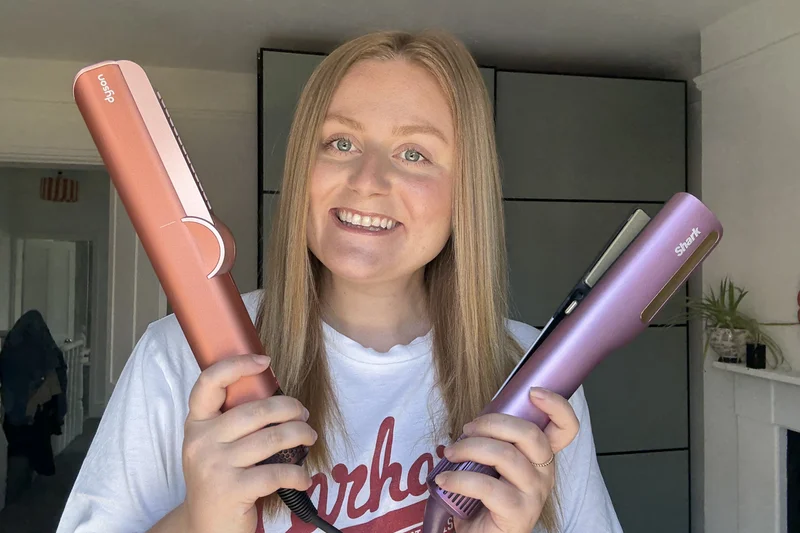
Few launches rivalled the Dyson airstrait when it debuted and kickstarted the wet-to-dry styling trend. But earlier in 2026, the Shark silkipro launched, and with it, posed one big question: can it deliver the same sleek finish for less?
Both devices promise to dry and straighten hair simultaneously, eliminating the need for separate hair dryers and straighteners, but they take very different approaches. As someone who’s tested my fair share of hair tools, I put them head-to-head.
To do a fair test, I used both tools side by side on the same wash day, styling half of my hair with each before comparing everything from drying speed and smoothness to ease of use, heat exposure and overall finish. While the results were closer than I expected, one styler ultimately proved more impressive.
Read more: Best hair dryers, reviewed
Read more: Best hot brushes, tested
- Why we love it- Dries and smooths faster than Shark, even on hefty sections
-
Lack of hot plates help to minimise heat damage
-
Take note- Expensive
- Huge plug attachment
The Dyson airstrait was one of the most intriguing launches in haircare when it debuted, largely because it ditched traditional hot plates in favour of a precisely directed airflow that dries and straightens hair simultaneously. The promise was a streamlined approach: your hair dryer and straighteners into one slick tool, cutting both costs and time. (At £450, though, you can buy a high-quality dryer and straightener for the same price, if not less.)
The tool has separate wet and dry styling modes, three heat settings, two airflow speeds and a small LCD to let you know which mode you’re operating. It also features an automatic pause mode that cuts the airflow after a few seconds of putting the tool down, and restarts as soon as you pick it up again. This helps you to save energy and, if you’re guilty of a “Did I turn the straighteners off” panic, this function will give you peace of mind.
The plates can be locked together to allow you to rough-dry your roots and I’d recommend taking your hair from wet to damp by rough blow-drying if you have thick hair. The styling process is the same as if you were to straighten your hair. Try as I might, though, to give some flick to the ends, I’ve never found the bounce to last.
When in use, the biggest strength against Shark’s iteration is its speed. The airstrait spreads hair evenly across the arms, creating more tension and drying larger sections thoroughly in a single pass. On my naturally straight-to-wavy hair, I consistently needed fewer passes than with the Shark, cutting my styling time by around two to three minutes overall. The finish was sleek, soft and impressively shiny, and my hair had none of the telltale signs (for example, a burning smell or frazzled ends) of heat damage.
While it performs exceptionally well, it’s a seriously expensive tool. The oversized plug, which is about the size of a mango, also isn't at all travel-friendly.
If minimising heat damage is your priority, Dyson still has the edge. Without ceramic plates making direct contact with the hair, it delivers excellent results using air alone, making the £450 sum easier to justify for frequent users who style their hair straight several times a week.
Key specifications
- Modes:Wet and dry
- Heat settings:3
- Airflow speeds:2
- Weight:0.92kg
- Cable length:1.98m
- Voltage (check if travelling abroad):220-240V
Read the full Dyson airstrait review
- Why we love it- Smooth, glossy finish
- Cheaper than high-end straightener and hair dryer combined
-
Functional as a traditional straightener, too
-
Take note- More than one pass needed per section when styling wet-to-dry
- Heated plates increase risk of damage to strands
Shark is undeniably positioning itself as a Dyson airstrait rival with its silkipro. But the tool takes a slightly different approach to achieving the results it promises. It combines high-velocity airflow with ceramic plates that continuously regulate temperature, allowing it to work as both a wet-to-dry styler and a conventional straightener (when used in dry mode). It also includes three interchangeable smoothing combs, designed to grip everything from fine, straight hair to thicker, curlier textures more effectively.
Like the Dyson, it can be locked closed to double as a hair dryer. I found this worked best for rough-drying rather than replacing a dedicated dryer. It also has a cool setting so that you can lock in your style.
One criticism shared by both tools is the size. Neither gets especially close to the roots in wet mode, meaning the hair around my crown took a little longer to dry and smooth than the mid-lengths and ends.
Testing it side by side with the Dyson, I was surprised by just how close the results were. Although the silkipro took more passes to fully dry each section, the finished style was every bit as poker straight and static-free.
In fact, one feature I preferred was how securely it held larger sections of hair between the plates. Where the Dyson occasionally let thicker sections slip out, the Shark kept everything neatly contained, making it feel more like using a traditional straightener (probably because it’s more similar to one).
The plug is also significantly smaller, making it a more practical option for packing into an overnight bag. That said, the ceramic plates mean you're introducing more direct heat than with the Dyson, so it won't appeal to anyone looking to seriously minimise heat exposure, especially because it requires more passes and contact with the plates for a 100 per cent dry result.
If your priorities are value, versatility and achieving a salon-sleek finish without spending £450, the silkipro is an incredibly viable option and comes remarkably close to matching the category leader.
Key specifications
- Modes:Wet and dry
- Heat settings:6 (3 in wet, 3 in dry – all different)
- Airflow speeds:3
- Weight:0.78kg
- Cable length:2.44m
- Voltage (check if travelling abroad): 230V
Read more: Shark’s glam vs Dyson’s airwrap: which hair multi styler is better?** **