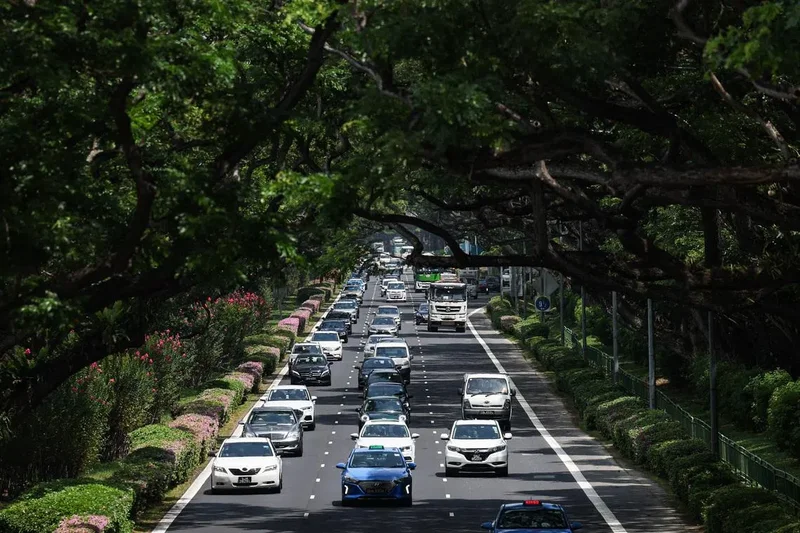
Commuters raise calls to review car ownership policies in transport master plan discussions
AI generated
SINGAPORE – Merging the Category A and Category B certificates of entitlement (COEs) into a single pool and introducing rebates and surcharges based on vehicle value were among the ideas discussed during the refresh of the Land Transport Master Plan.
Based on feedback from more than 400 participants in the second phase of focus group discussions, the Land Transport Authority (LTA) said participants explored ideas for categorising COEs.
These included using vehicle size as a differentiating criterion and allocating COEs based on need – particularly for large families with young children.
They also suggested creating a separate category for car leasing companies, imposing surcharges on those who own multiple cars and removing the Open category (Category E) COEs, which are almost always used for larger and more powerful cars.
At the focus group discussion on this topic, Edward Chia, deputy chairman of the government parliamentary committee for transport, proposed replacing the Category A and B COEs with a single COE pool. He suggested offering discounts for vehicles with lower open market values and imposing surcharges on those with higher values.
Open market value refers to the cost of a car at the point of import into Singapore, without factoring in the COE premium and other taxes or charges.
This follows participants’ observations that engine capacity and engine power rating criteria have become less effective at differentiating between mass-market and higher-end cars.
At present, Category A is for cars up to 1,600cc and 130bhp, as well as electric vehicles (EVs) with a maximum power output of 110kW.
Meanwhile, Category B is used to register larger, more powerful cars above 1,600cc or 130bhp, and EVs with a maximum power output above 110kW.
Ang Wei Neng, MP for West Coast-Jurong West GRC, and Chia both said manufacturers have been adjusting car specifications to allow their vehicles to qualify for Category A COEs, pushing premiums closer to those for Category B.
Chia noted that Category A COE premiums had exceeded those for Category B on two occasions: Feb 20 and April 22. This happened again for the third time on June 17.
At the most recent COE bidding exercise on July 22, the Category A premium ended at $126,000 – $3,890 lower than that of Category B, which closed at $129,890.
Beyond car ownership policies, participants also discussed improving alternatives to cars, including enhancements to first- and last-mile connectivity through the installation of more cycling infrastructure and sheltered walkways.
They also called for greater prioritisation of pedestrians and public transport over cars in road and traffic design, and highlighted the need for more accessible and family-friendly car-sharing services.
LTA said in a press release on July 27 that it will issue a consultation paper later this year to seek detailed public feedback on the proposed policy options before completing this review by the end of 2026.
On the topic of community, participants looked into how roads and paths could better accommodate the varying needs of pedestrians, cyclists and riders.
LTA staff shadowed commuters across 21 profiles during their journeys, gaining insights into the challenges faced by different groups. For example, they found that people with visual disabilities struggle to identify the direction of fare gates and escalators, and often rely on memorising routes to navigate the public transport network.
To improve road safety, many requested greater pedestrian priority in high-activity areas such as town centres, as well as speed-calming measures and lower speed limits.
They also noted the importance of gracious behaviour to reduce conflicts between different road users in shared spaces, such as setting up clearer norms for safe path-sharing and overtaking.
Micromobility also came up as a topic, given that bicycles, power-assisted bicycles and e-scooters complement public transport.
Participants, however, noted that greater adoption of such devices would hinge on improvements in safety, comfort and infrastructure, as well as more responsible user behaviour.
They expressed support for a more connected and dedicated micromobility network, including wider segregated paths, more sheltered routes and stronger integration with public transport.
They saw potential in shared motorised micromobility services, although they emphasised the importance of strengthening infrastructure and safety measures first.