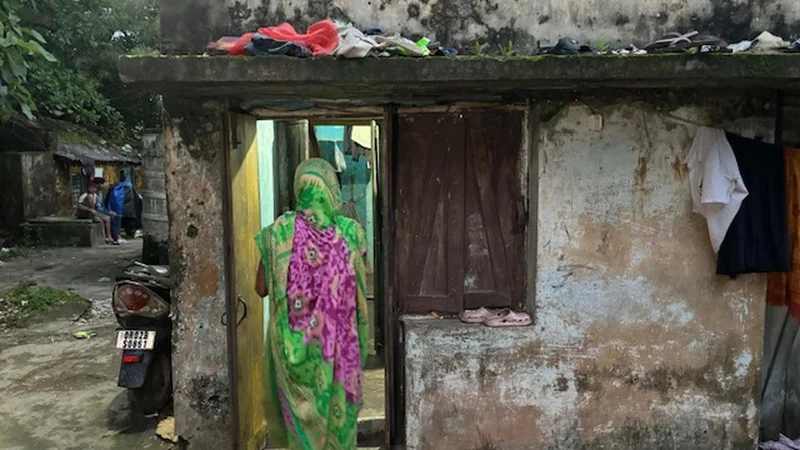
At 16, Radura Naik looks aged way beyond his years. Ever since his father, Susanta Kumar Naik, 38, was crushed to death at a worksite in Maradu, Kerala, nearly four years ago, fate has dealt Radura — then on the cusp of adolescence — a cruel bargain.
When the family was forced to leave their home in Ekalpur village in Odisha’s Kendrapara district and move to Bhubaneswar to survive after losing its sole breadwinner, Radura had to drop out of school after Class VIII and take up a physically demanding full-time job at a two-wheeler garage.
Muskan, meaning smile, reads the name of the garage along Cuttack Road. But smile is what seems to have deserted Radura’s life for good.
His paltry monthly salary of ₹2,000, together with his mother Babi Naik’s, 35, highly irregular daily wages, barely sustains the family’s hand-to-mouth existence. Radura’s three younger siblings — two sisters aged 12 and 10, and a brother aged 6 — still attend school, though how long they can continue remains uncertain.
Susanta Kumar, along with his relative Sankar Naik, 28, was crushed under a concrete slab while demolishing a two-storeyed house on October 26, 2022. Nearly four years later, the family is yet to receive any compensation, though litigation is in advanced stage before the employees’ compensation commission in Kerala.
“We had to come to Bhubaneswar to survive somehow since there was no work back in our village. I go to a nearby square every day, and if I am lucky, I get hired. At best, I find work for around 15 days a month, with a daily wage of about ₹500. We have to pay ₹4,000 in rent, including the electricity bill, and meet other expenses from what little my son and I earn,” Babi said, her children milling around her in front of their home in a chawl at Champa Pokhari in Chintamaniswar, Bhubaneswar.
What the family calls home is essentially a three-room matchbox-like shack, painted a dull blue inside, with hardly any ventilation, hemmed in by similar jerry-built houses and open drains. The door opens into a cubbyhole that passes for a sit-out, with an empty chottu gas cylinder on the floor and a few folded clothes in a wall cabinet. The bedroom is no different, with clothes hanging all around, and a kitchen tucked behind.
When their mother is away at work, the children are left alone in this house. And this happens often, after school and on holidays. Babi can scarcely afford to skip work to ensure their safety without risking food on their plates.
Unexpected medical expenses make an already precarious life even harsher, as happened earlier this week when one of her daughters injured her leg, draining ₹1,500 from their fragile budget. Her younger daughter suffers from a skin disease too, which remains largely untreated.
When her husband died, ending their 15-year marriage, Babi was in shock and hardly in a state to think of compensation. “I signed some documents handed to me by relatives, and my husband’s employer called to assure me that everything would be taken care of,” she recalled. Nothing was taken care of though.
The proceedings for compensation continue before the Commissioner for Employee’s Compensation, a quasi-judicial tribunal-like body under the Employees’ Compensation Act. “Earlier, the Deputy Labour Commissioner handled compensation matters. Now the Labour Department has little role except to submit relevant reports to the compensation commission,” said Minoy James, District Labour Officer, Ernakulam.
Centre for Migration and Inclusive Development (CMID), which initiated the legal battle for compensation, observed that the lack of responsiveness from parties concerned often determines the fate of litigation. “In this case, the litigation is at an advanced stage since we, along with Gram Vikas (an Odisha-based NGO working for migrant welfare) are closely following up the matter. But very often, unresponsiveness on the part of the parties concerned leads to a stalemate in litigation. The deceased rarely have relatives in Kerala to pursue compensation, and hence, in many instances, cases do not even get filed,” said Benoy Peter, executive director, CMID.
“Initially, there was a delay in obtaining the documents from the victim’s family in Odisha and arranging them properly. For instance, the vakkalatnama was submitted with a thumb impression made using cutex. The post-mortem report too was delayed, as it is handed directly to the relatives. Conducting the litigation from a long distance further hampered progress. Moreover, there is only a single tribunal for Pathanamthitta, Alappuzha, Ernakulam, and Idukki districts, which holds limited sittings in each district every month,” said Bobby Thomas, counsel for the victim’s family.
(The correspondent was in Odisha recently at the invitation of CMID and Gram Vikas as part of familiarising media with Odisha-Kerala migrant corridor)
Published - July 27, 2026 12:44 pm IST