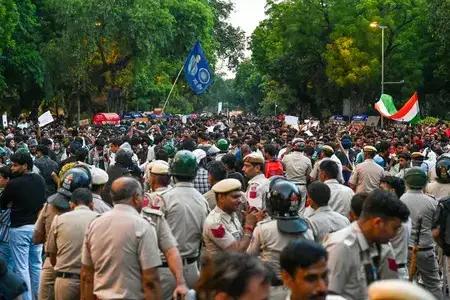
Student protests have played a defining role in shaping modern India. While many campus demonstrations remain local, some have gone far beyond university walls, influencing governments, changing public policy, and leaving a lasting mark on the country's political and educational landscape.
From language rights and reservation policies to electoral reforms and examination transparency, students have repeatedly emerged as catalysts for change. Here are five of the most significant student-led movements in independent India and the impact they created.
1. Anti-Hindi Agitation (1965): The movement that reshaped Tamil Nadu politics
One of the earliest and most influential student movements in post-independence India emerged in Tamil Nadu in 1965.
The immediate trigger was the implementation of the Official Languages Act, under which Hindi was expected to become the primary official language of the Union, replacing English after a transitional period. Many students and political groups in Tamil Nadu feared that this would disadvantage non-Hindi speakers in education, employment and government services.
Thousands of students joined demonstrations, strikes and marches across the state. Educational institutions remained disrupted for weeks, and protests continued for nearly two months.
The agitation prompted the Central Government to assure that English would continue as an associate official language alongside Hindi for official purposes.
Politically, the movement marked a turning point in Tamil Nadu, significantly weakening the Congress party's dominance and paving the way for the rise of Dravidian parties, which have remained influential in the state ever since.
2. Nav Nirman Andolan and the Bihar Movement (1974): When students challenged corruption
The Nav Nirman Andolan began in Gujarat in late 1973 when engineering students protested against a hostel mess fee hike. What started as a campus issue quickly expanded into a broader movement against inflation, corruption and administrative failures.
Around the same time, students in Bihar launched their own agitation under the Chatra Sangharsh Samiti, demanding educational reforms and action against corruption.
1974: A student agitation by the Bihar Chatra Sangharsh Samiti received the support of Gandhian socialist Jayaprakash Narayan, referred to as JP, against the Bihar government.Meanwhile, in Patna, JP called for "total revolution," asking students, peasants, and labour unions to non-violently transform Indian society. He also demanded the dissolution of the state government, but this was not accepted by Centre.Another significant movement was the Nav Nirman movement in Gujarat, between December 1973 and March 1974.
Veteran freedom fighter Jayaprakash Narayan, popularly known as JP, later extended his support and called for "Sampoorna Kranti" (Total Revolution), urging peaceful democratic change.
The movement evolved into one of India's largest mass mobilisations against the government and is widely regarded as one of the major political developments preceding the declaration of the National Emergency in 1975.
3. Assam Agitation (1979â1985): A student movement that led to a historic accord
The Assam Agitation remains one of the longest-running student-led movements in India's history.
Led primarily by the All Assam Students' Union (AASU), the movement demanded the identification and deportation of undocumented immigrants whose names, according to the protesters, had entered electoral rolls.
Assam witnessed six-year anti-foreignersâ movement during 1979-1985, culminating in the Assam Accord of 1985.
For nearly six years, protests, rallies and negotiations dominated public life in Assam, affecting governance and elections.
The movement concluded in 1985 with the signing of the Assam Accord between the leaders of the agitation and the Government of India. The agreement laid down procedures for identifying and addressing illegal immigration and continues to influence political and demographic debates in the region.
4. Anti-Mandal Commission Protests (1990): A debate that reshaped reservation politics
Few student movements generated as much national debate as the protests that followed the implementation of the Mandal Commission recommendations in 1990.
The V.P. Singh government announced 27% reservation for Other Backward Classes (OBCs) in central government jobs, triggering widespread protests, particularly among students in Delhi and several northern states.
Anti-Mandal Commission Protests (1990). (Getty Images)
Demonstrations, strikes and clashes occurred across numerous campuses. The period also witnessed tragic incidents of self-immolation attempts by protesting students, bringing the issue into national focus.
While the implementation of OBC reservations continued through subsequent legal and constitutional developments, the movement fundamentally changed public discourse on social justice, affirmative action and reservation policies. It also contributed to major political realignments during the early 1990s.
5. Jantar Mantar Education and Paper Leak Protests (2026): A new generation raises questions
The latest addition to India's history of major student movements emerged in 2026, when thousands of students gathered at Jantar Mantar in New Delhi.
The protests centred on repeated examination paper leak allegations, concerns over recruitment examinations, demands for greater accountability in competitive testing, and broader questions related to employment opportunities.
Students at Jantar Mantar are using art to protest alleged paper leaks
Students from different states and educational backgrounds participated in demonstrations, with several undertaking prolonged hunger strikes. The movement also drew support from public figures, education activists and civil society groups, bringing national attention to examination reforms and governance in the education sector.
The demonstrations intensified public discussion on examination security, transparency and institutional accountability. As policy discussions continue, the long-term impact of the movement on India's examination and recruitment systems is still unfolding.
Why student movements matterHistory shows that student protests often begin with issues that directly affect young peopleâlanguage, education, examinations, employment or equal opportunity. However, many eventually evolve into wider debates about governance, democracy and public policy.
From the Anti-Hindi Agitation that transformed Tamil Nadu's political landscape to the recent education-related protests that reignited conversations about examination reforms, students have repeatedly demonstrated their ability to influence national discourse.
While each movement emerged under different circumstances and reflected different political viewpoints, they collectively underline one important lesson: organised student voices have frequently played a significant role in shaping India's democratic journey.
Disclaimer: This article is intended to provide a historical overview of major student movements in India based on publicly available historical records and recent media reports. The inclusion of any movement does not imply endorsement of its methods, demands or political positions. The long-term impact of recent events, including the 2026 Jantar Mantar protests, will become clearer as policy developments continue.