We moved down to the ’Ninch in early 2021, right in the middle of when the whole country was saying “unprecedented” every second sentence. In between homeschooling, panic-bought canned goods and an alarming amount of banana bread, we somehow packed up our city life and headed south.
Soon after we arrived, someone casually mentioned that it takes eight years to count as a local here in Mount Martha. Five-and-a-half years on and we are still firmly on our L-plates. The first real sign that things were different came on school drop-off at the beginning of the school year. The kids did a slow sweep of the playground, then turned to me, completely baffled.
“Why does everyone look the same?”
We realised pretty quickly that our new local primary school was nothing like the messy, multicultural jumble we had loved and left behind in Melbourne’s inner city. According to the last census, about three‑quarters of Mount Martha’s roughly 20,000 residents were born in Australia and most speak only English at home.
The age profile tilts well into the 40s and beyond. It has long been blue-ribbon central, or to put it plainly, full of retirees, Range Rovers and golden retrievers. I often say that if reincarnation is real, I want to come back as a golden retriever on the peninsula. That is clearly the top of the evolutionary chain and the grooming budget on those fluffy blonde locks definitely exceeds my own.
We did not end up in Mount Martha by accident. We spent our weekends zigzagging down the peninsula, trying out suburbs. My husband, being the loveable nerd he is, built detailed spreadsheets to compare postcodes. Anything up to Mornington felt too much like an outer suburb of Melbourne, definitely convenient, often lovely but still in the city’s orbit. Closer to the pointy end of the peninsula, places like Dromana and Rosebud have their charms but felt busier, with more of a holiday than home vibe.
Mount Martha still feels like a place with edges, even if there is not a lot of edginess. Some streets are still half-dirt, the shops are more practical than pretty and the Nepean Highway acts like a moat, stopping the sprawl from turning us into something bigger and blander.
You are close enough to be back in Melbourne in “about an hour”, depending entirely on whether Peninsula Link is behaving or auditioning as a car park, but far enough that the city feels like somewhere you visit. I have even heard myself calling it “the big smoke”.
You can feel the place changing. Young families are moving in and bringing new energy and different worldviews with them. The once firmly blue political dial has started to twitch, a small sign that “stale, pale and male” thinking belongs to yesterday’s peninsula. The shift is slow (some would say glacial) but you can feel it in the school gate chatter, in community groups and in the odd rainbow flag appearing in shop windows at the local village.
Yes, we still call it a village.
Most nights, my husband and I end up indulging in the suburb’s favourite spectator sport, reading the Mount Martha Grapevine. It is the local Facebook page that leaves us despairing and laughing in equal measure. Forget Netflix, nothing beats the drama of a 200-comment argument about potholes, parking or an unleashed oodle on South Beach. We call it “pillow talk for peninsula people”. If you scratch the surface of a pothole thread, you often find something else underneath: anxiety about growth, outsiders and what this place is turning into.
Before it became a full-time suburb, Mount Martha was mostly a summer bolthole for wealthy city-folk and a scattering of fishermen and farmers. Grand old guesthouses took pride of place on the hill, and the more modest shacks appeared nearer to the sand.
Walk through the streets now, and you can see the town’s evolution in real time. Hamptons-style new builds sit beside weathered ’70s beach houses, like influencers brunching with their parents. Freshly painted weatherboards share fences with old fibro cottages and somehow it all still works.
Summer brings its own buzzy soundtrack. Every weekend, the steady mosquito-like whine of jet skis competes with the cicadas. By February, once the holiday hordes have retreated up the highway, Mount Martha exhales again. The sleepy rhythm comes back and it is all slower mornings, shorter queues and a bit of actual stillness.
The beach feels like it belongs to locals again. On any given day you might share the water with dolphins, seals or stingrays. The water turns glassy, the sand is a mix of pretty and gritty (be careful not to step on a pufferfish) and the whole scene feels pretty darn dreamy.
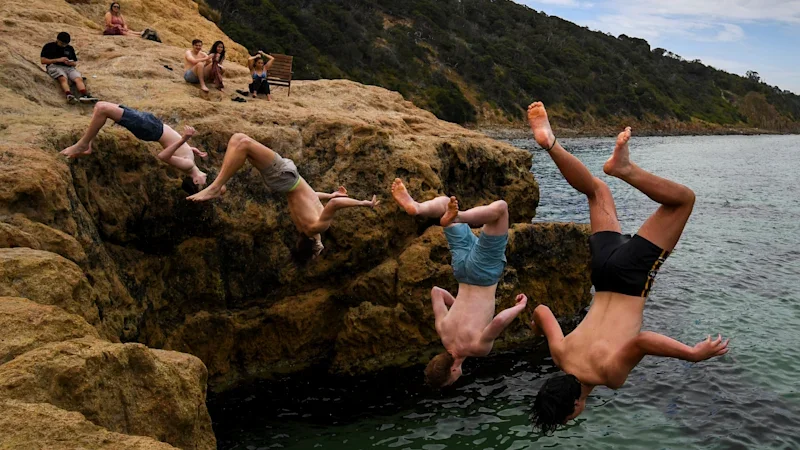
The kids roam free in a way that feels almost retro, like the 1980s but with more expensive mullets and an electric scooter. On a Saturday night, you see them hanging out at, behind and on top of the beach boxes that line the sand, a modern-day version of Puberty Blues. You might also find them gathering at the Pillars, although the much-loved spot is now so Insta-famous that it can be hard to find a place on the rocks to laze away a warm day.
Now and then the suburb’s bubble of calm gets pricked. There was a time recently that Liam Gallagher rented a place for a short stint and the entire suburb behaved like a neighbourhood watch group for Britpop. Middle-aged men started appearing in adidas jackets and bucket hats while buying vanilla ice cream at the IGA, all hoping to chance a run-in with their hero.
The move has not been entirely idyllic. The drive home from the MCG on a Thursday night can feel very long, especially if Carlton lose. On the upside, our local footy oval has a Jacob Weitering wing, which puts a smile on the face of this Blues tragic.
There are moments I miss the city, but every time I wake to the sun hitting the bay and I grab a coffee at Cibo (which is better than any city laneway cafe and, in my completely biased opinion, good enough to rival Rome) I remember why we came.
Among the salt air and the suburban squabbles we have found a community that feels like ours, in the way we know our neighbours’ names, we cannot get fish ‘n’ chips without happily running into three people we know (including the teens behind the counter), and help is always on hand if we ever find ourselves in a pickle like a flat tyre or locking ourselves out.
Eight years might make you a local, but even after five we feel at home and on winter mornings, when the sea wolves (the women who swim year-round) charge out of the bay laughing, it feels like the truest version of the place, slightly ridiculous, a little privileged and tougher and warmer than it first appears.
Edwina Pearse is a communications consultant.
The Opinion newsletter is a weekly wrap of views that will challenge, champion and inform your own. Sign up here.