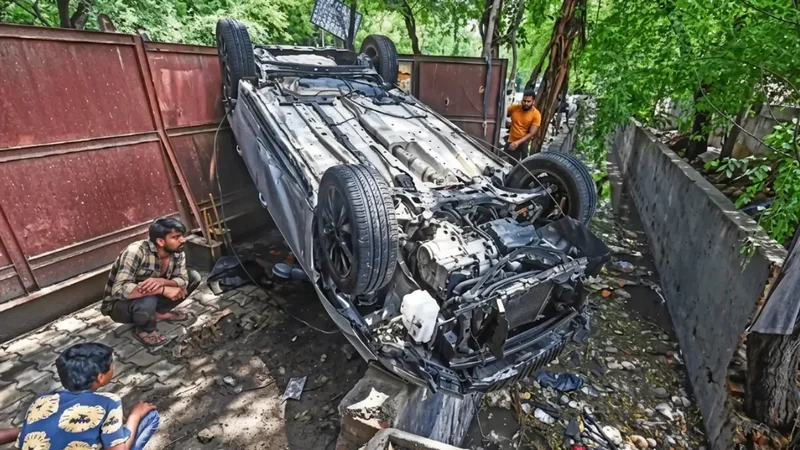
Another young life has been claimed after a vehicle fell into a drain in the national capital, once again laying bare a civic failure that Delhi has seen time and again over the years. Expert warnings, standard engineering guidelines and multiple deaths have not deterred open drains, poorly barricaded construction sites and unsafe roads from making everyday journeys deadly.
The tragic death of 20-year-old business student Yashvendra Singh should not have happened. Singh, who was in town for a short summer break from the US, had barely spent 10 days with his family before his life was cut short inside a drain in Delhi. Local residents jumped into the filthy water trying to rescue him, as friends frantically called for help, but he remained trapped inside the driving seat with his seat belt jammed as drain water filled the vehicle. By the time the police got him out and rushed him to the hospital, it was too late. His death has once again brought to light a painful reality that Delhi-NCR has refused to acknowledge despite years of similar tragedies.
Every few months another young commuter dies when an uncovered drain, an unprotected construction pit or a missing safety barrier turns an ordinary road into a death trap.
How a drive turned fatal
Yashvendra Singhâs death is not an isolated incident. It is part of a series of disturbing preventable tragedies in Delhi and the National Capital Region. In January, 27-year-old software engineer Yuvraj Mehta drowned after his SUV crashed into a broken boundary wall and plunged into a flooded pit at an under-construction commercial project in Noidaâs Sector 150. Dense fog had cut visibility as he negotiated a sharp curve but residents later pointed to a much bigger problem â the absence of streetlights, reflective boards and adequate barricades that could have alerted drivers. A deadly hazard, instead of a protected construction site, waiting for its next victim.
There were episodes during the year. In June, a 36-year-old man was killed after falling into an open drain in Narela in outer Delhi. In February, a 32-year-old man died after falling into an uncovered drain near a temple in Rohiniâs Sector 32. A similar incident took place in Janakpuri in which 25-year-old Kamal Dhyani, who was working in a call centre of a private bank, was returning home on his motorcycle when he fell into a 14-foot-deep construction pit and died. The victims, the neighbourhoods and the agencies involved may differ, but the root cause is strikingly similar: essential civic safety measures were either absent or woefully inadequate.
Most of the drain has neither protective covers nor barricades
The tragedies are particularly heart-wrenching because most of the victims are young people, simply going to work, college or home. Yashvendra Singh had travelled thousands of miles from Indiana to spend time with his parents and grandfather who is being treated for cancer in Delhi. Yuvraj Mehta was on his way home from work. Kamal Dhyani was returning home after finishing his shift. None of them took any great chances. Instead, they found infrastructure that didnât protect them when things went wrong. Road safety experts often say that modern roads forgive human error. In Delhi, however, even a minor driving mistake can become fatal because the road itself offers no margin for survival.
Roads break the rules of safety engineeringâThis repeated accidents shows a total failure to enforce basic engineering standards,â says former deputy transport commissioner Delhi, Anil Chhikara. According to him, protective barriers, reflective signage, guard rails and adequate lighting are not optional facilities but mandatory safety features, particularly around drains, construction zones and sharp curves. âOn poorly lit roads, drivers lose their spatial judgment and cannot tell where the road ends and a drain or excavation begins.â Visibility is even further reduced in fog or heavy rain, leaving motorists little or no chance to react before disaster strikes.
Traffic consultant Rajeev Sharad says India already has detailed engineering standards for protecting dangerous locations. Standard design practices require strong railings, CCTV surveillance, blinking lights, speed calming measures, reflective signboards and adequate buffer zones between roads and drains. If implemented properly, even a vehicle that skids or loses control should not fall directly into an open drain. But these measures are absent, poorly maintained or removed altogether once construction begins across Delhi and NCR.
Monsoon transforms Delhiâs civic failures into deadly hazardsThe rainy season exposes every weakness in Delhi's urban infrastructure. Open drains, damaged manholes and deep construction pits hidden under the muddy floodwater litter the waterlogged roads. Drivers frequently cannot tell the difference between a flooded road and an open drain, particularly at night or during heavy rain. Temporary barricades fall down, warning lights fail and reflective tapes vanish, rendering dangerous areas virtually invisible. Ironically, the season when civic negligence is most dangerous is the time when authorities should tighten safety arrangements.
Construction activity compounds the risks. The flyovers, Metro extensions, sewer networks and housing projects are all coming up at once, and Delhi and NCR remain among the countryâs biggest infrastructure hubs. Construction is a fact of life, but experts say the problem is a history of bad management on the sites. Barricades are often incomplete, excavation pits are left uncovered after working hours and warning signs do not even meet the minimum standards for visibility. These unfinished sites become death traps for commuters, especially those travelling early morning or late at night.
Indiaâs bigger road safety crisis exposed by numbersThe series of incidents in Delhi also highlight the bigger road safety issue in India. In 2023, more than 4.6 lakh road accidents occurred in the country resulting in nearly 1.73 lakh fatalities and more than 4.6 lakh injuries, the Ministry of Road Transport and Highways said. That works out to nearly 474 deaths a day on Indian roads. While speeding is a factor in many crashes, it is often the inadequacies of the road infrastructure (including unsafe construction zones, poor lighting, lack of crash barriers and dangerous roadside conditions) that determine whether a crash is survivable or fatal. City planners say these civic hazards get little attention compared to reckless driving, despite their role in many deaths.
Too many agencies, not enough accountabilityPerhaps the biggest reason these tragedies continue is the fragmented system of accountability. Municipal corporations maintain drains, the Public Works Department maintains major roads, development authorities maintain construction projects, and a lot of the work is carried out by contractors. Accidents involve multiple departments, which slows the fix. When someone dies there are inquiries, talk of compensation and agencies promising to do better. But months later another accident reveals little has changed on the ground. Experts warn that if institutional accountability is not fixed, Delhi will continue to react to tragedies rather than prevent them.
Delhi already knows the answer â but what is lacking is implementation.
According to road safety experts, stopping these deaths does not require revolutionary technology or significant investment. Regular road safety audits, especially before and during monsoon, can identify dangerous locations well ahead of accidents. Permanent protective railings should be erected to every drain adjoining a roadway. Every construction site should be illuminated throughout the night. Reflective signboards, flashing warning lights, speed calming measures and clearly marked diversions should be mandatory, not optional. Technologies like CCTV surveillance, drone inspections and GIS-based monitoring can further help the authorities identify missing barricades and compromised safety infrastructure before they claim lives.
How many more young lives before Delhi acts?Yashvendra Singhâs death is not another accident statistic. It is a story about a young man who returns home from abroad to spend some time with his family but ends up losing his life in a city drain. This is after the deaths of Yuvraj Mehta, Kamal Dhyani and several others who were briefly in the news before disappearing from public memory. All of these tragedies had familiar warning signs: missing barricades, open drains, poor lighting and inadequate engineering safeguards. There is no dearth of expertise, of design standards, of what needs to be done in Delhi. What it lacks is consistent enforcement and accountability. Until then, the capital runs the risk of asking the same heartbreaking question after every preventable death. How many more lives must be lost before the city finally gets it?