Although Venezuela remains in mourning for the more than 5,500 people killed in the June 24 earthquake, many Venezuelans had already been carrying a different kind of grief for the past two years. July 28, 2024, opened a fissure in Venezuela that is still there two years and one U.S. intervention later. At the center of that fracture is Chavismo, the ruling movement founded by the late president Hugo Chávez.
In the 2024 presidential election in Venezuela, Nicolás Maduro stayed in power despite the opposition’s allegations of fraud. Now the former president is imprisoned in a New York jail alongside his wife, Cilia Flores. At the same time, a new round of negotiations with Chavismo, which survived the U.S. military intervention on January 3, is set to begin on August 1. This chain of events has once again placed Venezuela at a crossroads.
The 2024 presidential election appeared to be the final stretch of a long and exhausting marathon to achieve political change through the ballot box. With opposition leader María Corina Machado barred from running, the Barbados Agreements (a 2023 deal between the Maduro government and the opposition aimed at securing freer and more competitive presidential elections) virtually defunct, and an electoral authority widely questioned, millions of Venezuelans went to the polls determined not only to vote but also to document the results at every polling station. That extraordinary civic mobilization became a portrait of a country seeking an institutional solution to its crisis after more than two decades of Chavista rule.
The election set off a chain reaction that continues to shape the present. “Without July 28, there would have been no January 3,” says political communications consultant Carmen Fernández. Chavismo was shaken and chose to bunker down in the face of an opposition that has since insisted that the election was won by Edmundo González Urrutia, the candidate chosen to represent the opposition after Machado was banned from running.
Venezuela’s National Electoral Council (CNE) never published a detailed breakdown of the election results. The tally sheets collected by the opposition, however, circulated around the world. Based on 83% of the official voting-machine records, the opposition maintains that it won 67% of the vote, or roughly 7.4 million ballots, compared with 30% for Chavismo, equivalent to about 3.3 million votes.
But what followed was one of the most repressive periods in recent years. More than 2,000 political prisoners, an undetermined number of exiles, and an intense campaign of surveillance and persecution by intelligence agencies demobilized much of society. Venezuelans began speaking about politics in whispers, if they spoke about it at all. Leading opposition figures, including Machado, were forced into hiding.
“There have been major electoral frauds in Latin American history, but none as brazen as this,” says historian Pedro Benítez. “Maduro was exposed on July 28, with fewer and fewer people willing to defend him and a population unable to resist what happened afterward,” he adds, referring to the U.S. military operation of January 3 and the beginning of Washington’s oversight of the interim government.
On the international stage, Maduro’s removal from power generated only muted opposition, if any at all. Within Chavismo itself, Maduro’s image gradually began to fade.
Coercion and contradiction
Two years later, the political meaning of that election has changed. Demonstrations have been called in Caracas for July 28 to mark the anniversary, but the demand that Edmundo González Urrutia’s victory be officially recognized has lost momentum in favor of a different priority: building a new path toward free and competitive elections. That is the agenda Washington has promoted through Dinorah Figuera, president of the National Assembly elected in 2015, the only Venezuelan institution that the United States still regards as legitimate and one that retains legal authority over certain Venezuelan assets in the country.
“Even if people wanted the vindication of the 2024 results, that possibility was ruled out by the United States and by the main actors,” says political scientist Benigno Alarcón. “But it must be remembered that, regardless of Edmundo González’s merits, people voted for María Corina Machado through him. What they demand is to see her governing.”
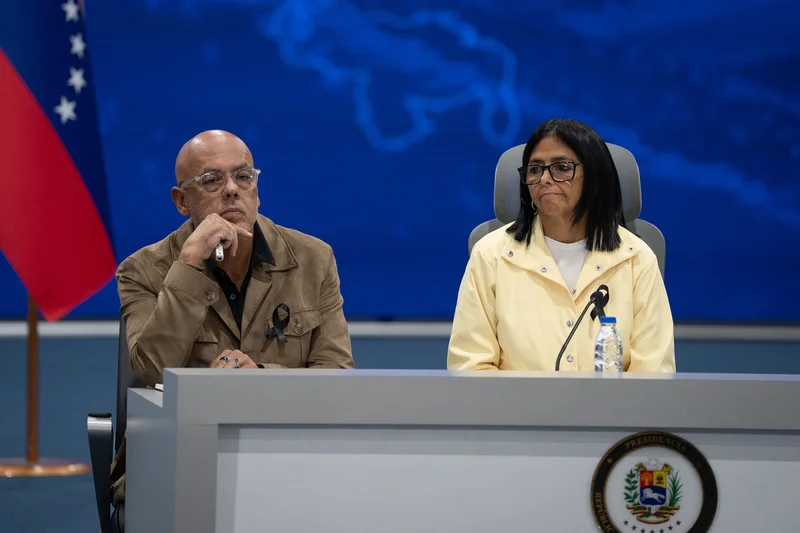
Even so, Chavismo continues to defend its version of events. In a recent interview with Spanish journalist Javier Negre, acting President Delcy Rodríguez insisted that Nicolás Maduro had been legitimately elected in 2024 and accused the opposition of falsifying the tally sheets on which it bases its claim to victory.
As acting president, Rodríguez now derives much of her international legitimacy from the backing she periodically receives from Donald Trump. Last week, the U.S. president again praised her and stated that Venezuela is not yet ready to hold elections, despite the imminent launch of a roadmap intended to lead to a new vote.
As Fernández notes, Trump’s strength as a negotiator lies in his unpredictability. Jorge Rodríguez, the president of the National Assembly, struck a similar tone not long ago when he said the government did not have the “headspace” to think about an electoral process in the midst of the national emergency.
“It’s almost an insult for politicians to sit around deciding who should sit on the National Electoral Council,” he told a press conference. But 72 hours later, he reversed course and confirmed that talks would begin on August 1.
For Alarcón, the biggest weakness of the negotiations is the absence of María Corina Machado. “The talks are beginning with a fractured pillar. Without María Corina, the sustainability of any agreement is at risk once a new government takes office,” he says.
Machado and the opposition’s Unitary Platform have avoided publicly criticizing the initiative before its launch, even though Washington’s move caught them by surprise. On Sunday, Machado said in a statement that she was not participating in the process, but neither would she stand in its way if it produced progress toward democratization.
Fernández believes that, despite the uncertainty, one fact is clear: sooner or later, Venezuela will have to re-legitimize all branches of government through elections. “This has not been presented as a traditional negotiation table, but as a way to begin the transition,” she explains.
The U.S. State Department has backed the talks between the 2015-elected National Assembly and the interim government headed by Delcy Rodríguez.
“What is being defined now is the initiative’s dual objective,” Fernández adds. “On one hand, to reach an electoral agreement and, on the other, to establish legislative bases that legitimize foreign investment and debt refinancing. The United States is intent on doing big business with Venezuela, but there is a legal vacuum. The 2015 National Assembly, for example, did not enact the hydrocarbons law and for that reason it is on shaky ground.”
Analysts agree that the success of the talks will depend on three factors: Washington’s ability to exert pressure on both sides, the speed with which tangible results are achieved, and the degree of legitimacy Machado chooses to grant the process.
“Only then could a relatively balanced negotiation emerge and avoid repeating the pattern of the previous 17 rounds of talks, in which the side with the greatest power ultimately violated the agreements,” says Alarcón. “What has been clearly demonstrated in this case is the United States’ capacity for coercion.”
That debate also runs through the opposition. Henrique Capriles has publicly argued that Machado must be involved. Other opposition figures have called for broader representation at the negotiating table. Dinorah Figuera herself ended up describing the opposition leader last week as an indispensable figure for the process.
Earthquake disaster reshapes political landscape
The June 24 earthquakes also changed the political context in which the talks are set to begin. Benítez notes that major disasters often accelerate political change by placing additional strain on existing power structures.
Machado has been outside Venezuela since December, when she left to receive the Nobel Peace Prize. She has not returned because of the threats that still hang over her, even though Chavismo was forced to accept a limited political opening after Maduro’s fall in January. When she attempted to return shortly after the earthquakes, she accused Chavista officials of pressuring her to stay away.
“So far you could say it has won the earthquake race,” says Alarcón. “It has greater flexibility to mobilize resources, it has received international financial support and donations are beginning to arrive more directly. That gives it some breathing room.” However, he warns that the tragedy has further eroded the legitimacy of the interim government led by Delcy Rodríguez, which could spur new social protests and deepen internal tensions within the ruling bloc.
The available data seem to point in that direction. The latest Atlas Intel poll for Bloomberg, conducted after the earthquake, found that 65% of Venezuelans disapprove of the government’s handling of the emergency.
“The perception that has taken hold is that Chavismo is not only incompetent, but acted with criminal negligence, that the Venezuelan state lost the capacity to protect its citizens,” says Fernández.
The talks beginning on August 1 will show whether this new landscape, together with the factors shaping Venezuela’s current political reality, is enough to open the door to a genuine transition.