Christopher Nolan’s The Odyssey is finally here, bringing with it an epic retelling of one of the oldest stories in human history. For centuries, it has inspired many artists, filmmakers, and novelists eager to interpret its wandering hero and all the mythical encounters has has on his hard-earned journey home. Nolan is simply the latest creative to take on a story that’s proven remarkably adaptable, surviving shifts in culture, language, and medium without losing its emotional resonance.
If there’s one movie inspired by The Odyssey that’s worth revisiting in light of Nolan’s blockbuster, it’s one that you’d probably least expect.
Decades before Hollywood’s latest attempt, Hayao Miyazaki tried his own hand at adapting a part of Homer’s story. Inspired by the Phaeacian princess who aids a shipwrecked Odysseus, Miyazaki and Topcraft — a relatively unknown animation studio that predated Studio Ghibli — essentially transformed a minor character from Homer’s poem into one of animation’s defining champions of empathy. Many of the same themes Miyazaki explored with this character would go on to fuel some of his greatest anime movies, including Princess Mononoke, Porco Rosso, and Spirited Away.
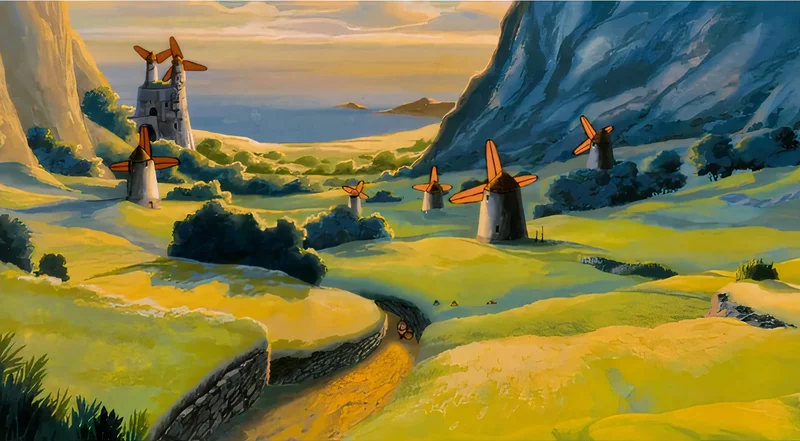
While Nausicaä of the Valley of the Wind — and the manga it was adapted from — do something pointedly different from The Odyssey, echoes of the ancient poem run through nearly every major idea. It chronicles a perilous journey across a fractured world and meditates upon humanity’s relationship with nature. The similarities begin with Nausicaä herself. Like Odysseus, she’s defined less by overwhelming strength than by empathy, curiosity, and an almost stubborn refusal to accept the world in its current state. She moves between hostile kingdoms and navigates impossible political conflicts, chief among them the brutal warfare between Pejite and Tolmekia. She also repeatedly survives encounters that should end in catastrophe. Every new destination introduces another culture, another danger, and another lesson about the people left behind after civilization collapsed.
Miyazaki, of course, doesn’t limit himself to Homer alone. Nausicaä’s reverence for the natural world also draws clear influences from the 12th-century Japanese folktale The Lady Who Loved Insects, which follows a young princess who defies social convention by studying caterpillars instead of admiring beautiful butterflies. As the protagonist here, Nausicaä inherits that same sense of curiosity. Rather than fear the giant, armored bugs called the Ohmu, she seeks to understand them and recognizes that they aren't monsters but living creatures reacting to humanity's violence. In doing so, Miyazaki embraces a worldview common throughout Japanese folklore, one in which nature possesses its own spirit and demands respect instead of domination. (That's a concept that would later become central to the plot of Princess Mononoke.)
In The Odyssey, each of Odysseus’ many obstacles is treated like a test or challenge by the gods. Miyazaki asks a different question entirely: What if the world isn’t testing humanity at all? What if humanity is responsible for its own suffering?
That idea lies at the heart of Nausicaä. The toxic Sea of Corruption appears to be the planet’s greatest threat, an ever-expanding forest poisoning everything around it. Yet Nausicaä discovers that the opposite is true. The forest is quietly healing a world devastated by human wars, cleansing poisoned soil left behind by industrial-scale destruction. The true enemy isn’t nature but the endless cycle of conflict that convinced people they could dominate the world in the first place.
That theme feels surprisingly resonant with The Odyssey. Homer wrote about warriors returning from a decade-long conflict only to discover victory came with profound personal and societal costs. Odysseus survives Troy, but the war lingers in every subsequent choice he makes. Home is no longer simply a place to return to; it’s something that has to be rebuilt after violence has fundamentally changed the very nature of his reality.
Miyazaki reaches a similar conclusion from a different direction. The world of Nausicaä exists in the shadow of the Seven Days of Fire, a cataclysmic war that devastated the world a millennium ago. Every kingdom believes that another weapon, another army, or another show of force might finally secure peace, but every attempt only pushes the world further toward true annihilation. Nausicaä rejects that logic and insists that empathy is more powerful, and important, than conquest. The only way to save humanity is to preserve what makes them human in the first place.
Perhaps that’s why Nausicaä still resonates more than four decades later. It answers the same philosophical questions that Homer asked but does it through the lens of Japanese folklore, all as a way to ruminate on postwar anxieties — and the enduring belief that compassion is humanity’s greatest survival tool.
Christopher Nolan’s The Odyssey follows a warrior desperately trying to return home. Nausicaä of the Valley of the Wind takes inspiration from one of the compassionate strangers who help him along the way. By transforming Homer’s briefly seen princess into the hero of her own epic, Miyazaki makes compassion — not conquest or cunning — a person’s greatest source of strength. And so, one of the poem’s richest modern descendants has been hiding in plain sight for decades, floating just above the Toxic Jungle on the wings of a blue-clad princess.
Nausicaä of the Valley of the Wind is available to stream on HBO Max