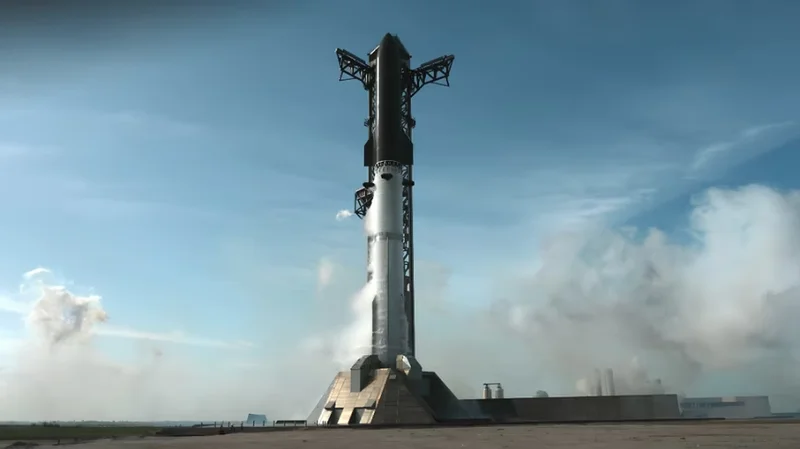
The headline number from Starship’s 13th flight is not 20 satellites. It is one word in SpaceX’s own flight report: intact.
Starship lifted off from Starbase in Texas at 5:51pm on Friday, after delays and engine replacements pushed the attempt back. It was the second flight of the V3 vehicles. It was also the first completed launch since the company went public, The Register reported.
One hour, five minutes and 21 seconds later it was floating in the Indian Ocean in one piece.
Why intact is the story
Starship re-entered and gathered heatshield data. It then flew what SpaceX called “a dynamic banking move to mimic the trajectory that future missions returning to Starbase will fly”.
It steered to the target zone on its four flaps. Then it relit all three Raptor engines. It performed a landing flip and a landing burn, and settled softly onto the water.
That sequence left the vehicle whole. It gave SpaceX, in the company’s words, “critical views of an intact heatshield for the first time”.
Heatshields are the reason reusable rockets are hard. Until now SpaceX has mostly been reading damage after the fact. This time it got to look at one that survived.
The satellites, and the engine that mattered more
Starship deployed all 20 Starlink V3 satellites, the first flight of the new generation. Engineers made contact with every one of them over radio and laser links and pulled down telemetry.
None were meant to stay up. They were released on a trajectory that SpaceX expects brought them down about 20 minutes later.
Roughly 39 minutes into the flight, Starship did something quieter. It reignited a single Raptor engine in space.
SpaceX called it “a core capability for future orbital missions”. A rocket that cannot relight in space cannot change where it is going. That burn is what lets Starship settle into a stable orbit rather than trace an arc back to Earth, and it is the capability NASA needs if Starship is to carry astronauts towards the Moon.
Everything else on the flight was about reuse. This was about destination.
The part that did not work
The Super Heavy booster had a worse evening.
It completed the high-thrust portion of its boostback burn on all 33 engines, a first for a V3 booster, then cut the burn short. It tried to relight for the landing burn and only some of the engines caught.
A subset ignited “before experiencing a hard splashdown in the Gulf”, SpaceX said.
On a test flight that is data rather than disaster. It is also the one box left unticked, and the contrast is stark: the ship landed softly and survived, the booster did not.
Catching the ship
SpaceX has caught a booster with its launch tower before. Catching the upper stage is a harder problem, and Musk says it is next.
“Unless we discover problems after mission data review, SpaceX will attempt to catch the ship with the tower on next flight,” he wrote on X, in remarks reported by The Information.
An intact vehicle and a clean heatshield are exactly the evidence you would want before trying that. A ship that launches from Starbase, returns to Starbase and is caught rather than fished out of an ocean can fly again in days rather than months.
Others are chasing the same trick. China caught a rocket booster in a net this month. Blue Origin still does not know why New Glenn exploded in May.
The market is not cheering yet
Starship has to justify a great deal. Starlink’s expansion runs through it, at a moment when Amazon says it has enough satellites to switch on a rival. So does SpaceX’s NASA work.
Investors have been cool since the listing, and the shares have drifted lower in recent weeks. The company that made several thousand of its own staff wealthy at the IPO has spent the time since being asked what it is worth.
Friday will not settle that. But a ship that flies, deploys, relights, lands softly and comes back whole is a better argument than a scrub notice.
Get the TNW newsletter
Get the most important tech news in your inbox each week.