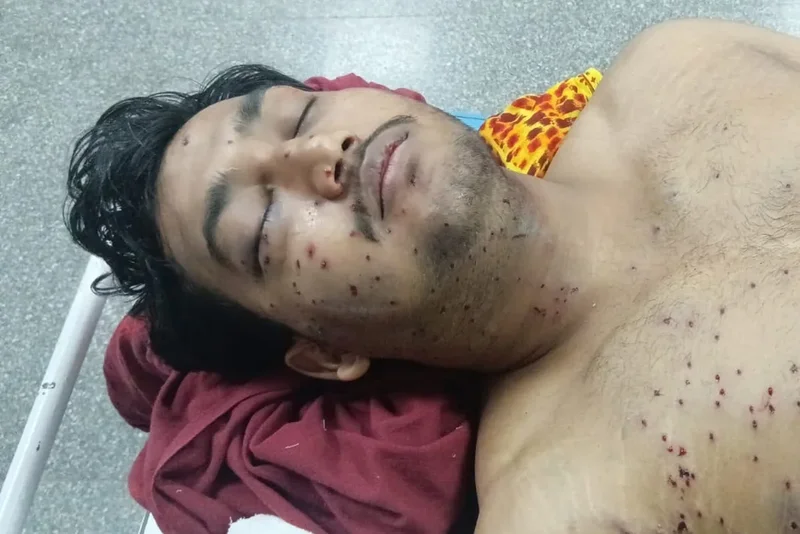
An internal investigation by India's paramilitary security force has reportedly confirmed the use of a controversial pellet gun during last week’s crackdown on peaceful protests in Delhi.
The security forces’ alleged use of pellet guns, a controversial crowd-control weapon that shoots a spread of multiple tiny pellets, became a major source of outrage among protesters last week after a march on India’s parliament was brutally quashed.
Delhi Police and the Rapid Action Force wing of India’s Central Reserve Police Force – a federal paramilitary force under India's home ministry – have not denied using tear gas, baton charges and other brute force methods to prevent protesters with the Cockroach Janta Party (CJP) from approaching parliament last Monday. They have said that the use of force was proportionate and that some protesters threw stones at police.
But there was outrage at evidence, in the form of protesters displaying distinctive wound patterns, that the security forces may have used pellet guns against protesters in the capital for the first time. The Independent spoke to two of the injured protesters while they were receiving treatment in hospital. Both alleged they were struck by pellets fired by security personnel during the crackdown on demonstrators marching towards Parliament.
Indian media outlets cited CRPF sources as saying an internal probe into the matter has been completed, finding that a lone Rapid Action Force personnel member fired seven rounds from a pellet gun, with five rounds striking protesters and two hitting the ground, during the 20 July protest march.
At least four young protesters, aged between 20 and 25, were reported to have sustained pellet gun injuries, according to media reports.
Following those media reports and a blanket denial issued by Delhi Police, the CRPF initiated an investigation into whether pellet guns were used by the RAF, their riot-control wing.
“Five of the rounds hit the protesters and two hit the ground. The rounds were fired after protesters attacked security personnel and started pelting stones,” a CRPF sources told the Indian Express.
Calling it an internal “professional assessment” that pellet guns were used, an official told The Hindu that the “initial findings are known, but a final report will be available only after a comprehensive investigation and review”.
CRPF director general Gyanendra Pratap Singh said they will release a report on the incident in due course, now that the so-called “cockroach” protests have ended with the government agreeing to meet the movement’s demands.
“Now, since the agitation has been called off, and assembled people have dispersed, we would make a professional post-event assessment, like we do after every major assignment, and then let you know the view of the Force headquarters,” he said.
Delhi Police categorically denied using pellet guns after reports emerged of students receiving treatment at the hospital.
“Delhi Police neither possess pellet guns nor do they use them in the ongoing protest. The public is requested not to share or circulate any unverified or misleading information,” they said in an X post, warning of action for spreading rumours.
The Independent spoke to Sahil Lohchab, a 20-year-old student who suffered severe facial and eye injuries. Doctors have told him he is likely to lose sight in one eye.
Mr Lohchab, who later appeared in front of the press alongside opposition leader Rahul Gandhi, said he had a national flag in his hand when he was shot with pellets and his eye swelled up instantly.
“I was leading protesters and I had my hands folded when they fired,” he said, describing a gesture of peace towards the security forces.
Irshad Mansoori, 25, a reporter for Outlook Magazine, has been identified as another pellet gun victim.
Medical records from Delhi's Safdarjung Hospital showed injuries "consistent with pellets striking" the body of the journalist, according to local media. Reports said Mansoori was examined by specialists from three hospital departments to confirm the assessment.
The incident appears to be the first confirmed use of pellet guns by security forces during crowd-control operations in the Indian capital.
The weapons have, however, long been used to target demonstrators in Indian-administered Kashmir, where activists say scores of protesters have been killed or critically injured due to their use. An Amnesty International report documented at least 88 cases of people who lost their eyesight due to metal pellets fired by security forces in Kashmir between 2014 to 2017.
Other instances saw metal pellets lodged in their skulls, near their eyes, and other body parts with doctors finding it too risky to remove the pellets.
The Indian government formally describes pellet guns as a legitimate “non-lethal” weapon for crowd control. But the UN Office of the High Commissioner for Human Rights calls pellet-firing shotguns "one of the most dangerous weapons used against protesters" in Kashmir.