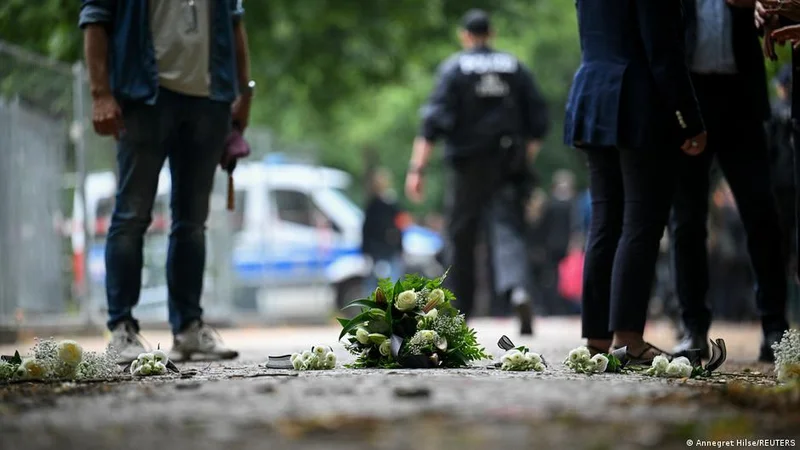
Berlin remains in shock following the attack on the "Christopher Street Day" (CSD) parade on Saturday. Hundreds of thousands of people had been celebrating peacefully and advocating for the rights of queer individuals — until, around 10 p.m., an attacker drove his vehicle into the crowd in the Tiergarten Park, right in the heart of the city.
One woman was killed and 29 others were injured, some seriously. Authorities quickly said the incident was a terrorist act committed by an Islamist. The suspect initially managed to flee but was later killed by police.
On Sunday afternoon, during a memorial service at St. Mary's Church (Marienkirche), not far from the Brandenburg Gate, Chancellor Friedrich Merz (CDU) said: "We will do everything to protect the freedom of our country and our society — everything!" He called out to the mourners: "Stand together, celebrate, and show the joyful face of our open, free society." Yet, right now, no one feels like celebrating.
This sentiment was echoed by the opposition. "Hatred must never triumph," said Luigi Pantisano, leader of the socialist Left Party. "Regardless of whether the hatred stems from religious fanaticism or if the attacks and hostility come from elsewhere," he continued.
The suspect was known to police
The suspected perpetrator was a 21-year-old German national, born to a woman of Lebanese origin. He was known to the police as a sympathizer with the Islamist terrorist militia "Islamic State" (IS) in Syria. In the summer of 2025, he attempted to travel to Syria via Turkey and Lebanon to join IS fighters. However, he was detained in Lebanon, brought back to Germany in November 2025, and placed in pre-trial detention.
He stood trial in Berlin on charges of preparing a serious act of violence. Prosecutors sought a prison sentence of two years and ten months. However, the court released the young man, handing down a suspended sentence of one year and ten months. The IS sympathizer had been free since mid-May of this year — a decision the prosecution appealed.
Although the man's phone was wiretapped for a time, he was not subject to comprehensive surveillance.
At liberty despite clear IS sympathies? That must not happen again, Federal Interior Minister Alexander Dobrindt of the conservative Christian Social Union (CSU) said on Sunday: "Part of the review process will be determining whether suspended sentences are actually appropriate in such cases," Dobrindt told public broadcaster ZDF. "It is simply a matter of being able to restrict the freedom of movement of such individuals," Dobrindt concluded.
The main opposition party, the far-right Alternative for Germany (AfD) spoke of a total failure of security policy. "If an Islamist 'threat actor' known to the police was able to commit such an act, there must be a thorough investigation into why he was able to move about freely in the first place," said AfD interior policy spokesperson Martin Hess.
Konstantin von Notz of the environmentalist Green Party called for greater powers for security agencies in dealing with violent Islamists and drew a parallel to previous incidents: "It leaves one utterly stunned that this apparently involves yet another 'person of interest' who was already on the authorities' radar," the Green Party politician said.
Criminal prosecution under scrutiny
"What actually happened after his release from prison? With whom did he maintain contact? Even though he was under surveillance, there was clearly a gap here; that is precisely what we need to examine in minute detail — and rest assured, we will," said Sebastian Fiedler of the center-left Social Democratic Party(SPD) which is currently part of the federal government as junior coalition partner to the conservative CDU/CSU bloc.
"Overall, our criminal laws regarding terrorism are too lenient," terrorism expert Peter Neumann of King's College London told public broadcaster ZDF. He noted that prison sentences in Germany are short by European standards, particularly when compared to those in France and the United Kingdom.
However, many experts also point out that it is difficult to maintain comprehensive surveillance on individuals whom German courts have not sentenced to prison. The Federal Office for the Protection of the Constitution, Germany's domestic intelligence agency, estimates that there are currently around 420 individuals in Germany classified as "Islamist security threats" — a term referring to people whom authorities believe capable of committing a terrorist act. It remains unclear whether the suspected perpetrator Abdul B.* was among them. Security experts estimate, however, that placing all such individuals under round-the-clock surveillance would completely overwhelm the authorities — especially given that the total number of potentially violent Islamists in Germany is estimated to be significantly higher, at around 9,000 people.
Dirk Peglow, chairman of the Association of German Criminal Investigators (BDK), told the Handelsblatt newspaper on Monday: "In the case of an individual posing such a high level of risk, release from custody must not mean the end of state monitoring." However, Peglow also pointed out that if authorities are expected to monitor particularly dangerous individuals over extended periods, state security and surveillance units must be "appropriately equipped in terms of personnel, technology, and organization"— which, at present, they are not.
The court had ordered the young man to attend a total of 26 appointments at a deradicalization center. Abdul B. had already completed two of these; a third counseling session was scheduled for that Monday. There is widespread criticism now of whether such trainings de facto serve their purpose.
This article has been translated from German.
**DW withholds the full names of perpetrators in order not to increase their publicity and the likelihood of copycat killers. *