- See more This is Money on Google - save us as a Preferred Source
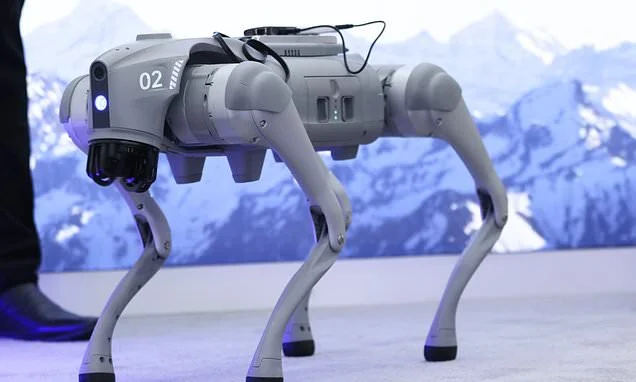
He can scamper about on all fours and even lift a mechanical paw to give you a wave.
But in a few summers' time Poochie could have a much more important role – carrying out crucial aeroplane safety checks before you jet off on holiday, taking over a job currently carried out by pilots.
That is the aim of Tata Consultancy Services (TCS), which has created artificial intelligence-enabled technology which will allow the mechanical pet to carry out a range of industrial functions.
Already in use with an unnamed global agri-chemical firm, TCS now hopes to win customers in the aerospace industry – carrying out inspections in aviation manufacturing as well as maintenance work.
To that end, Poochie and other robot gadgets developed by the Indian firm were on display at the Farnborough Air Show last week.
The technology is described as ‘physical AI’ – robots equipped with a chip that can process data ‘on the edge’, meaning they can use their own processors to analyse and react to what they find themselves rather than having to wait for remote instructions.
The AI-enabled dog can carry out a range of industrial functions
Poochie, for example, is equipped with cameras and other sensors as well as ‘reasoning models’ that can direct itself where to go and what to look for, using a ‘Jetson’ chip developed by Nvidia.
The four-legged robot dog itself is made by Chinese firm Unitree but TCS’s innovation is to build an AI system that captures and analyses data and gives the robot instructions on what to do.
Its challenge now is to convince the safety-obsessed aviation industry – and perhaps wary passengers – that it can be trusted.
But Anupam Singhal, president of manufacturing at TCS, is bullish about the prospects that the technology will be widely adapted.
Mr Singhal insists that it is not a case of humans being replaced by AI but instead that a ‘human plus AI’ model is the future, making the workforce more productive.
He told the Mail and This is Money: ‘The probability of making an error by AI would be much lower than a human making an error.’
And he described how Poochie’s job could go beyond industrial processes.
‘In fact, if you look at it, every flight before it takes off – the pilot goes around the plane to check whether everything’s correct.
‘That job can be done by the quadruped – it can go into all the nooks and corners and everything of the plane, it can go and give you the feedback if something is not right.
‘Obviously, it’s a regulated process. Regulators need to be given a clear demonstration of how it helps – how it makes [things] safer.
Mr Singhal acknowledged that a 'mindset shift' may be needed for the change to be accepted but pointed out that passenger planes have already been using autopilot to fly for a number of years.
'You are 30,000 feet in the air and the plane's on autopilot - so if you ask me this industry has been autonomous as much as anything else.'