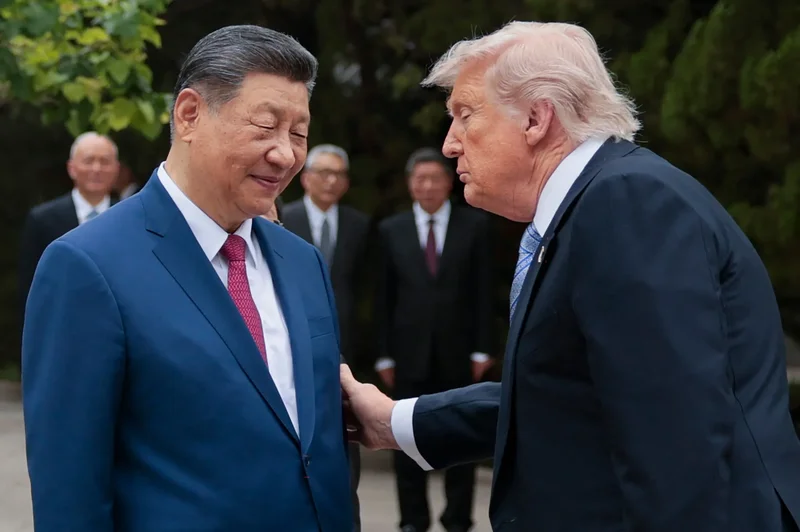
If you want a peek into Donald Trump’s mercurial soul, pay up. By subscribing to “Truth PSI” for a mere $100,000 a month, you can obtain his posts a few milliseconds ahead of the crowd. That head start matters because Trump’s posts move markets. When he announced a tariff “pause” on April 9th last year, the S&P 500 jumped by 9.52% and the NASDAQ jumped by 12.16%. Running a few milliseconds ahead of such market skinny is money in the bank. Selling that slender head start is all part of Trump Media’s attempt to monetize proprietary assets.
The sketchy ethics of Trump’s move to monetize his own unpredictability are as plain as the nose on your face. But it is harder to see that his moves reflect a shift in global economics away from market fundamentals towards a politicized world. While markets have always been troubled by political influences, the politicization of economic and social life has recently increased dramatically.
We have entered the age of Big Players. In this brave new world, once mighty market forces have been washed away in a flood of personal political influence. Today, Big Players like Trump or Xi or Modi move markets, not the demand-supply basics that economists call “underlying fundamentals.”
What Makes a Big Player?
In economic theory, a “Big Player” is “anyone who habitually exercises discretionary power to influence the market while himself remaining wholly or largely immune from the discipline of profit and loss.” Big Players, then, are big, insensitive, and discretionary. They are big because their words and deeds move markets. They are insensitive to the discipline of profit and loss.
Unlike ordinary firms that are driven from the market when they generate losses, Big Players are not under similar market pressure. They are largely unconstrained. Finally, Big Players are discretionary because they are not bound by any simple, understandable rules. They act on judgment, even mood or whim in some cases. Their exercise of discretion is the opposite of the rule of law. The rule of law means known, stable, impersonal rules that apply equally to everyone and that no one can suspend on a whim.
The Big Players are, in the most literal sense, lawless. Such lawlessness is not necessarily criminal, of course. But it does eat out the sinews of the system leaving it weaker and more chaotic. You can build expectations around a rule. You cannot reliably build expectations around a personality. A Big Player’s got personality, and lots of it, which is the whole problem in a nutshell. Too much personality makes a Big Player mercurial, mysterious and more than a little difficult to predict.
Together these three properties make the Big Player corrosive. When a Big Player matters, market participants must divert attention away from the underlying fundamentals and toward the Big Player. What will they do next? Who has their ear? These questions crowd out economic reasoning and replace it with court politics. Luck counts for more; skill counts for less.
Beyond Trump: Big Players as a Global Phenomenon
Trump may be the poster child, but Big Players are proliferating across the globe.
Boris Johnson’s March 2020 announcement that Britain was going into a COVID lockdown is a perfect example. Even before Parliament passed any new legislation, Johnson’s word was as good as law when there was no law. His word sent many plans and many contracts to ruin. And it realigned all expectations around his say-so, around similar announcements that might be coming. Thus, attention that might have been devoted to local coping mechanisms or new business opportunities was peeled away and newly affixed to the Prime Minister and his stalwart scientific advisors. Governments everywhere during COVID discovered the same terrifying power to upset every apple cart and uproot every private plan by a simple say-so. Lockdowns were Big Playership on a worldwide scale.
When Xi Jinping moved against Alibaba and Ant Group in 2020 and 2021, Xi’s word wiped out hundreds of billions in market value overnight. The message to every entrepreneur in China was unmistakable: You could be next. Don’t rock the boat. The rational response to such arbitrary power is not to satisfy consumer demands, but to keep in the good graces of the Big Player. In the extreme, political calculations are all that matter, and economic calculations count for little.
Modi’s shock demonetization in India in 2016, which wiped out 86% of India’s currency overnight, was pure Big Player folly. The resulting cash shortage hit ordinary households and small businesses the hardest. And, in the end, did little or nothing to achieve its stated goals of fighting crime and corruption.
Big Players, left, right, and center
For generations, the great debate in political economy was capitalism versus socialism. It was markets versus the state, private property versus collective ownership, left vs. right. That debate still echoes loudly in our politics. But look past the noise and you will find that both sides are now firmly in the Big Player camp. Both the left and the right want to politicize more and more aspects of social and economic life. Neither is for the rule of law. Neither is for free markets. The two parties fight as hard as ever. But it has become a shameful, uninspiring, downright degraded fight over who shall hold the whip. Welcome to the age of Big Players, and good luck.
The opinions expressed in Fortune.com commentary pieces are solely the views of their authors and do not necessarily reflect the opinions and beliefs of Fortune.