- See more Daily Mail on Google - save us as a Preferred Source
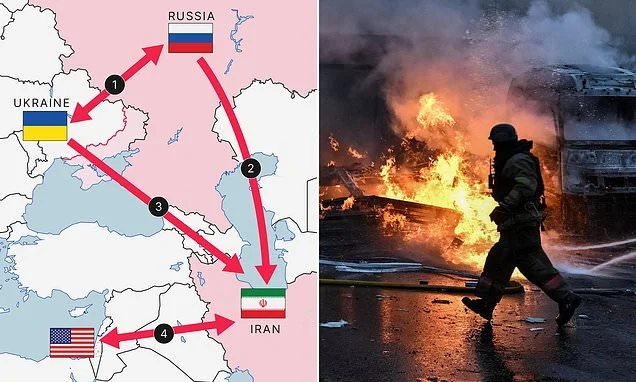
Fears are mounting that Russia's war in Ukraine and the war in Iran could merge into one conflict after a Ukrainian strike on an Iranian ship heightened tensions between the two regions.
Tehran condemned Ukraine for carrying out the strike over the weekend on what it claims was a commercial vessel in the Caspian Sea, adding that the explosion killed one sailor and injured another.
After Ukrainian president Volodymyr Zelensky acknowledged the attack, adding that the Iranian vessel was being used to transport Russian 'military cargo', Iran's foreign minister weighed in.
In a post to X, Abbas Araghchi said: 'Zelensky has attacked an Iranian commercial vessel, killing a sailor.
'A blatant UN Charter violation done at Israel's behest to drag Europe into its war. In calls with EU High Rep [sic] [Kaja] Kallas and [Russian] FM [Sergei] Lavrov, made clear that what the freeloader in Kyiv did CANNOT GO UNANSWERED.'
Tehran decried the attack on its vessel as an act of aggression. It said it would defend its national interests and security, while accusing Kyiv of seeking to expand the war in Ukraine.
It came after Zelensky said on Saturday he would share evidence with the US showing Russia is assisting Iran in targeting US bases in the Middle East through satellite surveillance.
Taking to X, the Ukrainian leader wrote: 'Since the beginning of July, we have recorded active Russian satellite surveillance of the Gulf states and U.S. military facilities located there.'
Navy ships of Iran and Azerbaijan move during an exercise between Iran and Azerbaijan in the Caspian Sea (File pic)
Firefighters work at the site of the postal distribution centre of Nova Post company, hit by a Russian drone strike, amid Russia's attack on Ukraine
'These images subsequently appear in Iran. At the same time, there is a clear correlation between Russia's satellite imagery of these sites and Iranian strikes - both before the attacks, in preparation for them, and afterward, to assess the damage inflicted.'
The new developments follow months of speculation that the two conflicts are intertwining.
Iran has claimed it is not involved in Russia's war on Ukraine, although Kyiv has said Tehran is supplying drones to the Kremlin.
The Islamic Republic also called on European countries to hold Ukraine accountable.
The strike fuelled speculation in Tehran that it was intended as a warning that Iran's Caspian coastline is vulnerable and could be used as leverage in future negotiations with the US, according to the Financial Times.
Although the Caspian Sea lies more than 600 miles from the front line in Russia's war with Ukraine, Kyiv has steadily expanded its long-range drone capabilities, allowing it to strike targets deep inside Russian territory.
After inflicting heavy damage on Russia's oil infrastructure and contributing to fuel shortages, that capability is increasingly being viewed as a potential factor in the wider confrontation involving Iran.
Hamidreza Azizi, an Iran expert at the SWP Berlin think-tank, outlined several possible explanations for Ukraine's strike on the Iranian-linked vessel.
Writing on X, he said one possibility is that Kyiv wanted to reinforce its value as a strategic partner to Washington, which continues to supply crucial military support, including Patriot air defence systems.
According to Azizi, such an operation would not have been possible without approval from the US and its Western allies.
Another interpretation is that the US and Israel encouraged Ukraine to increase pressure on Tehran because they feared direct attacks on Iranian infrastructure could provoke retaliation against key economic assets across the region.
A third possibility, wrote Azizi, is that the strike was linked to threats made by Yemen's Houthi rebels against shipping in the Bab el-Mandeb Strait, a route that Saudi Arabia has relied on to export oil while avoiding the Strait of Hormuz.
The expert also suggested Tehran is concerned that Ukrainian intelligence services could back ethnic insurgent groups inside Iran, mirroring Kyiv's alleged support for opposition forces in Syria during the campaign against Bashar al-Assad's regime.
In response, Iran could target vessels linked to Ukraine in other maritime routes or strike Ukrainian infrastructure directly.
Ukrainian servicemen repair the damaged anti-drone net in the frontline town of Druzhkivka, Donetsk region
Motorists drive past a large billboard pledging revenge against US President Donald Trump along Jomhouri Street in central Tehran
Vessels at the Strait of Hormuz, as seen from Musandam, Oman
Tehran could also formally recognise Crimea and the Donbas as Russian territory.
'In any case, what is clear is that Iran's war is becoming increasingly intertwined with two other conflicts: the Saudi-Houthi confrontation and the Russia-Ukraine war,' Azizi warned.
'With each passing day, the war is evolving into an increasingly complex, multidimensional, and international conflict.'
The growing overlap between the conflicts has prompted some analysts to argue that the distinction between them is beginning to disappear.
William Spaniel, associate professor of political science at the University of Pittsburgh, said earlier this year that the blurred front lines had 'effectively merged the Russia-Ukraine war and the Iran war into a single conflict'.
'We are still not at a true world war as there is no one actor fighting on two fronts simultaneously like the United States during World War II,' he said.
'But it is further connecting the battlefield outcomes, and it will have longer-lasting implications for how the battle lines are divided.'
Ukraine's years of fighting Iranian-designed Shahed drones have also strengthened its position with Gulf states.
Zelensky has used that experience to present Ukraine as a provider rather than simply a recipient of military assistance, offering low-cost, battlefield-tested technology to countries looking to bolster their own defences.
Kyiv is now exporting not only interceptor systems, but also software, electronic warfare equipment and maritime drones.
Speaking to The Guardian in April, Orysia Lutsevych, head of the Ukraine Forum at Chatham House, said that Ukraine's expanding security relationships in the Gulf had strengthened its standing with Washington, countering Donald Trump's repeated claim that Kyiv had 'no cards' in its war with Russia.
'Ukraine is trying to show that our cards are about being a very robust, agile, fast-adapting and producing economy that can both defend against Russia and also defend other countries through weapons system sales,' Lutsevych said.
She argued that those Gulf partnerships could also become an important source of investment for Ukraine's defence industry.
'Ukraine has production capabilities but not enough investment. It can produce more, but it doesn't have enough orders or capital,' Ms Lutsevych said. 'So this actually comes as a great opportunity to use these production facilities.'
Fiona Hill, who served as a Russia adviser during Trump's first administration, argued that if cyber warfare, hybrid operations and other forms of so-called grey zone conflict are included, a global conflict has effectively been underway for some time and has intensified since the outbreak of the Iran war.
'I think it meets that threshold for a system-changing war,' said Hill, now a senior fellow at the Brookings Institution.
'There'll be all kinds of new configurations of countries that will have sprung up.'
Zelensky has tried to present Ukraine as a provider rather than simply a recipient of military assistance
Smoke billows into the sky following Ukrainian drone strikes on warehouses of Russia's online retailer Wildberries, in St. Petersburg, Russia
She warned that disruptions to oil and fertiliser supplies could draw more countries into the conflict, while raising questions about whether China might seek to exploit Washington's focus on the Middle East by increasing pressure on Taiwan.
'We've got a 'four horses of the apocalypse' going here … and I just feel that people are sleepwalking into it'.
After Ukraine's strike over the weekend, the Iranian Foreign Ministry summoned Ukraine's chargé d'affaires in Tehran to convey its protest over what it described as a 'hostile and criminal' attack.
Government news agency IRNA reported that during the meeting, Iran stressed that 'the Islamic Republic will firmly defend its security and national interests and will not leave attacks on the lives and property of its citizens unanswered'.
Meanwhile, as Iran's foreign ministry threatened to respond, some Iranians took to social media to call for retaliation using the country's Kheibar Shekan ballistic missiles.
Several users criticised what they described as the Foreign Ministry's 'weak diplomacy'.
One comment read: 'As long as this weak diplomacy remains in government, every fox will see itself as a lion against us.'
Other users highlighted the range and capabilities of Iran's missile arsenal, arguing that Tehran should demonstrate its deterrence.
A threatening message on Telegram read: 'A gentle reminder to Mr. Zelensky: All of Ukraine is within reach of Iran's ballistic missiles, including super-heavy Khorramshahr -4.'