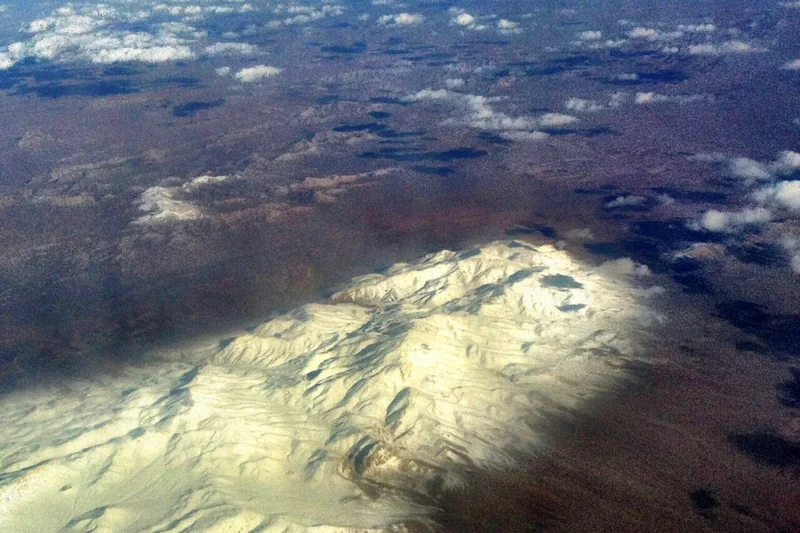
In between vowing to âassume total controlâ of Iranâs oil and threatening to bomb its bridges and power plants, Queens-born U.S. President Donald J. Trump made an interesting disclosure this July 13. Speaking to talk radio host Hugh Hewitt, Trump said, âWe have eyes on it and Pickaxe Mountain is a possible target for a nice big fat shot right in the front door […] Weâre going to take out Pickaxe Mountain. Tell the Iranians to be ready.â
Known within Iran as Kuh-e Kolang Gaz La, Pickaxe Mountain has been subjected to increased scrutiny by journalists, think tanks, and United Nationsâ nuclear weapons observers since late last year as one of Iranâs possible new underground nuclear enrichment sites. But recent reports on this formidable geological formation issued by the nonprofit Institute for Science and International Security (ISIS), as well as a deep dive by Scientific American last Thursday, have added new concerns on top of the prior evidence that Iran has been busy building-out the site. In shortâbeyond covert subterranean construction by Iran itselfâPickaxe Mountain is a uniquely tough natural fortification laced with Andesite, a volcanic rock capable of withstanding anywhere from 21,000 to 43,000 pounds per square-inch of pressure.
In other words, the bunker-busting GBU-57 bombs that Trump has threatened to unleashâwhich reportedly only penetrate about 26 feet (7.9 meters) through medium-strength rockâarenât likely to devastate any potential nuclear centrifuges tucked beneath this mountain any time soon.
And, if it exists, the facility really is deep: âThe mountain has a height of [5,276 feet] 1608 meters above sea level,â ISIS noted in its latest analysis this July. â[And the] facility is estimated to be at least [328 feet] 100 meters deep under the mountain.â
The hidden fortress
Given Pickaxe Mountainâs origins in the closing of the prehistoric Neo-Tethys ocean back in the Oligocene epoch, you could describe it as a natural fortress well over 23 million years in the making. This ancient landmark was slowly ground into existence as the Arabian tectonic plate collided with the Eurasian tectonic plate, forming the Zagros mountain rangeâa process that spanned multiple geological epochs.
Pickaxe Mountain, located about 140 miles (220 kilometers) south of â Tehran, bears some similarities to Mount Saint Helens in Washington state in that its hard rock is also the volcanic product of what geologists call a subduction zone. As the ancient Neo-Tethys oceanâs crust along the edge of the Arabian Plate was pushed incrementally underneath the Eurasian Plate, water suffused throughout this rock lowered its melting point creating a greater volume of molten magma. And, as that hot magma arose toward the surface, it cooled into tough andesite rock laced throughout the mountainâs limestone deposits.
âItâs basically a volcanic arc above a subduction zone,â as geologist Richard Walker, a professor of tectonics at the University of Oxford, summed it up for Scientific American.
The Lower Depths
According to ISIS and other geopolitical researchers, Iran began digging tunnels below Pickaxe Mountainâs 5,276-foot natural shield sometime in 2020, hoping to replace its centrifuge assembly facility in Natanz, which had been damaged in an apparent act of sabotage.
âGiven Iranâs security considerations, one should expect that future uranium enrichment and even weapon-related activities could eventually be concentrated in a single, heavily protected location,â Farzin Nadimi, a senior fellow with the Washington Institute for Near East Policy, told German news site DW on Friday.
âPickaxe Mountain is the most logical candidate for that role,â Nadimi said.
But, while researchers have collected satellite imagery and munitions data documenting activity at the site, ISIS noted that it âremains unclear when Pickaxe Mountain could be operational.â
âIt is also unclear if Iran still plans on installing a large-scale assembly facility, given the destruction of Iranâs centrifuge program,â the groupâs analysts added. In other words, you could be forgiven for wondering what the benefit would be of bombing a nigh-impenetrable mountain to barely rattle a suspected Iranian nuclear weapons facility that may-or-may-not actually be there yet.