analysis
Asia
Indonesia faces crucial choice after central bank chief's surprise resignation
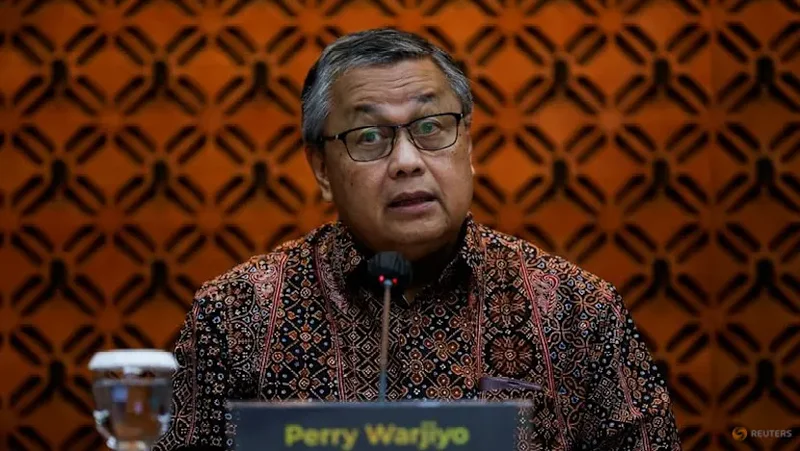
While Perry Warjiyo's resignation caught markets by surprise, the appointment of Senior Deputy Governor Destry Damayanti as interim governor sends a positive signal, say analysts.
JAKARTA: When news broke on Monday (Jul 27) morning that Bank Indonesia governor Perry Warjiyo was resigning two years before his term was set to expire, there was a knee jerk reaction - with the stock market and the rupiah dipping temporarily before a rally.
The Jakarta Stock Exchange Composite Index (JCI) fell 32 points (0.5 per cent) to 6,153 within 20 minutes of opening before rallying back up to around 6,175 when it closed.
And when the Indonesian foreign exchange market opened at 9am local time, the rupiah softened to 17,972 per US dollar - down from 17,935 per US dollar on Friday - before surpassing the 18,000 mark two hours later.
Analysts attributed the short-lived market backlash to the appointment of Senior Deputy Governor Destry Damayanti as interim governor, which might have provided investors some confidence that the central bank is in safe hands.
"Destry has extensive experience in formulating monetary policy and safeguarding financial system stability. Her appointment also sends a positive signal that policy continuity will be maintained," Yusuf Rendy Manilet of the Center of Reform on Economics told CNA.
But whether the stability will hold is still uncertain as President Prabowo Subianto can either nominate Destry as Perry's permanent successor or opt for another candidate.
By law, the president can nominate whomever he wants for the position albeit the nominee will still need to be vetted by the national parliament. There is no specific timeline for when a permanent replacement must be named.
“If the transition results in a professional who can guarantee a continuation of policy, (then) the volatility will be manageable,” said Achmad Nur Hidayat, an economist from Jakarta’s National Development University.
“But if the transition is perceived as a political attempt to weaken Bank Indonesia’s independence, the repercussions could spread beyond the foreign exchange market to the state budget, the banking sector, businesses and ultimately, households.”
As such, analysts stressed the need for Indonesia to choose its next central bank governor carefully.
“The timing of the Bank Indonesia leadership change is particularly delicate,” Bhima Yudhistira of the Indonesia think-tank Center of Economic and Law Studies (CELIOS) told CNA.
Perry’s resignation comes after the country’s currency fell to record lows this year, hitting the psychological mark of 18,000 rupiah per US dollar in June, its weakest levels since the late 1990s Asian financial crisis.
Meanwhile, higher oil prices, which stem from tensions in the Middle East and the United States’ decision to impose tariffs to nearly all of its trading partners, have put more pressure on Southeast Asia’s largest economy.
The sudden departure of the former central bank governor also came as Indonesia is preparing to present its 2027 budget to the parliament on Aug 14, ahead of the country’s Independence Day celebration on Aug 17.
POTENTIAL REPLACEMENTS
The government announced on Monday that Perry had resigned "for personal reasons" without giving more details.
"Yesterday, the president officially received a letter of resignation from the BI governor," State Secretary Prasetyo Hadi told a press conference at the central bank's headquarters in Jakarta, referring to Perry, who was notably absent.
"The president accepted Perry Warjiyo's resignation and conveyed his utmost gratitude for his dedication in leading Bank Indonesia for seven years."
Prasetyo declined to elaborate on the reason for Perry’s resignation but denied speculations that the 67-year-old was in poor health.
Perry spent more than four decades at Bank Indonesia and was widely regarded as a steady hand in steering monetary policy.
Appointed governor by then-president Joko Widodo in 2018, Perry led the central bank through the Covid-19 pandemic and was reappointed to a second five-year term in 2023, which was due to expire in 2028.
Prasetyo said Prabowo has not decided who he will nominate as Perry’s permanent replacement. But analysts said the president need not look far.
Like Perry, the majority of his five deputies are long-time central bankers with at least 30 years of experience working for Bank Indonesia.
One of the exceptions is Destry, 62, who began her career as an economist at several private and government institutions before becoming the central bank’s senior deputy governor in 2019.
Another exception is Thomas Djiwandono, 54, who was a journalist between 1996 and 1999 before becoming a financial analyst and consultant. Prabowo appointed him as deputy finance minister in October 2024 before nominating him as Bank Indonesia deputy governor in February 2026.
Beyond the central bank deputies, talk is rife that Prabowo could also be considering external candidates including the current Finance Minister, Purbaya Yudhi Sadewa.
Quoting anonymous sources, several Indonesian media outlets have reported since June that Prabowo is considering Purbaya for the central bank top post.
Purbaya was appointed finance minister in September 2025. If he is nominated for the central bank role he would need to step down as minister.
Yusuf of the think-tank CORE said Prabowo must prioritise candidates from inside the central bank before considering external prospects.
“The central bank’s roles are very technical and require experience in managing monetary policies,” he said.
“Purbaya’s expertise is more fiscal than monetary and Purbaya still has a considerable amount of unfinished work on the fiscal side including increasing our tax collection and various reforms.”
Bhima of CELIOS said Bank Indonesia also needs to be run by someone who can maintain its independence.
“The central bank needs a figure who is not politically affiliated and can withstand political meddling and interference,” he said.
Before resigning ahead of his central bank nomination, Thomas was a member of Prabowo’s Great Indonesia Movement Party (Gerindra). He is also Prabowo’s nephew.
CHALLENGES AHEAD
Analysts said the need for a credible central banker is “greater than ever”.
Domestically, Indonesia is heading towards a fiscal deficit of 734 trillion rupiah (US$40 billion) due to ballooning energy subsidies and a number of ambitious government programmes like the free nutritious meal initiative and the building of thousands of village cooperatives across the archipelago.
Indonesia's parliament last month passed sweeping legislation that mandates the central bank's role to support growth, while empowering lawmakers to make binding recommendations for independent financial regulators and the central bank.
Rating agencies Moody's and Fitch cited concerns regarding changes in Bank Indonesia's mandate as among key drivers of their credit rating outlook cut to "negative" earlier this year.
However, rival rating agency S&P this month kept its Indonesia rating outlook "stable" and said that Bank Indonesia has had a level of operational independence since July 2005 that was roughly in line with regional peers and it did not expect its changing mandate to drastically affect such independence.
All three rated Indonesia's debt at the second to lowest investment grade.
Amid these challenges, Achmad of Jakarta National Development University said restoring investor confidence will not be easy and the first step will be to ensure that the central bank selection process to find its next governor is transparent and professional.
“Investors need to know if the central bank will refuse pressures to keep interest rates too low, print more money or finance unsustainable spendings,” Achmad said.
“They want to know if monetary policies will remain consistent, if decisions on interest rates, liquidity management and currency stability are based on economic data instead of short term political needs.”