BYD has gone from being a name few British buyers had heard of to one of the biggest success stories in the global car industry in remarkably little time. The Chinese company started out making rechargeable batteries before moving into electric cars, and today it's one of the world's largest manufacturers of electrified vehicles. It famously makes every single part of its cars except the glass and the tyres, with that level of vertical integration helping it grow at astonishing speed and become a rival to the established players.
The Sealion 7 is the flagship of BYD's UK range, sitting just below the more premium models that will carry the newly introduced Denza badge. It's a sleek family SUV aimed squarely at the heart of one of the most competitive sectors of the market, taking on rivals such as the Tesla Model Y, Hyundai Ioniq 5 and Kia EV6 as well as other Chinese rivals such as the Xpeng G6, with BYD banking on a combination of generous standard equipment, impressive technology and competitive pricing.
It's exactly the sort of car I wanted to spend more time with.
A first drive can tell you plenty about a new model, but it's only after weeks and months of everyday use that you discover whether an electric car really delivers. Is it as easy to charge as the brochure suggests? Does the technology remain intuitive once the novelty wears off? Can it cope with long journeys, family duties and the day-to-day demands of modern life?
Over the coming months I’ll be putting the BYD Sealion 7 through exactly those tests. From motorway miles and urban commutes to shopping trips and weekends away, we'll discover whether BYD's flagship SUV really deserves its growing reputation – and whether one of China's biggest automotive success stories can tempt buyers away from the familiar European, Korean and American alternatives.
BYD Sealion 7 Comfort
- Base price:£46,990
- Options:Polar White metallic paint (£1,100)
- Total price:£48,090
- Battery size:82.5kWh
- Maximum claimed range:300 miles
- Maximum charging rate:150kW
- 0-62mph:6.7 seconds
BYD Sealion 7 Comfort – first report
It wasn’t the acceleration, the giant touchscreen or even the fact that I was driving a Chinese electric car through deepest Somerset that made me realise the BYD Sealion was something rather different.
It was the yawn.
Somewhere on a winding country road, bordered by high hedgerows and the sort of villages where everyone notices an unfamiliar number plate, I let out an entirely innocent yawn. Before I’d even finished, the car politely interrupted.
“Are you tired? Perhaps you should take a break.”
I blinked.
My wife has been known to say something similar. I wasn’t expecting it from the car.
The Sealion had actually seen me yawn. It wasn’t scolding me so much as looking after me. Slightly unnerving? Yes. Clever? Undoubtedly. It felt like the first of many moments when I realised this wasn’t simply another electric SUV packed with gadgets. It was almost trying to be a travelling companion.
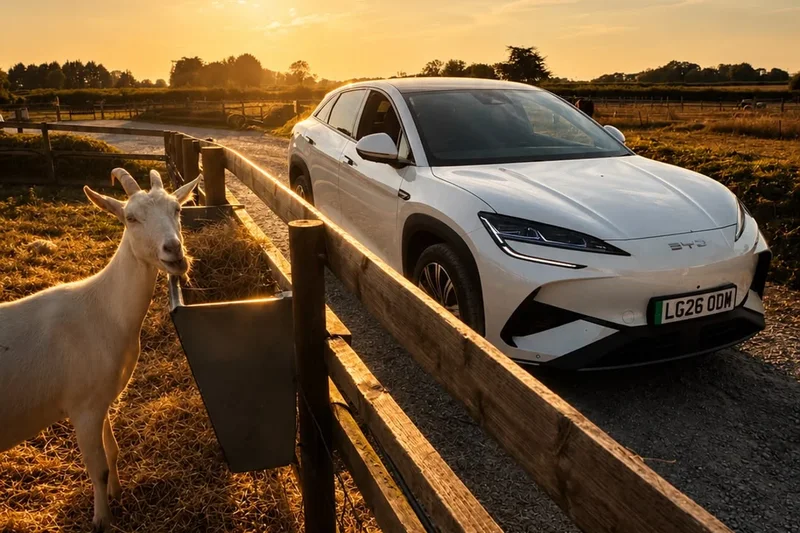
Driving a Chinese car is still something of a conversation starter in rural Somerset. The Sealion, in gleaming white and with more than a hint of rock-star swagger, attracted plenty of curious glances in market squares and village car parks.
Questions followed almost everywhere I stopped.
“How far does it go?”
“How quickly does it charge?”
And, inevitably…
“So…it’s Chinese?”
We’ve become entirely comfortable with our phones, laptops, televisions and half the contents of our kitchens coming from China. Cars somehow still surprise people.
After only a couple of weeks, I found myself confidently answering technical questions like I’d worked for BYD for years.
“Is it more high-tech?” asked our local mechanic.
“I think it probably is,” I replied, sounding far more authoritative than I had any right to.
The Blade Battery sounds like marketing jargon until I was told it’s a fundamentally different approach to battery design. It’s engineered for durability, thermal stability and efficient packaging, allowing more of the car’s floor to be devoted to energy storage. You don’t notice any of that while driving, of course.
Inside, it certainly feels futuristic. The vast central screen—about the size of a family pizza—makes sat-nav directions blissfully easy to follow. Better still, my phone simply sits on a flat charging pad instead of disappearing into one of those mysterious storage compartments that manufacturers always seem to imagine we’ll fill with pencils, loose change or forgotten receipts.
The cabin itself somehow feels lighter than the car’s considerable dimensions suggest. It’s airy, spacious and astonishingly quiet. Even at motorway speeds there’s remarkably little wind noise, leaving only the faintest whisper from the tyres. Conversation becomes effortless and, perhaps more surprisingly, so does thinking. You arrive feeling noticeably less fatigued than after covering the same distance in many conventional SUVs.
The dashboard screen can rotate from landscape to portrait at the press of a button – a feature that never quite loses its novelty. It’s one of those gimmicks that initially makes passengers smile before you discover it can actually be rather useful depending on which apps you’re using.
One small gripe? The door handles. They protrude when the car is unlocked and only sit flush once it’s locked. It’s not quite as elegant as some rivals. Then again, perhaps that’s simply another way the Sealion is quietly communicating with me.
“Don’t forget to lock me.”
Apparently the conversation between driver and car never really ends.
Out on the road, though, the technology quickly fades into the background and what you’re left with is simply a very reassuringly efficient car.
Electric cars have a reputation for feeling brutally quick in a straight line but slightly detached once the road begins to twist. The Sealion largely avoids that trap. Yes, it accelerates with the sort of instant shove that caught me by surprise, overtaking becoming little more than a flex of your right foot, but it’s the way it settles into a hedge-lined B-road that impressed me more.
The steering isn’t sports-car sharp, nor does it pretend to be. Instead it has a natural, reassuring weight that encourages smooth driving rather than frantic inputs. The suspension was unfazed by Somerset’s roads, which are rarely billiard-table smooth, yet the Sealion absorbed broken surfaces, potholes and ridges with ease.
After only a day or two I found myself instinctively easing off the accelerator earlier, allowing the car to harvest energy while gliding almost silently towards junctions. It becomes oddly satisfying, almost a game, trying to drive as smoothly and efficiently as possible.
We wandered repeatedly into Somerton, threaded through the Mendip lanes, passed sheep, goats and even a mozzarella buffalo farm. The Sealion waited patiently behind tractors without complaint before stretching its legs effortlessly on faster roads.
Adaptive cruise control and lane assistance made longer journeys noticeably less tiring without ever feeling overbearing. Unlike some systems that seem determined to wrestle the steering wheel from your hands, BYD’s setup generally feels more like an attentive co-driver than an anxious driving instructor.
One favourite detour took us to East Coker, where T.S. Eliot is buried in the church of St Michael. It felt entirely appropriate to arrive there in near silence, the electric motor barely disturbing the peace of the churchyard. Inside is the simple memorial to the poet whose words seem somehow to fit both the landscape and modern travel:
“In my beginning is my end.”
Standing there, before setting off once more, I couldn’t help thinking of another line from Little Gidding:
“The end of all our exploring will be to arrive where we started and know the place for the first time.”
There’s something about exploring England by electric car that makes you notice places differently. Journeys become quieter, more deliberate and somehow more observant. Without the constant background soundtrack of an engine, birdsong, the wind through trees or even the church bells of a nearby village become more part of the journey.
From East Coker we zipped across to Bath, where the Sealion glided into the city with all the serenity you’d hope for before we escaped to The Gainsborough Bath Spa Hotel.
Range anxiety? Hardly.
We began with around 325 miles available, and charging proved reassuringly quick. Planning stops quickly became less about necessity and more about deciding when we fancied a coffee. That’s probably the biggest compliment I can pay any modern EV: after a few days you stop thinking about it being electric at all.
Even more impressive was the way the Sealion logged every single journey, however tiny, building up a neat diary of everywhere we’d been. Like the car noticing my yawn, it all contributed to the sense that this was a vehicle paying attention.
The Sealion isn’t simply loaded with technology for technology’s sake. It feels as though every useful idea has been squeezed into it, yet most of them quietly fade into the background once you’re driving. The clever bits don’t demand your attention; they simply make the experience easier, calmer and more enjoyable.
Except the yawn detector.
That one rather stays with you.
I’ve learnt that if you’re going to spend time with a BYD Sealion, you should remember your manners.
Because somewhere behind that enormous touchscreen, it might just be watching.