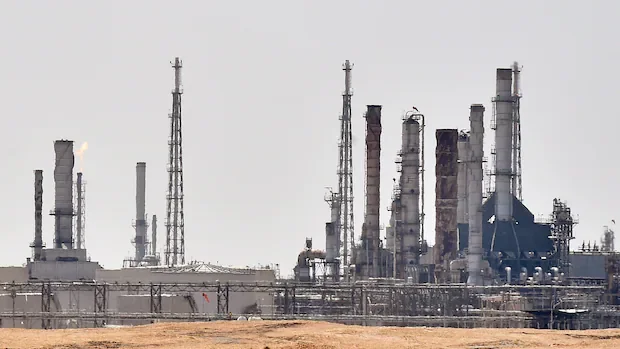
Saudi Arabia says it shot down Iranian drones targeting its oil facilities
While the U.S. paused attacks on the weekend, Iran appears to have not yet let up
Saudi Arabia, Jordan and Iraq reported drone attacks on Monday, two days after the United States abruptly suspended a two-week campaign of airstrikes against Iran, as Tehran appeared to put U.S. President Donald Trump's latest strategic U-turn to the test.
Saudi Arabia said it shot down drones aimed at petroleum targets, some in its eastern province and others in the capital Riyadh. It said the drones had been launched from Iraq by Iran-backed militia, and it reserved the right to respond.
Separately, Iran's Houthi allies in Yemen said they had targeted transit sites carrying oil to Saudi Arabia's main Red Sea oil port of Yanbu, in retaliation for what it said were Saudi drone incursions into Yemeni airspace. The Houthis last week threatened to extend the disruption to global oil supplies to a second major waterway by announcing a blockade of Saudi Arabia's oil industry, sending oil prices higher.
Earlier Monday, Jordan reported shooting down two drones, and Iraqi security sources reported a series of drone attacks on camps housing Iranian opposition Kurdish forces in northern Iraq.
Officials did not identify the sources of those drones.
Brent crude, which had briefly ticked above $100 US a barrel last week for the first time since May, fell around 6.5 per cent on Monday to just over $90, having touched levels as low as $87.55.
U.S. paused attacks over the weekend
Iran said on Monday it was still in control of the Strait of Hormuz and not seeking to resume peace talks with the United States, after Trump on the weekend halted a two-week bombing campaign that his top brass told him had run its course.
Following 13 successive nights of intensifying bombing that provoked Tehran to fire on U.S. bases in response, Trump halted the campaign over the weekend. Iran said it would suspend its own attacks for as long as the U.S. pause endures.
LISTEN | The Economist's Gregg Carlstrom on the Houthis entering the picture:The end of the U.S. bombing campaign sent oil prices tumbling in the hope that disrupted global supplies could resume flowing.
The U.S. ambassador to the United Nations, Mike Waltz, said on Sunday that Trump had paused the campaign to allow room for negotiations. Trump, Secretary of State Marco Rubio and other U.S. officials have described Iran as "begging for a deal."
But the spokesperson for Iran's Foreign Ministry, Esmail Baghaei, said in a televised press conference on Monday that Iran had not asked to resume peace talks with the United States.
Messages were still being passed between the sides through mediators, but "reports about Iran requesting negotiations with the U.S. are fabricated," Baghaei said. "This is not in our DNA."
Tehran also indicated it was still in control of the world's most important waterway for energy markets.
The halt to the renewed U.S. bombing campaign leaves no clear indication of what leverage Washington can exert to achieve Trump's aim to break Iran's grip on the strait.
Trump launched his renewed bombing campaign to punish Iran after Tehran fired on ships using a route through the strait that has been promoted by the United States, which has told vessels to sail close to the coast of Oman.
WATCH | CBC's Margaret Evans on how Iran has changed since her last reporting trip:Iran says ships may pass only through a channel that runs closer to its own coast, which it controls and where it intends to impose transit fees.
Washington and Tehran reached an agreement in June on a framework for talks meant to take place by the end of August to resolve major issues such as Iran's nuclear program.
But the sides have disputed the meaning of the memorandum's language about the Strait of Hormuz, with Washington insisting it requires Tehran to allow free travel while Iran says it grants it the authority to supervise transit.
Netanyahu to meet Trump for 1st time since war started
The two weeks of renewed U.S. bombing killed scores of people in Iran and destroyed bridges and tunnels across the south as well as military targets.
Four U.S. service members were killed by Iran's return fire against U.S. bases in neighbouring Arab states. Iran also struck civilian infrastructure in Gulf countries in what it said was retaliation for U.S. strikes on civilian targets.
Iran aims to formalize its control over the strait in an agreement with Oman, which controls the opposite shore.
Israel has not taken part in the two-week U.S. bombing campaign this month.
Israel's Prime Minister Benjamin Netanyahu on Monday departed for the U.S. to meet Trump in Washington early this week.
It will be Netanyahu's eighth meeting with Trump since the U.S. president returned to office, and their first since February, right before Israel and the United States launched a joint aerial campaign against Iran.
"In these complex times, you need to act with both great determination and great wisdom. We will discuss all the issues on the agenda, primarily Iran. Of course, our goal is to protect our security and also to expand the circle of peace around us," Netanyahu said in a video statement upon departure.
The U.S. and Israel co-operated last year in a nearly two-week bombing campaign, during which Trump claimed that Iran's nuclear program had been "obliterated."
The meeting comes as support for Israel in the United States has been falling, according to polls taken of both registered Democratic and Republican voters.
With files from CBC News