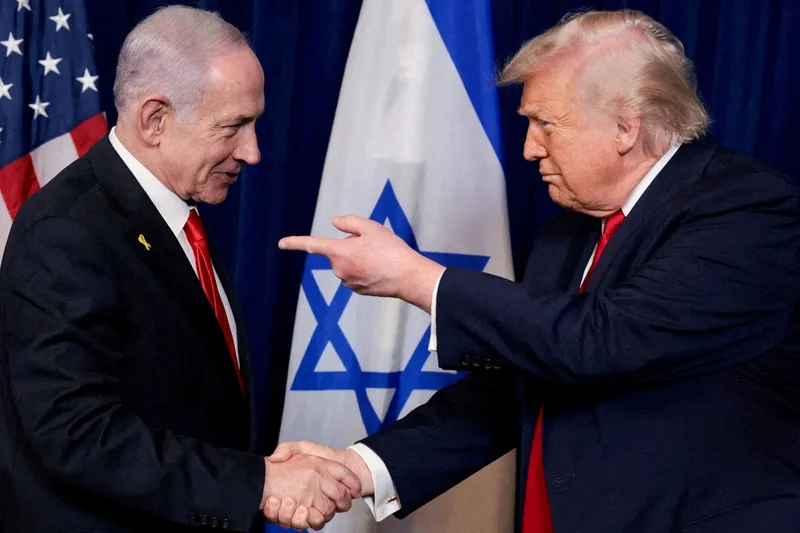
Israeli Prime Minister Benjamin Netanyahu departed for Washington on Monday, where he said he would meet U.S. President Donald Trump for their first face-to-face talks since the start of their conflict with Iran.
It will be Netanyahu's eighth meeting with Trump since the U.S. president returned to office, and their first since February, right before Israel and the United States launched a joint aerial campaign against Iran.
"In these complex times, you need to act with both great determination and great wisdom. We will discuss all the issues on the agenda, primarily Iran. Of course, our goal is to protect our security and also to expand the circle of peace around us," Netanyahu said in a video statement upon departure.
Israel had not taken part in a two-week U.S. bombing campaign this month that provoked Tehran to fire on U.S. bases in response.
Trump halted the campaign over the weekend. Iran said it would suspend its own attacks for as long as the U.S. pause endures. Israel has warned Tehran that any attack would trigger a forceful Israeli response.
Netanyahu has in recent weeks acknowledged that he and Trump have had some differences, as Israeli and U.S. interests in the region appeared to diverge.
An acrimonious phone call in June where the president called the prime minister "fucking crazy", first leaked to the media and later publicly confirmed by Trump himself, laid bare the strains that have at times emerged between the two leaders.
In an apparent gesture to Trump on Sunday, Israel said it would allow a multinational security force to enter Gaza as proposed under Trump's peace plan for the enclave.
On July 21, Israel announced that it had redeployed some of its forces in southern Lebanon, as part of the U.S.-backed agreements reached with Lebanese authorities in recent weeks.
A meeting with Trump that showcases what has traditionally been a close relationship between the two leaders could help Netanyahu at home, where he is facing an October 27 election and is struggling in opinion polls.
It also comes as support for Israel in the United States has been falling.
A poll from earlier this month found a profound generational chasm has opened among Jewish adults in the U.S., revealing stark differences in how they perceive the centrality of Israel to their religious identity, a new poll indicates.
For many older Jewish Americans, unwavering support for Israel remains a core tenet of their faith, yet younger generations are increasingly finding their spiritual connection through other means, such as the observance of Jewish holidays.
This divergence, highlighted by an AP-NORC poll, suggests that the differing perspectives on Israel’s actions since the Hamas-led October 7, 2023, attack and the ensuing war in Gaza now extend beyond mere political affiliations, reaching into the very fabric of religious identity.
The survey, conducted by The Associated Press-NORC Center for Public Affairs Research among 1,022 Jewish adults, indicates this split is particularly pronounced among those who identify as religiously Jewish. Notably, Jewish adults who are religiously unaffiliated but identify as Jewish in other ways generally report less emotional connection to Israel.