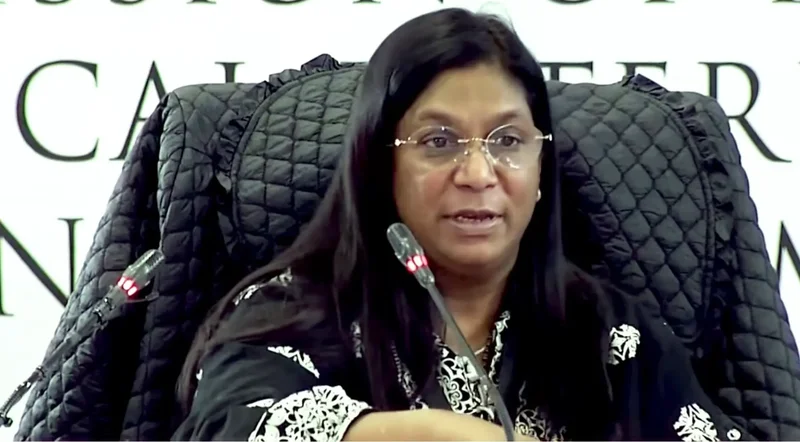
Former Independent Directorate Against Corruption (Idac) head Andrea Johnson repeatedly referred questions about evidence against Crime Intelligence head Dumisani Khumalo to senior investigator Dylan Perumal.
Johnson told the Madlanga Commission that she could not explain how allegations of fraud and corruption involving senior Crime Intelligence officials were incorporated into the directorate's investigation.
Under questioning by evidence leader Mahlape Sello, Johnson said she had relied on information Perumal provided and could not account for the evidential basis of several allegations that had led to arrests.
Perumal, Idac's chief investigator, had been scheduled to testify before the commission on Tuesday but was admitted to hospital over the weekend. Johnson said she had contacted him about his availability.
"I did undertake to try and speak to Mr Perumal to find out about his ability and or when [he is able] to come back. He indicated that he will engage with his medical practitioner and then he will give proper feedback. I did also indicate that they would like to have feedback about why he may or may not be able to attend and when he will be able to attend," she said.
Sello referred Johnson to a statement Perumal had commissioned from National Coloured Congress MP Fadiel Adams as part of Idacs's investigation into the alleged irregular appointment of Khumalo as head of Crime Intelligence.
In a supplementary affidavit, Adams alleged that Khumalo's security vetting process had been fast-tracked.
"Khumalo's vetting process was allegedly fast-tracked by [National Police Commissioner Fannie] Masemola, who knew that Khumalo did not have a top-secret clearance for many years. Khumalo worked in Crime Intelligence when he was a captain and had no skill and experience in the CI environment at senior management level. I suspect the vetting processes were manipulated in favour of Khumalo as well," Adams stated.
Adams has since opened a fraud and corruption case against Perumal, alleging that the investigator compromised a live, sub judice investigation by sharing sensitive and confidential case information with fellow senior Idac investigator Brian Padayachee.
Earlier in her testimony, Johnson acknowledged that a Section 28 summons she had signed on 6 February 2025 in relation to Khumalo could be legally vulnerable if investigators were unable to demonstrate a proper evidential basis for allegations that security vetting processes had been manipulated.
Although his initial affidavit did not contain details, Adams’s affidavit solicited by Idac investigators also alleged that Major-General Nozipho Madondo's transfer from KwaZulu-Natal to Crime Intelligence headquarters was facilitated by Khumalo even though she allegedly lacking top-secret security clearance.
"Madondo poses a risk to Crime Intelligence, the SAPS and the country," Adams alleged, claiming that senior officials had undermined SAPS policies and procedures by facilitating her appointment.
Sello questioned Johnson about how Madondo had become part of the investigation.
"Where and how does General Madondo's name come into play if not introduced by Mr Perumal, and if so, on what basis? Would you have any sense of how that came to be?" he asked.
"No, not at all," Johnson replied.
Sello then asked what advice she would give the commission if the available documents did not factually or legally justify the Section 28 summons.
"Then the investigation is problematic. Whatever follows is problematic," Johnson said.
She added that unless investigators could provide a detailed and satisfactory explanation for the evidential basis of the investigation, it could not stand.