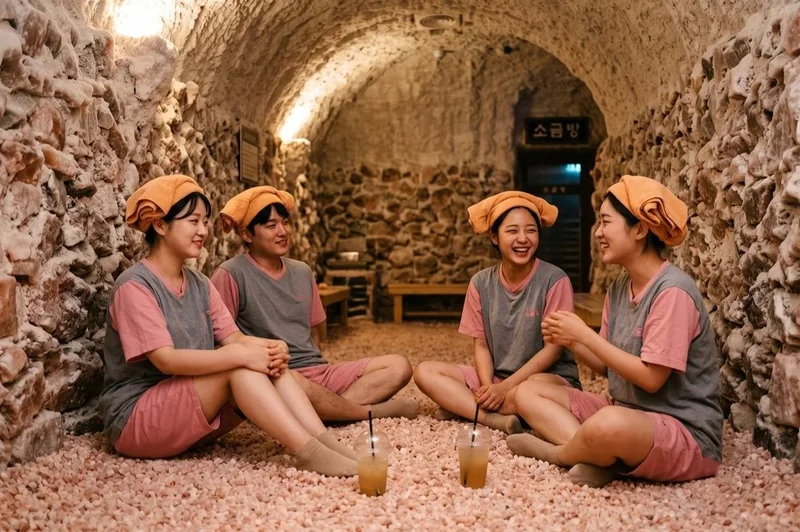
"We used to see maybe one or two young customers out of ten, but these days it’s closer to eight."
Kim Geum-sook, 68, snack bar employee at a jjimjilbang in Seodaemun District, Seoul
At 2 p.m. on July 21, the clientele at the charcoal-fired jjimjilbang, a Korean bathhouse and sauna complex in Seoul's Seodaemun District, looked a little different from the normal visitors. Of the 36 visitors relaxing in the bathhouse's standard-issue lounge clothing, 21 were young adults in their 20s and 30s.
Kim Geum-sook, 68, a snack bar employee who has worked at the facility for 16 years, said, "It is the first time so many young people have visited like this." She added that the influx is breathing new life into an industry battered by closures during the pandemic.
From private rooms to social gatherings
Long associated with middle-aged and older customers, saunas are shedding their dated image. Young adults are recasting them as a prime location for trendy wellness rituals, driving a cultural revival that has turned traditional bathhouses into fashionable social spaces.
This shift is especially visible online, where a new class of sauna influencers posts reviews and documents their trips to saunas Korea and neighboring Japan. Dedicated accessories, including personalized sauna hats and bath bags, are gaining popularity.
On YouTube, the viral "What's in my bag" format has inspired a wave of "What's in my sauna bag" videos that detail the specific skincare and recovery tools users bring with them to the baths.
The ways consumers visit saunas have also changed. The market now features premium solo saunas trips and private rooms for traditional Korean-style body scrubs. Simultaneously, visiting saunas is becoming more communal, with organized gatherings allowing participants to meet new people, while other activity groups like running clubs finish their workouts with group sauna sessions to recover.
The shift mirrors a broader international trend. Bloomberg recently documented a "new sauna wave" in the United States, reporting that a new generation of stylish, community-oriented bathhouses serve as alternatives to cafes, bars and clubs.
Novel experience over childhood nostalgia
The domestic boom is attributed to a generational disconnect that has transformed a familiar weekend routine into an unfamiliar cultural experience. Mok Ji-soo, 53, the publisher of the Busan-based magazine "Jipap Mokyoktang" (Neighborhood Bathhouse), said many young adults did not grow up visiting bathhouses with their parents.
"The joy of treating a sauna visit as a novel experience or adventure is a big part of the appeal," Mok said.
Young sauna visitors also described the trend as an entirely new culture.
"I had never visited a sauna with family or friends before seeing viral social media posts about them," Seo Ji-yeon, 30, said. "I was fascinated by the on-site dining options."
Park So-yeon, 31, said saunas are a unique experience for people her age.
"For a generation like us who didn't grow up doing weekend bathhouse trips, saunas are a totally new experience with a cool retro vibe," she said.
Beyond the novelty, the physical environment of the sauna offers a rare escape from constant connectivity. The sauna-focused Instagram account @godoghan_sauner cited a massive demand for spaces for physical and mental relaxation among the account's roughly 120,000 followers.
"Saunas have now become not simply a space for bathing, but a space for recovery," the account said.
The instagrammer added that people increasingly want to put down their smartphones and fully disconnect from their busy routines. Because mobile phones cannot be used in the extreme heat of many of the rooms, the jjimjilbang has become a place for younger people to enjoy a digital detox.
This article from the Hankook Ilbo, the sister publication of The Korea Times, is translated by a generative AI system and edited by The Korea Times.