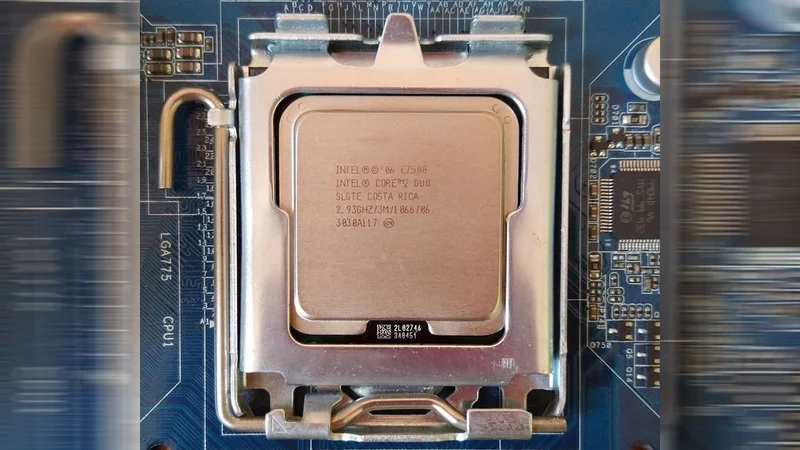
Today marks 20 years since the first raft of Intel Core 2 Duo processors, codename Conroe, was launched. Ten Intel Core 2 Duo and Intel Core 2 Extreme processors were unveiled for consumer and business desktop and laptop PCs and workstations on July 27, 2006. We were lucky enough to test Intel’s now legendary new desktop processors earlier in the month, and our reviewer anointed the Core 2 Duo “the new king.” Our early hands-on review underlined that “as soon as Core 2 Duo hits the market, it will outperform the complete Athlon 64 family (X2 and FX) in all areas, including gaming, where AMD has traditionally been very strong.”
| Core 2 Model | Clock Speed | Multiplier | Front Side Bus Speed | L2 Cache |
|---|---|---|---|---|
| Extreme X6800 | 2,933 MHz | x11 | 266 MHz (FSB1066 QDR) | 4 MB |
| Duo E6700 | 2,666 MHz | X10 | 266 MHz (FSB1066 QDR) | 4 MB |
| Duo E6600 | 2,400 MHz | X9 | 266 MHz (FSB1066 QDR) | 4 MB |
| Duo E6400 | 2,133 MHz | X8 | 266 MHz (FSB1066 QDR) | 2 MB |
| Duo E6300 | 1,866 MHz | X7 | 266 MHz (FSB1066 QDR) | 2 MB |
The GHz race ends with an architectural revolution
One of the defining characteristics of the first Intel Core 2 Duo chips was that they kicked the GHz race to the periphery of the battlefield. After years of chips being sold with this performance statistic placed most prominently, Intel and the tech media had to educate the wider public that higher GHz numbers didn’t define performance.
Intel Conroe desktop chips came with a generational performance uplift we don’t see often. These third-generation dual-core processors from Team Blue would “provide up to a 40 percent increase in performance and are more than 40 percent more energy efficient versus Intel's previous best processor,” according to launch-day PR. Testers also observed that even the entry-level new Conroe chips could outpace the mighty flagship desktop Pentium Extreme Editions, despite running at nearly half the clock speed.
Behind the real-world performance successes Intel eagerly highlighted, and reviewers seemed genuinely excited by, there were a number of architectural innovations and refinements. Intel boasted that the Core 2 Duo contained “a whopping 291 million transistors” and had achieved many benchmark firsts in internal tests. Conroe arrived with higher efficiency, shorter pipelines, improved branch predictions, new shared Smart Cache, and substantially higher IPC, all built upon Intel’s newest 65nm process technology. With this attractive new price, it wasn’t difficult for Intel to retire its former king, with its hot, power-hungry, and big GHz Netburst architecture.
Defining the next decade+
With the Core 2 Duo, Intel regained its performance leadership from AMD and its Athlon parts. Conroe, the desktop Core 2 architecture, didn’t get singled out in our five best Intel CPUs of all time article (2024), but it was the direct ancestor of the legendary Core 2 Quad CPUs. These quad-core CPUs would take the Gillette-like next logical step with four cores on a chip, combining two Conroe dies in a single package, and launching in January 2007.
Moreover, from the mid 2000s onwards, multi-core became mainstream and developers seriously began to optimize applications and games for processors boasting more than just Core 0. Admittedly, single-threaded performance can still be important in Windows/apps/games in 2026.
To conclude, Intel’s Conroe would set the foundations for the firm’s CPU market dominance for more than a decade. Most would argue this successful run lasted all the way until the AMD Ryzen family matured and hit full stride with the Ryzen 3000 series.
Get Tom's Hardware's best news and in-depth reviews, straight to your inbox.
Mark Tyson is a news editor at Tom's Hardware. He enjoys covering the full breadth of PC tech; from business and semiconductor design to products approaching the edge of reason.