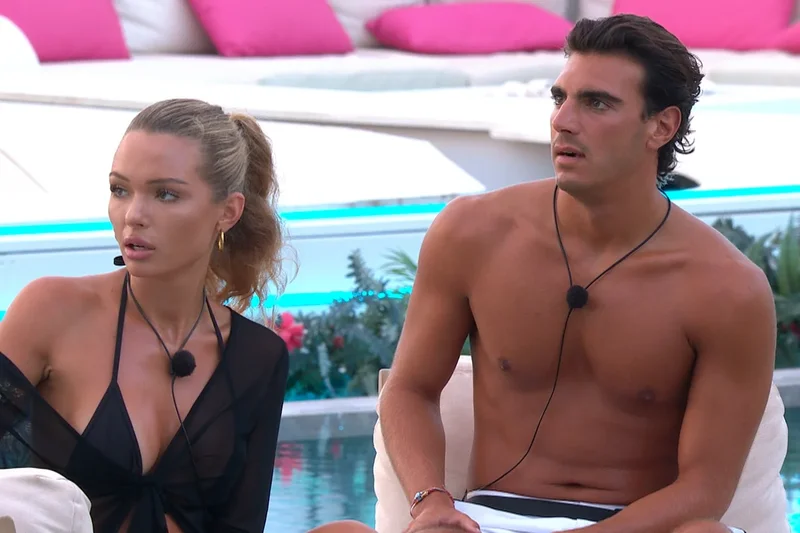
Remember when Love Island used to be, well, fun? The sceptics among you are probably rolling your eyes and denying it ever was. Given the dark headlines that have surrounded the show in recent years and sombre subsequent attempts to make the production’s welfare watertight, I can understand the unease. But once upon a time, Love Island really was top-tier entertainment, appointment television filled with bright, chaotically messy characters and love stories for the ages – or, failing that, the next three to six months.
But while a sick compulsion has kept me tuning into ITV2’s dating show year on year, I’ve found this year’s viewing experience far bleaker than that of previous seasons. Love Island has always promised high octane drama and silly challenges, yet the cast of 2026 have been more prone to tearful breakdowns over broken hearts and backstabbing, all resulting in a group of beautiful finalists with supremely damaged egos. Four couples are heading into the final episode tonight (although a last-minute twist means one more will be eliminated before the public vote), and tensions are still high. The couples feel weak, and the friendships just as fractious. How on earth did we get here?
Let’s start at the beginning. Thanks to major mistakes in casting, this series has been doomed from the off. Casting is a complex and mysterious process, but we know that there are contestants who apply for the show and those who are scouted, whether that’s down to a celebrity connection or a hefty social media following. As Love Island has rightfully stepped up its duty of care towards contestants, the show now leans heavily on the secondary category, with producers picking people already used to some level of exposure.
It hasn’t always been this way. Back in the halcyon days of 2019, future British content creation royalty Molly-Mae Hague rocked up to the villa as a bombshell, introduced herself as an influencer, and was immediately met with suspicion and uncertainty from the British public. She’d barely raise an eyebrow in 2026. Today, the islanders (particularly the women) are virtually all influencers, with ITV actively scouting big-name internet stars like TikToker Jasmine Müller or Irish influencer Charleen Murphy for the current series.
Müller in particular felt like a huge get for ITV, her casting prompting fans to declare that she was the only thing that could get them into the show again. Used to documenting their lives near-constantly, influencers should struggle far less with the round-the-clock filming that Love Island entails. The cast of 2026 are also used to having total control over their image. You can hear it in the way they talk, communicating through a garbled lexicon of therapy speak and TikTok sounds about “boundaries”, “standing on business”, and being “girls’ girls”.
The problem with casting a bunch of influencers on your show is that you end up with groups of individuals with images to build and brands to maintain. The longer they stay in the show, the better – but this time it’s for their careers as TikTok stars and TV presenters, as opposed to because they might find love (or, at least, a fling for the rest of the summer). That there's been more villa talk about public opinion and the final than ever before speaks to this obsession.
But a far more macro issue has also proven inescapable on series 13: the dire state of gender relations. Love Island has always reflected trends in modern dating, and the image depicted of Gen Z’s romantic behaviour in 2026 has been damning. In the villa this season, the men refused to commit, telling the girl they’re coupled up with that they were 10 toes down one moment then speaking about being “open” and wanting a “test” the next.
When the boys returned from Casa Amor with either a new girl on their arm or a sheepish look on their faces, the female islanders were humiliated. Gender lines were drawn; the girls repeating how disgusted they were by the boys’ behaviour and criticising their “lustful” actions, while the boys egged each other on as they insisted they had every right to “explore connections” (whatever that means). Bed-swapping and partner nabbing is, of course, Love Island’s bread and butter. But on this season it felt like communication completely broke down between the girls and boys, and trust and respect went out the window.
I could have put up with all of this if there was at least a bit of levity, but series 13 has been seriously lacking. There’ve been rivers of tears – mostly from Müller, Anglista Gunda, Mica Harris and Ellie Chadwick – but not a lot of laughs. Fans look back on the early series through rose-tinted glasses, absolutely, but it’s the friendships that make those eras just as iconic as the relationships. It wasn’t just the early days of Chris Hughes and Kem Cetinay’s bromance either; if fans could have voted best friends Shakira Khan, Toni Laites and Yasmin Pettet as three-way winners on last summer’s season, without their men, they likely would have.
The cast of 2026 might call each other “girlie” and “angel”, but their friendships feel as flimsy as these nicknames are cloying. These are not real friends; going into the final, the consensus among viewers is that these aren’t real couples either.
Four pairs remain: Angelista and Simba Kudyiwa, Julia Majchrzak and Lorenzo Alessi, Müller and Kavan Murphy, and Yasmin Hadlow and Tommy Stagg. To be honest, I can’t imagine any of these couples lasting on the outside beyond the two-month mark. More surprisingly, nor do I even have a favourite. Whichever couple wins, there will be a sense that one of the islanders was the favourite, propelling the other to their share of the £50,000 prize. A hollow victory, and it’s not even happened yet.
Many of the problems Love Island is facing are reflective of uncomfortable truths about Gen Z, gender relations and our image-obsessed society. But there’s also the simple issue of the show forgetting how to be fun. For all the discourse it generates, Love Island has never claimed to be anything other than the escapist entertainment we so desperately need right now. I’ve spent more than a decade fully committed to the villa, but after the summer of 2026, I’m not sure me and this show can withstand another recoupling.