Latest
Firefighters were racing to contain dozens of wildfires across Spain and France on Monday before a new wave of extreme temperatures that forecasters warned would worsen conditions and potentially start new blazes.
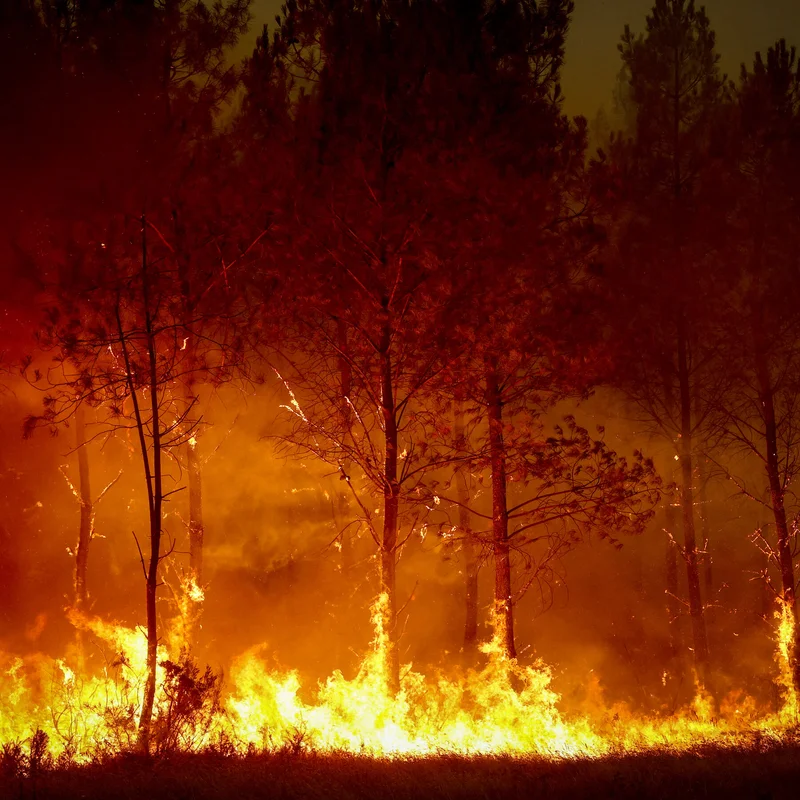
Fueled by parched vegetation after weeks of successive heat waves, deadly fires around the cities of Bordeaux, Valencia and Madrid, Spain’s capital, have evaded dayslong containment efforts by more than 4,000 firefighters. The fires have forced hundreds of thousands of people to evacuate, burned hundreds of homes and resurfaced fears about Europe's warming climate.
“The sky was red,” recalled Atika Farhati, 77, one of more than 300,000 people forced to seek shelter in the two countries. Speaking from an exhibition center in Bordeaux, Ms. Farhati recalled the flame-scarred view from her fifth-floor balcony in a nearby town. “Now that we’re here, we can only wonder how it’s going to end,” she said.
In France’s hardest-hit southwestern Gironde region, the wildfires have burned through over 100,000 acres and displaced at least 200,000 people, one of the largest peacetime evacuations in the country’s history. As flames came within a few miles of Bordeaux, a center of France’s winemaking region, on Monday, all train services in the region south of the city had been canceled and Mayor Thomas Cazenave said he was preparing for the possibility that more evacuation notices could be issued.
President Emmanuel Macron of France led a crisis meeting on Monday before a scheduled visit to Gironde in the afternoon, while ministers are expected to meet with representatives of industries from Gironde and the neighboring Landes region.
A brief letup in conditions overnight helped firefighters to slow the spread in several places around Madrid and Bordeaux. But a dangerous blast of heat and strong winds projected for this week is stoking fears of new blazes, with meteorologists warning of gusty winds, low humidity and temperatures topping 100 Fahrenheit.
Fernando Grande-Marlaska, Spain’s interior minister, said on Monday that firefighters had a “crucial” two-day window to control the fires around Madrid before extreme temperatures were expected to hit. According to Spain’s Ecological Transition Ministry, the wildfire there was already the largest in the country’s recent history.
Hundreds of miles away, in the eastern province of Castellón, a worsening blaze forced the evacuation of another 16,000 people over the weekend, opening up a dangerous new front and threatening a national park. On a visit there on Monday afternoon, Prime Minister Pedro Sánchez said fires throughout Spain had burned their way through more than 100,000 acres since last week, with a projected rise in temperatures dashing hopes of a reprieve.
“This climate emergency is exceeding every threshold and scale that scientists have long warned Spain and Europe as a whole about,” said Mr. Sánchez, urging those who had been evacuated to be patient until it was safe to return.
Here’s what else we’re covering.
- Casualty toll:The Spanish authorities said at least two people were killed over the weekend, in the eastern provinces of Castellón and Valencia. The French authorities have not reported any fatalities.
- Evacuations:Hundreds of thousands of people have been warned to evacuate or shelter in place since the latest wildfires began last week. In the Gironde and Landes regions in France, local officials warned more than 220,000 people to leave their homes. Across the border, the Spanish authorities called for the evacuations of 60,000 people around Madrid and an additional 16,000 near Valencia.
- Fire clouds:The heat generated by the wildfires is so intense that officials said it had created its own dangerous weather system: a pyrocumulonimbus. These large, heat-fueled thunderclouds appear to have accelerated the spread of the fires in the Gironde. Read more ›
- Scorching summer:Record-setting heat waves in Western Europe created the conditions for the latest wildfires in France and Spain, parts of which had already faced unusually hot and dry summers. Read more ›
Germán Huertas, 38, received a call on Friday telling him that the grounds around his mother’s house were on fire in El Tiemblo, Spain, a town near the border between Madrid and Ávila. A friend had found a ladder, climbed onto the roof and managed to keep the flames at bay before Huertas took over, spraying water around the house. “The last few days have been terrifying,” he said. “You only truly grasp it when the fire is right on top of you.”
Since Friday, Huertas has been working nonstop alongside dozens of volunteers who call themselves the “Infernal Brigade.” The volunteers have turned their attention to El Castañar, a historic chestnut grove with trees up to 500 years old. “I told my girlfriend, ‘I don’t know if this is the last time I’m ever going to see this,’” he said.
This is already the worst year on record for wildfires in France, Prime Minister Sébastien Lecornu said on Monday, with two months of summer still to go. “Our country is experiencing an unprecedented fire season: 116,085 hectares have already burned, and 13,566 fires have been recorded since January. We have already surpassed the record set in 2022 (72,000 hectares burned),” he wrote on social media.
“We’re still in the midst of the crisis,” Sophie Brocas, the prefect for the region that includes the fire-hit areas, told reporters on Monday. She said the blaze in the Gironde area was “one we’ve never seen before in France.” She added: “It’s not like a fire that moves from point A to point B because it’s driven by the wind. It’s a fire that creates its own wind and leaps several kilometers at a time.”
Her office said in a statement that the flames had not spread overnight but that the situation remained critical. “Today, thanks to more favorable weather conditions, crews are focusing on treating the fire’s edges and creating tactical firebreaks, supported by aerial resources,” the statement said. “It will not be possible to return to the evacuated municipalities until the fire has been brought under control,” it added.
Guillaume Bos, who stayed in his village outside Bordeaux to fight the fires with farmers, said they managed to save most of the houses at the heart of the village, but about six were completely destroyed, along with 90 percent of the surrounding forest.
“In the heat of the moment, with the adrenaline pumping, you don’t think, you just go for it,” he said. “But now, the adrenaline is wearing off, and the reality is painful, because there are people who depend entirely on the forest for their livelihood.” Around his home, he said, “everything is burned as far as the eye can see.” Though the worst is now over, he is still spraying water around the village to keep embers from reigniting. “It’s a round-the-clock effort,” he said.
Guillaume Bos, a 36 year-old business manager, saw flames sweep through his village, Le Temple, about 18 miles west of Bordeaux. When the village’s 600 residents were ordered to evacuate on Friday, his wife and son scrambled away in a car packed with personal belongings. Bos, who owns forest land, stayed behind with farmers and others to fight the flames, using tractors and trailers loaded with water tanks. “The firefighters were elsewhere, and we were really left on our own,” Bos said. “A friend of ours called us in distress — he was in tears — and said, ‘My house is going to burn down.’ So we rushed over there.”
An image captured by the Copernicus Sentinel-2 satellite on Sunday shows wildfires burning outside of Madrid with a scorched area around 30 miles wide and plumes of smoke stretching south. One of the fires, in the province of Ávila, has become the largest in the country’s modern history, the Spanish authorities said.
A new heatwave and drought conditions are increasing wildfire danger levels in France and Spain this week, according to weather forecasters. Temperatures are expected to reach highs of 40 degrees Celsius (104 Fahrenheit) in parts of France, where the national weather service warned that soil moisture levels had fallen to unprecedented lows. In Spain, the weather service said the latest heat wave was expected to last until at least Sunday, with temperatures reaching 42 degrees Celsius (nearly 108 Fahrenheit) or even higher, particularly across southern areas.
Alexandre Bidau, who stayed in the Bordeaux area to fight fires, spoke by phone from the hospital where his wife was about to give birth. He said he had returned home after her labor pains intensified. Several members of his family have already been hit by the fire: One of his aunts lost her house, and his brother and his mother had to evacuate. Now, as the air outside his home becomes hard to breath and ashes fall in his garden and swimming pool, he worries that he might have to evacuate as well. “I hope they’ll be able to keep it under control today and even stop it,” he said.
Alexandre Bidau, a 33-year old construction worker living in Pessac, on the western outskirts of Bordeaux, volunteered to help firefighters on Sunday. He borrowed a water tank of over 1,000 liters with his brother and his cousin, using it to save a friend’s house that was about to be engulfed by flames. Firefighters also asked them to carry out reconnaissance and water-spraying missions. “It really broke my heart to see all these burning woods, that scorched vegetation” Bidau said. “But I also feel a sense of satisfaction from helping people save their homes and assisting firefighters,” he added, noting that he had crossed paths with dozens of other volunteers from the construction industry — and a baker who gifted a bag of baguettes.
In another sign that the wildfires west of Madrid are not fully under control, regional authorities have ordered the evacuation of Valdemaqueda, a town of about 870 people roughly 25 miles away from the Spanish capital. Residents received alerts on their phones telling them to leave their homes and buses will take evacuees to Boadilla del Monte, much closer to Madrid. Nearly 90,000 people remain evacuated or under orders to shelter at home across parts of Madrid, Toledo and Ávila, a spokesperson for the Interior Ministry said on Monday afternoon.
President Emmanuel Macron of France will travel to Gironde, the region in France hit hardest by the fires, this afternoon, his office said. Macron, who chaired a crisis meeting on the fires earlier today, will meet with firefighters and local officials to “convey the nation’s support” and “thank them for their unwavering commitment,” his office said.
A new heat wave is forecast to develop across Western Europe this week, with forecasters warning that soaring temperatures, dry conditions and strengthening winds could intensify the wildfire threat across parts of the continent, including in areas where firefighters are already battling several active blazes.
This latest spell of extreme heat will be the fourth heat wave to affect Europe since May, with temperatures expected to climb to 40 degrees Celsius (104 degrees Fahrenheit) or higher in parts of France, Spain and Portugal.
Officials have warned that a combination of exceptional heat, parched vegetation, gusty winds and a prolonged lack of rainfall will dangerously increase the likelihood of new fires igniting and of existing blazes spreading.
According to the European Forest Fire Information System, parts of southwestern France and northern Spain are forecast to remain under “very extreme fire conditions” — the highest category in its fire danger forecast — through at least Wednesday. Areas of Portugal, Britain and Ireland are also facing the same elevated level of fire danger.
In Spain, AEMET, the country’s weather service, said the latest heat wave was expected to last until at least Sunday, with temperatures reaching 42 degrees Celsius (nearly 108 Fahrenheit) or even higher, particularly across southern areas. The service warned that the mix of high temperatures, gusty winds and very low humidity would heighten fire risks.
France is also bracing for another surge of heat, with temperatures expected to reach 40 degrees Celsius in parts of the country, especially in the southwest. Météo-France, the country’s weather service, warned that the return of dry and very hot conditions would further increase wildfire risks, with the number of regions facing high fire danger expected to rise across much of the country from Wednesday.
The Mistral and Tramontane winds — powerful, dry winds that can sweep through southern France and rapidly worsen wildfire conditions — were expected on Monday in the country’s Mediterranean areas, although conditions were forecast to become calmer from Tuesday.
Météo-France also said that as of July 22, soil moisture levels across France had reached unprecedented lows, compounding the risk of wildfires.
In Portugal, soaring temperatures, dry conditions and parched vegetation have also prompted wildfire warnings, with temperatures expected to reach 40 Celsius in parts of the country this week.
While the most intense heat is forecast across southwestern Europe, unusually hot conditions are also expected to spread across areas of Britain. The Met Office, the country’s weather service, said the hottest weather will be focused across central and southern parts of England, where temperatures could reach up to 35 degrees Celsius (95 degrees Fahrenheit) by midweek.
Residents in northeast Scotland were allowed to return home on Saturday after more than 500 firefighters, staff and volunteers battled a wildfire in the Cairngorms National Park. The blaze remained active on Monday, though rain and lighter winds on Sunday helped slow it down, officials said.
Laurent Nuñez, France’s interior minister, said that there had been nearly 14,000 fires in the country since the beginning of the summer season and that over 280,000 acres had burned — almost double the total area burned during the summer of 2022, which was already a devastating year for wildfires. The blaze in the Gironde area is behaving “in a completely erratic manner,” he said after a cabinet meeting in Paris. “It’s self-sustaining; it feeds on itself; it spreads out in all directions.” The fire is stable but not contained, he warned, urging French citizens to be extremely vigilant, given that nine fires out of ten are caused by humans.
Spain’s prime minister, Pedro Sánchez, warned on Monday afternoon that “these are difficult, complex hours,” as rising temperatures could complicate firefighting efforts. “Another heat wave is on the way, so I urge everyone across the country to exercise the utmost caution and take every preventive measure,” he said from the eastern city of Castellón, where another wildfire was threatening a national park and had forced thousands of people to flee their homes. More than 420,000 acres have burned across the country, up from 321,000 last week, he said, and he asked those who had been evacuated and were eager to return home to be patient.
In the devastating wildfires in France, officials said that firefighters had encountered a dangerous phenomenon that many of them had not seen before: a pyrocumulonimbus, or “fire cloud.”
These large, fire-fueled thunderstorms, also known as pyroCbs, are created by intense heat from large blazes or volcanic eruptions. They produce lightning and burning embers that can spark more fires, and they generate high and unpredictable winds that fan the flames and spread the embers. But they rarely bring rain.
One pyrocumulonimbus generated more blazes over the weekend in one of the hardest-hit areas of France, Marc Vermeulen, the director of fire and emergency services in the Gironde region, said at a news briefing on Sunday.
“While this type of fire occurs regularly in Canada and Australia, it is unprecedented in France,” Lt. Col. Eric Brocardi, a spokesman for the National Firefighters Federation of France, told Agence France-Presse.
“The fire became extremely virulent and unpredictable again generating its own wind and spreading erratically toward the Bordeaux metropolitan area,” Laurent Nuñez, France's interior minister, also said on social media.
Wildfires are so hot they can sometimes create their own weather systems. The smoke from the fires acts as a plume of heat rising fast into the atmosphere, according to Britain’s Royal Meteorological Society. That chimney effect sucks in air at ground level, feeding the blazes oxygen and pushing them into new terrain.
As the hot air rises, it expands and cools, causing its moisture to condense. The water vapor and ash particles combine to form a gray or brown cloud that can then develop into a pyrocumulonimbus (pyro means “fire” in Greek) storm cloud.
In the Gironde region, 103,000 acres have burned, according to officials, and 220,000 people have been asked to evacuate from Gironde and the neighboring Landes region.
The pyrocumulonimbus phenomenon presents extreme challenges for firefighters.
“These fire-generated clouds are linked to extreme fire behavior that impedes firefighting efforts and can devastate communities,” according to NASA, which emphasized the need to better understand the clouds “given the ongoing and projected increases in fire activity and severity.”
Ephrat Livni contributed reporting.
“Nothing like this has ever happened before,” said José Fernández, 62, as he walked his dog in Madrid’s Plaza España on Monday. Skies over the Spanish capital were clear — unlike on Saturday, when a thick haze and an acrid smell hung over the city, forcing him and many others to wear masks. He lamented the burning of lush vegetation in the surrounding area, and like many Spaniards across the increasingly scorched country, he speculated about the causes of the massive blazes: too much brush in the emptied countryside, he said, and a lack of coordination between national and regional authorities. What was clear, he said, was that the fires were “painful for us.”
For winemakers in the Bordeaux region, smoke from the fires is one more threat on top of heat and drought. “This year, it feels like we’re on another planet,” said Gabriel Barre, 44, who owns an independent operation in Fronsac. He said he wasn’t sure how the smoke would affect this year’s harvest, though it could result in a smoky vintage.
The fires have disrupted travel around southwestern France. Part of the highway connecting Bordeaux to Bayonne, further south, is closed, Vinci Autoroutes, the highway operator, said in a statement. All train service south of Bordeaux has also been cancelled until at least Tuesday. France’s national railway company said in a statement on Sunday that the government recommended postponing all travel to the region. “This measure is intended to limit passenger traffic and facilitate emergency response efforts,” the company said. “Tickets may be canceled or exchanged at no charge.”
Spain’s interior minister, Fernando Grande-Marlaska, said the wildfires in Madrid were being brought under control but urged caution as firefighters faced crucial hours before weather conditions worsen on Wednesday. “We have the emergency under control and we have the resources, but we have to acknowledge that progress is slow because the weather isn’t helping us,” Mr. Grande-Marlaska said at a news conference on Monday. “Today and tomorrow are absolutely crucial. The forecast for Wednesday is very unfavorable.”
Thomas Cazenave, the mayor of Bordeaux, said that it was preparing for new evacuation orders but that it was “difficult to predict” whether the entire city would need to be evacuated. “No matter what happens, we’ll have solutions because we’re preparing for all possibilities,” he told reporters at an exhibition center where evacuees have taken shelter. “The humidity level has risen,” he noted. “But on the other hand, I’m still being very cautious.”
Éric Brocardi, a spokesman for France’s National Federation of Firefighters, told France Inter radio this morning that battling the blazes was “like a battle between David and Goliath.” He added: “We got a reprieve thanks to the rain last night, which will allow us today to race against the clock before the expected rise in temperatures.” He also noted that resources were strained, as extreme heat across France has forced the country to rethink its national firefighting strategy. “Firefighters from the north can’t all travel south as they did before, because there’s also a risk in northern France,” he said.
Spanish authorities said the wildfires in the Madrid region had slowed but urged residents to remain cautious. The fires “slowed their advance overnight, allowing firefighting crews to make progress against the flames,” the regional government said in a statement. “The fire remains active and has not yet been stabilized.” Spain’s interior minister, Fernando Grande-Marlaska, had warned on Sunday evening that progress in battling the flames remained “very slow.”
Parts of Portugal are forecast to face “very extreme fire conditions” this week, according to the European Forest Fire Information System, with much of southwestern France and northern Spain expected to be at the same level of risk.
Portugal’s weather service, IPMA, has placed parts of the country’s south and large swaths of its central and northern areas under its highest wildfire danger warning through Sunday. Temperatures are expected to rise up to 40 degrees Celsius (104 Fahrenheit) in the coming days.
Laurent Peyrondet, the mayor of Lacanau, a town in the Gironde area, told RTL radio on Monday that light rain had fallen overnight, offering a short but insufficient reprieve. “The situation is stable, but the fire hasn’t been brought under control in certain places, so we have to keep fighting,” he said. The mayor said he was mostly worried about a road connecting his town to Bordeaux. “If it crosses that road, it’ll be a disaster,” he said.
As a fierce, fast-moving and capricious wildfire spread to within 10 miles of Bordeaux on Sunday, the city, France’s sixth largest, had become a refuge for thousands of people evacuated from their towns and villages.
Many of them took shelter in Bordeaux’s cavernous exhibition center, united by fear, confusion and a determination to get back their homes, which they desperately hoped would be spared by the flames.
There are differing voices in this instant community, attesting to the divergent lives of the people across the Gironde region. Fear is leavened by hope, gratitude to the firefighters is tinged by anger toward the authorities, and optimism in a swift recovery is offset by uneasiness about the natural forces that led to this disaster.
“I don’t want to start again at zero to find a new apartment,” said Imane El Idrissi, 35, a single mother who fled at 4 a.m. on Saturday, after the police pounded on her door to warn her it was time to leave. “I don’t have the means.”
Ms. El Idrissi, who was born in Morocco, said she had carefully gathered all her immigration and residency documents, filling her suitcase with papers in place of clothing. Her two daughters were born in France, she said, but she couldn’t shake the fear that if she left the country, she might not be allowed back in.
Her friend, Atika Farhati, 77, a retired hospital worker, said she worried about losing her apartment and treasured possessions, including a Chinese vase. Her town, Eysines, northwest of Bordeaux, lies in the path of the fires, which were blown east by swirling winds from the Atlantic toward the city.
“The sky was red,” she said, recalling the flame-scarred view from her fifth-floor balcony. “Now that we’re here, we can only wonder how it’s going to end.”
For Roger Peuron, that outcome is not seriously in doubt. A retired engineer who worked at an armaments factory in Saint-Médard-en-Jalles, Mr. Peuron, 89, said he was confident the fire would be stopped short of his town, if only to prevent it from igniting a factory that makes fuel for strategic ballistic missiles.
“If that ever happened to the industry,” he said, “it would be a true catastrophe.”
Still, Mr. Peuron said France had never witnessed a fire like this, and it raised profound questions about how people should change their relationship to their environment. Sprawling pine forests that were planted across the region over centuries are now an accelerant for fire.
“We need to replace the trees because the sap in the pines is flammable, and the trees don’t have deep roots, so they are easily blown over by the wind,” Mr. Peuron said. “The pines were planted to drain the region’s swamps, but they’re no longer suited to the environment.”
“We need sequoias,” he added. “They’re sturdy!”
French officials backed up Mr. Peuron’s contention about the extraordinary nature of the fire, reflecting a warming climate. About 42,000 hectares, or 103,000 acres, have burned in Gironde since the fire started last week. It has forced the evacuation of about 220,000 people, one of the largest peacetime evacuations in French history.
At the same time, fires in central Spain have burned about 50,000 hectares and displaced 105,000 people.
So far this summer, forest fires have burned 115,000 hectares in France, according to the French interior minister, Laurent Nuñez. By comparison, the average yearly loss from 2014 to 2023 was 9,000 hectares. In the summer of 2022, which was considered devastating and led France to bolster its firefighting resources, about 70,000 hectares burned.
On Sunday, a heavy yellow-orange cloud of smoke hung over Bordeaux, an elegant city of 260,000 that is famous as the center of France’s wine industry. An acrid smell pervaded its streets, and tiny particles of soot flecked the air. Pedestrians wore face masks, and many shut themselves in their homes.
As the fire crept toward the city limits, Bordeaux’s mayor, Thomas Cazenave, said on Sunday that the authorities did not expect they would have to order an evacuation. But he and other officials warned that uncertainty was the watchword, as shifting winds and heat made it difficult for firefighters to gain control of the blaze.
The forecast for Bordeaux calls for high temperatures of 37 degrees Celsius on Tuesday and 41 on Wednesday — about 99 and 106 degrees Fahrenheit.
At the exhibition center, the talk was of how long people would have to wait before they would be allowed back home. People passed the time reading, playing cards, and, in the case of one young man, Julien Hochard, picking at his guitar.
“There’s a solidarity that we’ve seen emerge here, one that’s slowly growing,” said Mr. Hochard, sitting on a camp bed next to his friend, Céline Lartigue. She said she had been impressed by firefighters’ efforts to stem the blaze.
But from a nearby bed, Rabah Boukabous piped up to disagree.
“I think the authorities reacted late,” he said. “They should have recognized the gravity of the situation.”
“They could not have prevented it,” said Mr. Boukabous, 70, “but they could have limited it.”
Catherine Porter contributed reporting from Paris